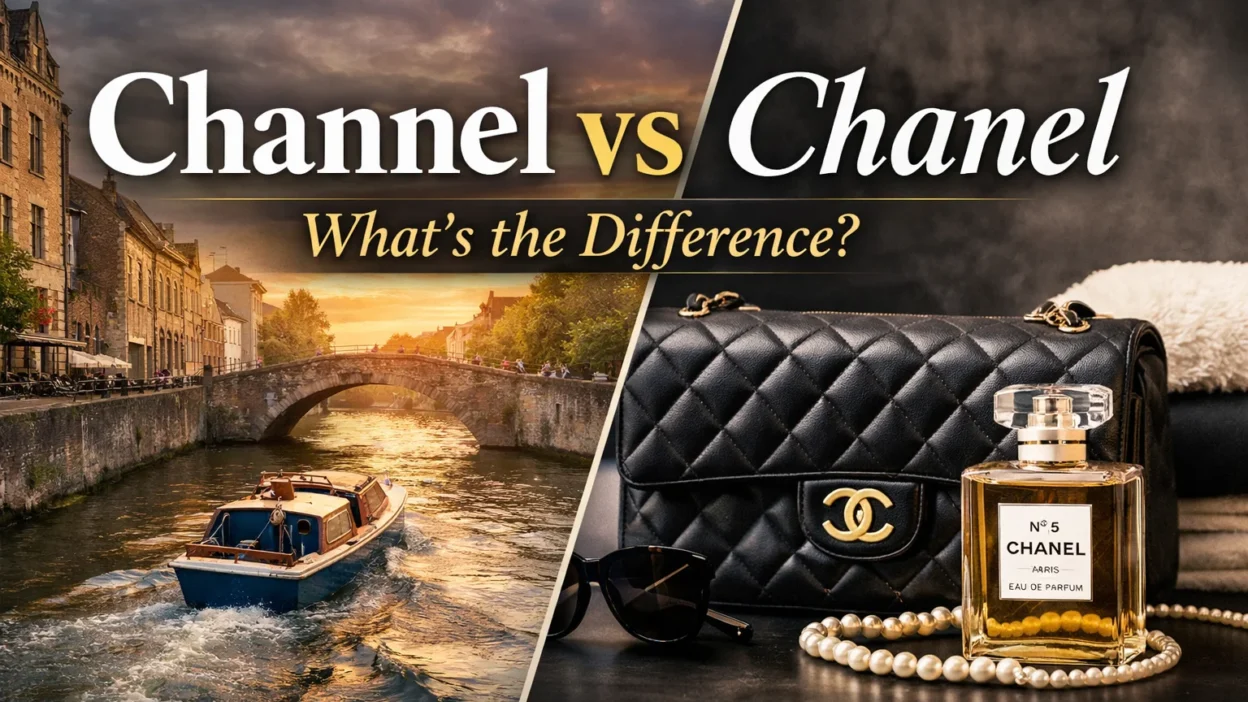
Channel vs Chanel What’s the Difference? The Only Guide You’ll Ever Need helps you see why these words look the same and sound very similar, yet have completely different meanings.
Many English learners and native speakers confuse them at first glance, especially during writing, typing fast, or in everyday conversation. This confusion happens often in Google searches and YouTube comments, where even one letter that separates the terms can change everything.
A Channel is a common English word people use to describe a path, river path, medium, television station, TV station, or communication route in communication, media, technology, and broadcasting. On the other hand, Chanel is a famous, French, luxury fashion brand founded by Coco Chanel, known around the world.
From personal experience, I’ve noticed how this small difference feels simple but creates big mistakes when the meanings are misunderstood.
Channel vs Chanel: The Fastest Way to Understand the Difference
Let’s cut straight to the point.
- Channel is a common noun. It describes a path, medium, or system through which something flows.
- Chanel is a proper noun. It refers to a globally recognized luxury fashion brand.
That’s it. One word belongs to everyday language. The other belongs to branding and identity.
Here’s how it plays out:
- “I started a gaming channel last week.”
- “She bought a Chanel perfume yesterday.”
Same sound. Completely different meaning.
CLICK HERE: Arial vs Aerial: What’s the Difference
What Does “Channel” Really Mean? A Deep Dive
“Channel” might seem simple at first. In reality, it’s one of those flexible words that stretch across multiple fields. Its core idea remains steady though. Something moves through it.
Think of it as a bridge or conduit. Information, water, energy, or even customers travel from one point to another.
Let’s break that down into real-world usage.
Channel in Media and Content Creation
This is where most people encounter the word daily.
A channel acts as a container for content. It organizes videos, broadcasts, or streams into a single identity.
Examples include:
- YouTube channels
- TV channels
- Streaming platforms
When you subscribe to a creator, you don’t follow random uploads. You follow their channel. That word signals structure, consistency, and ownership.
Example in action: “I’ve been growing my travel channel for six months.”
Short sentence. Natural rhythm. Clear meaning.
Channel in Communication
Now shift into how people exchange information.
Businesses rely on communication channels to connect with audiences. These channels carry messages from sender to receiver.
Common examples:
- Email newsletters
- Social media platforms
- Customer support chats
Each one functions differently. Still, they all share the same purpose. They move information efficiently.
Example: “We improved response time by optimizing our support channels.”
Notice how the word fits seamlessly into professional language.
Channel in Marketing and Sales
Things get even more interesting in business strategy.
A channel here refers to the path a product or service takes before reaching the customer. It’s not just communication. It’s distribution.
You’ll hear terms like:
- Sales channels
- Distribution channels
- Marketing channels
For instance, a company might sell products through:
- Its own website
- Retail stores
- Third-party marketplaces
Each route forms a separate channel.
Example: “They expanded into new sales channels to increase revenue.”
That sentence carries weight. It reflects real business decisions.
Channel in Physical and Scientific Contexts
Not all channels exist online or in business plans. Some are physical. Others exist at a microscopic level.
Water flows through channels carved by rivers. Electrical signals move through channels in the human body.
Examples include:
- Irrigation channels
- Ocean channels
- Ion channels in biology
Example sentence: “The engineers redirected water through a new channel.”
Same word. Different domain. The meaning still holds strong.
What Does “Chanel” Mean? More Than Just a Name
Now step into a completely different space.
“Chanel” isn’t flexible like “channel.” It doesn’t stretch across contexts. It stays anchored to one identity.
It represents Chanel, one of the most iconic names in fashion history.
That alone sets it apart. You don’t use it casually. You use it precisely.
The Origin Behind the Name
The brand comes from Coco Chanel. Her influence reshaped fashion in the 20th century.
She introduced designs that emphasized simplicity and elegance. Over time, the name “Chanel” became synonymous with luxury.
That history matters. It explains why the word carries such weight.
Where You’ll See “Chanel” Today
Unlike “channel,” which appears everywhere, “Chanel” shows up in specific contexts.
You’ll find it in:
- Fashion shows
- Designer collections
- Perfume branding
- Luxury retail
Example: “He gifted her a Chanel handbag.”
The sentence feels refined. That’s not accidental. The word itself carries prestige.
Why Capitalization Is Non-Negotiable
This detail trips people up.
“Chanel” must always be capitalized. It’s a proper noun. Lowercase usage strips away its identity.
Compare these:
- “She loves chanel.” ❌
- “She loves Chanel.” ✔️
That single capital letter preserves meaning and professionalism.
Channel vs Chanel: A Side-by-Side Breakdown
Sometimes, the fastest way to understand something is to see it clearly.
FeatureChannelChanelTypeCommon nounProper nounMeaningPath, system, or mediumLuxury fashion brandUsageEveryday languageBrand-specificFlexibilityHighly versatileVery specificCapitalizationUsually lowercaseAlways capitalized
When in doubt, come back to this table. It cuts through confusion instantly.
Why People Keep Mixing Them Up
This confusion isn’t random. It follows predictable patterns.
First, both words sound identical. Say them aloud. There’s no difference.
Second, the spelling barely changes. One extra “n” disappears, and meaning flips.
Third, typing habits play a role. Fast writing leads to overlooked errors.
Finally, not everyone recognizes the brand immediately. Without context, “Chanel” looks like a variation of “channel.”
Put those factors together, and mistakes become almost inevitable.
Common Mistakes That Slip Into Writing
Let’s break down the errors people make most often.
Mistake One: Using “Chanel” for Content
“I just launched a new vlog Chanel.”
This sentence feels fine at a glance. Still, it’s wrong.
Correct version: “I just launched a new vlog channel.”
Mistake Two: Using “Channel” for the Brand
“She wore a stunning channel dress.”
Now the sentence loses its intended elegance.
Correct version: “She wore a stunning Chanel dress.”
Mistake Three: Ignoring Capitalization
Even when people use the right word, they often miss the capital letter.
“chanel is a luxury brand.”
That small oversight makes the sentence look careless.
Correct version: “Chanel is a luxury brand.”
Why This Difference Actually Matters
It might seem like a minor spelling issue. It isn’t.
Small mistakes create bigger problems:
- They reduce trust in your writing
- They confuse your audience
- They weaken your authority
In professional environments, details signal competence. If your writing contains obvious errors, readers notice. They might not say anything, but they’ll remember.
Now think about SEO.
Search engines rely on precise keywords. If you mix “channel” and “Chanel,” your content targets the wrong audience. That leads to lower rankings and poor engagement.
Accuracy isn’t just about grammar. It directly affects visibility.
Memory Tricks That Actually Work
Forget complicated rules. Simple associations stick better.
Here are a few that work instantly:
- Channel = two “n” letters → think “network.”
- Chanel = one “n” → think “name.”
Or visualize:
- Channel → screen, videos, communication
- Chanel → perfume, fashion, luxury
Once that image locks in, confusion disappears.
When to Use Channel vs Chanel in Real Life
Let’s make this practical.
Use “channel” when:
- You talk about media platforms
- You describe communication methods
- You explain systems or pathways
Use “Chanel” when:
- You refer to the fashion brand
- You mention luxury products
- You discuss style or design
Quick test: If the sentence involves content or flow, choose “channel.” If it involves fashion or branding, choose “Chanel.”
SEO Insight: Why This Confusion Hurts Rankings
Search engines don’t guess your intent. They rely on exact wording.
“Channel” is a broad keyword. It appears in multiple industries. “Chanel” is a branded keyword. It attracts a specific audience.
If you mix them, your content becomes unclear. That leads to:
- Poor keyword targeting
- Lower click-through rates
- Higher bounce rates
Precision improves performance. Every single time.
Related Word Confusions Worth Knowing
If you struggle with “channel vs Chanel,” you might notice similar patterns elsewhere.
A few examples:
- Affect vs Effect
- Complement vs Compliment
- Stationary vs Stationery
Each pair looks similar. Each pair carries different meanings.
Learning one sharpens your awareness of others.
FAQs
What is the main difference between Channel and Chanel?
The main difference is that Channel is a common English word used for communication, media, or a television station, while Chanel is a luxury fashion brand created by Coco Chanel.
Why do people confuse Channel and Chanel?
People often confuse them because they look the same, sound very similar, and are separated by just one letter, which makes mistakes easy.
Is Channel used in everyday language?
Yes, Channel is widely used in everyday conversation, writing, and broadcasting to describe a path, medium, or communication route.
What does Chanel refer to?
Chanel refers to a famous French luxury fashion brand that is known around the world for style, elegance, and iconic products.
Can using the wrong word cause problems?
Yes, using the wrong word can lead to embarrassing spelling mistakes and confusion, especially in professional writing and online communication.
How can I remember the difference easily?
You can use simple memory tricks like linking Chanel with fashion and Channel with communication or media.
Is the difference only about spelling?
No, the spelling difference may be small, but it changes the entire meaning, which is why context is very important.
Where are these words commonly seen?
You will see them in Google searches, YouTube comments, fashion blogs, Ecommerce stores, and marketing reports.
Conclusion
Understanding Channel vs Chanel is simple once you know their meanings and context. Even though they look similar, their uses are completely different one belongs to communication and media, while the other is part of luxury fashion culture. By practicing and paying attention to correct spelling, you can avoid mistakes and use the correct word every time.