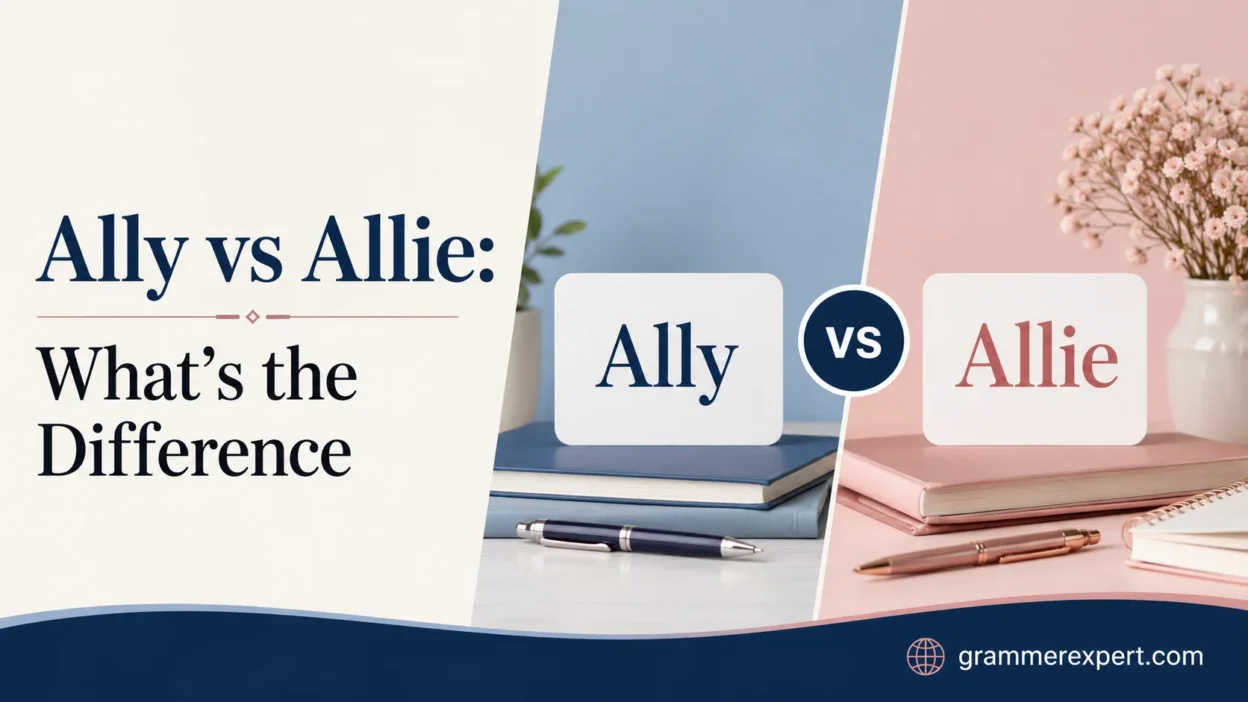
I once paused mid sentence while writing an email, thinking about Ally vs Allie: What’s the Difference and Which One Should You Use? and the correct spelling. A tiny change in a word that sounds the same can create a very different meaning, which feels awkward or even funny when you mix it up. Many writers, students, and even seasoned editors face this confusion because the words look similar and sound exactly alike.
On the page, a small difference suddenly flips the idea completely, and your sentence can become unintentionally strange. Nobody notices it when spoken out loud, but in writing, it becomes important to choose the right one every time.
In simple terms, an ally refers to a loyal supporter, partner, or friend—someone who supports, helps, or will stand by another person’s group or even a country. On the other hand, Allie is usually a name or nickname, and using it as a substitute does not make sense unless it is a real person, like when you say she is my Allie. This is a common issue in emails, social media, gaming, politics, and everyday speaking and writing.
For example, in a meeting, a coworker who brought coffee might be named Allie, but saying she is your ally means she supports you. That is why many people feel confused, since both meanings exist but apply in different situations.
Ally vs Allie Quick Answer
Here’s the simple truth:
- Ally = a word that means a supporter, partner, or someone on your side
- Allie = a name, often short for Allison or Alexandra
READ MORE: Arial vs Aerial: What’s the Difference
Quick examples
- “She’s a strong ally in difficult situations.”
- “Allie called to confirm the meeting.”
👉 Bottom line: If you’re writing professionally, you almost always mean ally.
What Does “Ally” Mean?
The word ally carries weight. It shows support, loyalty, and connection.
Definition and usage
An ally is someone who stands with you. They support your goals, defend your ideas, or work alongside you.
You’ll see it used in:
- Personal relationships
- Workplace dynamics
- Politics and global relations
- Social movements
It can also function as a verb.
- “They decided to ally with the organization.”
That flexibility makes it more than just a casual word. It’s a concept tied to trust.
Real-world examples of “ally”
Let’s ground it with clear usage:
- “He became her biggest ally during the project.”
- “The two countries formed an ally partnership.”
- “You need at least one ally at work who supports your ideas.”
Notice how each example shows support or partnership. That’s the core idea.
Common contexts where “ally” appears
You’ll see this word across many situations:
Workplace
- A colleague who backs your ideas
- A manager who advocates for you
Social causes
- Someone who supports equality or justice
- People who amplify marginalized voices
Relationships
- A friend who stands by you
- A partner who helps you grow
A quick insight
Think of ally as a bridge. It connects people through shared goals. Without that connection, the word loses its meaning.
What Does “Allie” Mean?
Now let’s switch gears.
Allie isn’t a vocabulary word in the same sense. It’s a proper noun.
Name origin and meaning
“Allie” often appears as a nickname or shortened form of names like:
- Allison
- Alexandra
- Alice
- Alina
It has a friendly, informal feel. You’ll mostly see it in personal contexts.
When you should use “Allie”
Use Allie only when referring to a person.
- “Allie is coming over later.”
- “I met Allie at the conference.”
That’s it. No hidden meanings. No alternative uses.
Example sentences
- “Allie just started a new job.”
- “I texted Allie about the event.”
- “Allie shared her notes with the team.”
If you can replace it with a person’s name, you’re using it correctly.
Ally vs Allie — Side-by-Side Comparison
Here’s where things become crystal clear.
FeatureAllyAllieTypeCommon nounProper nounMeaningSupporter or partnerA person’s nameUsageFormal and informal writingPersonal references onlyGrammar roleNoun or verbName onlyExample“She is my ally.”“Allie is my friend.”
Key takeaway
- If you’re talking about support, use ally
- If you’re talking about a person, use Allie
Why People Confuse Ally and Allie
This confusion isn’t random. It comes down to how English works.
They sound identical
Both words are pronounced the same. That makes them homophones.
English is full of these:
- There vs Their
- Your vs You’re
- To vs Too
So your brain hears one sound and guesses the spelling.
Spellcheck doesn’t save you
Here’s the tricky part.
Spellcheck won’t flag this mistake because both words are correct. It can’t read your intent.
So you might write:
- “She is my Allie in this project.”
Technically spelled right. Completely wrong meaning.
Names blur the rules
Names don’t follow strict grammar patterns. That makes them unpredictable.
You’ve seen variations like:
- Charlie
- Sophie
- Jamie
So “Allie” feels like it could be a normal word. It isn’t.
A simple truth
When sound leads and logic follows, mistakes sneak in. That’s exactly what happens here.
How to Remember the Difference (Simple Trick)
You don’t need a complicated rule. Just use this quick memory hack.
The “Y vs IE” trick
- Ally → “Y” = You support someone
- Allie → “IE” = Names often end this way
It’s simple. It sticks.
Another way to think about it
Picture this:
- Ally stands beside you in a battle
- Allie is texting you about lunch
One feels strategic. The other feels personal.
Common Mistakes to Avoid
Even strong writers slip up here. Let’s fix that.
Mistake: Using “Allie” in professional writing
❌ “She is my Allie during negotiations.” ✅ “She is my ally during negotiations.”
Mistake: Treating both words as interchangeable
They are not synonyms. They belong to different categories.
Mistake: Ignoring context
Context tells you everything. Ask yourself:
- Am I talking about support? → ally
- Am I naming someone? → Allie
Quick correction examples
Incorrect SentenceCorrect Sentence“He became my Allie at work.”“He became my ally at work.”“Ally invited me to dinner.”“Allie invited me to dinner.”“We need an Allie in this situation.”“We need an ally in this situation.”
Ally vs Allie in Professional Writing
This is where the difference really matters.
In emails, reports, or articles, using the wrong word can quietly hurt your credibility.
Why “ally” dominates in professional settings
Most professional writing deals with:
- Collaboration
- Support
- Strategy
All of these connect directly to ally.
Where accuracy matters most
You should double-check your spelling in:
- Job applications
- Business emails
- Academic writing
- LinkedIn posts
One small error can make your writing feel careless.
A quick case study
Imagine sending this email:
“I’m looking forward to working with you as my Allie on this project.”
It sounds friendly. But it also sounds like you don’t understand the word.
Now compare:
“I’m looking forward to working with you as my ally on this project.”
Clear. Professional. Confident.
Insight
Precision builds trust. Even small words carry weight.
Quick Usage Checklist
When you’re unsure, run through this fast checklist.
Use “ally” if:
- You mean supporter
- You’re writing professionally
- The word describes a role or relationship
- It fits as a noun or verb
Use “Allie” if:
- It’s someone’s name
- You’re referring to a specific person
- You could replace it with “John” or “Sarah”
Deep Dive: Ally as a Concept
Let’s go deeper for a moment.
The word ally isn’t just about language. It reflects behavior.
What makes someone an ally?
- They support your goals
- They advocate for you
- They stand with you in tough situations
Types of allies
You’ll find allies in different roles:
Strategic allies
Partners in business or politics
Social allies
People who support causes or communities
Personal allies
Friends or family who stand by you
A powerful quote
“An ally is not someone who speaks for you, but someone who stands with you.”
That idea captures the essence of the word.
Mini Case Study: Workplace Communication
Let’s look at a realistic scenario.
Situation
A manager writes:
“I need an Allie to support this initiative.”
Problem
The sentence sounds off. It creates confusion.
Fix
“I need an ally to support this initiative.”
Result
The message becomes clear and professional. No distractions.
Lesson
Clarity beats cleverness. Always.
FAQs
What is the main difference between ally and Allie?
The main difference is simple: ally means a supporter, partner, or friend, while Allie is usually a person’s name. One shows a relationship, and the other identifies someone.
Can I use Allie instead of ally in writing?
No, you should not use Allie as a substitute for ally. It only makes sense if you are referring to a real person with that name.
Why do people confuse ally and Allie?
People get confused because both words sound the same and look very similar. In speech, the difference is not noticeable, but in writing, it becomes important.
Where is the word ally commonly used?
The word ally is used in many contexts such as politics, social situations, gaming, and everyday conversations to describe someone who supports you.
How can I avoid making this mistake?
To avoid mistakes, remember this rule: if you mean a supporter, use ally; if you are talking about a person’s name, use Allie. Double-check your sentence when writing.
Conclusion
Understanding the difference between ally and Allie helps you write with more clarity and confidence. A small spelling change can completely shift the meaning of your sentence, so it is important to choose carefully. Once you practice using each word in the right context, it becomes easy to avoid confusion and communicate clearly every time.