Enable vs Inable: What’s the Difference? Learn why enable is correct, while inable is obsolete or nonstandard in modern English writing and usage.
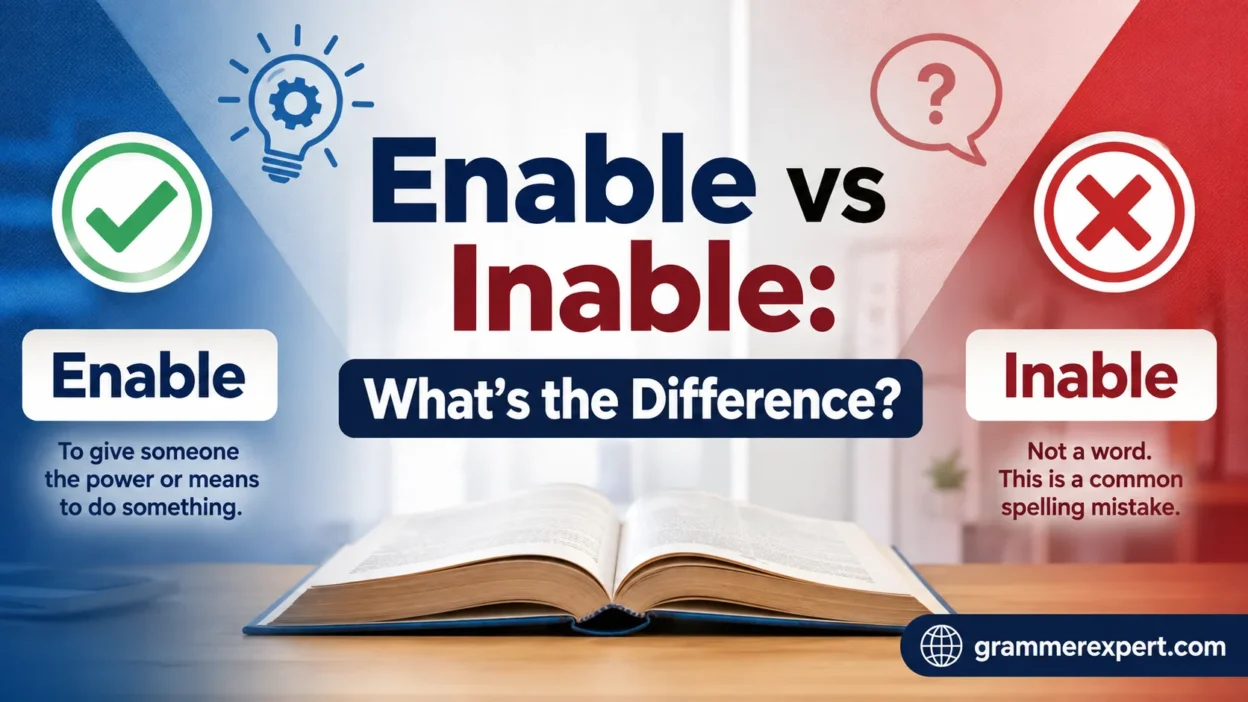
In English, enable and inable may look like identical forms, but modern English treats them differently. Enable is the correct, standard, widely used verb, while inable is obsolete or nonstandard and may appear in emails, essays, or professional writing because it looks convincing. This can lead to second-guessing the word, hesitation, and confusion. The simple fix is to understand the pattern, meaning, and real rules of English language usage. A clear understanding of the correct word, incorrect word, spelling, grammar, context, language, vocabulary, and written communication makes your writing flow sharper, smoother, and more polished. The inable meaning also matters because the myth that it is the normal opposite of enable can turn small words into big problems.
The proper word to use in ordinary sentences is enable, a recognized word in the English language. Its definition describes the act of giving someone the ability or authority to do something, or giving something the capability, permission, or means to perform an action. For example, new software can enable us to complete a task efficiently, while a device or feature can become operational and make possible a useful result. In simple terms, enable can give someone the ability to act, provide an opportunity, or make something practical and easy. Merriam-Webster provides related meanings that support this definition. In professional writing, the right word choice can improve efficiency, explain completion clearly, and show whether the writer means capability, permission, or another practical action.
Enable vs Inable: Quick Difference
| Word | Part of Speech | Main Meaning | Modern Standard Usage |
| Enable | Verb | Make possible, provide ability, or activate | Very common |
| Inable | Verb/adjective | Historical form of enable or obsolete form related to unable | Rare, obsolete, nonstandard |
| Unable | Adjective | Not able or not capable | Very common |
The key difference is modern usage. Enable appears naturally in everyday speech, professional writing, technical documentation, education, business, and formal English. Unable is equally established when you need to describe a lack of ability.
Inable belongs in a different category. Etymonline describes it directly as an obsolete form of enable, while Wiktionary records both an obsolete verb meaning “to enable” and an obsolete, now nonstandard adjective meaning “unable.”
So, if you’re writing an email, article, essay, report, or website copy, enable or unable will almost always be the right choice.
READ MORE: Aswell vs As Well: What’s the Difference? (With Examples)
What Does Enable Mean?
Enable as a Verb
Enable is a transitive verb. It describes an action that makes something possible or gives someone the means, ability, permission, or conditions needed to act.
For example:
- The scholarship enabled Maria to attend college.
- The new software enables employees to work remotely.
- Please enable notifications before continuing.
- Better lighting enabled the camera to capture clearer images.
The word can describe people, technology, systems, laws, money, education, equipment, and circumstances.
Cambridge Dictionary defines enable as making someone able to do something or making something possible. It also commonly uses the structure enable someone to do something.
The Main Meanings of Enable
Although the word has several uses, they share one basic idea: something becomes possible because another factor provides what is needed.
Enable can mean:
- Make something possible: “The grant enabled the project to continue.”
- Give someone the means: “The training enabled workers to use the equipment safely.”
- Give someone an opportunity: “The flexible schedule enabled her to study.”
- Cause something to operate: “Enable Bluetooth before pairing the device.”
- Give legal authority or power: “The law enabled the agency to regulate the industry.”
Merriam-Webster also recognizes the legal sense of enable, meaning to give legal power, capacity, or sanction.
Common Grammar Pattern: Enable Someone to Do Something
One of the most useful structures is:
enable + person/thing + to + verb
Examples:
- The new road enabled residents to reach the city faster.
- This feature enables users to save their settings.
- The course enabled me to improve my writing.
- Extra funding enabled the team to hire more staff.
Avoid dropping to when this structure requires it.
Correct: The program enables students to learn online.
Incorrect: The program enables students learn online.
This pattern is especially common in formal and academic writing.
What Does Inable Mean?
Is Inable a Word?
This question needs a more careful answer than simply saying “no.”
Inable has existed in English, but it isn’t a normal modern word. Historical sources record it as an older form of enable. Etymonline identifies inable as an obsolete form of enable.
Wiktionary records two English uses:
- inable as an obsolete, now nonstandard adjective meaning “unable” or “not able”
- inable as an obsolete, now nonstandard verb meaning “to enable”
That historical record explains why you might occasionally encounter the spelling in older texts or unusual sources.
However, historical existence doesn’t make a word a good choice for modern writing.
If you’re writing contemporary English, don’t use inable when enable or unable is intended.
Why Inable Causes Confusion
The confusion usually comes from the word able.
English contains familiar pairs such as:
- able → unable
- enable → disable
- possible → impossible
- regular → irregular
Because in- can sometimes express negation, it may seem logical to create inable from able. English doesn’t work that neatly, though.
The established modern word is unable, not inable.
Likewise, the established opposite of enable in many technology-related contexts is disable, not inable.
Think of it as a road map rather than a mathematical formula:
able → unable
enable → disable
Those patterns are established through actual English usage. You can’t always create a standard word simply by attaching a prefix that seems logical.
Enable vs Inable: Meaning and Usage Compared
Meaning
Enable means to make something possible or provide the ability or means to do something.
Inable has historical meanings, but its modern use is obsolete or nonstandard.
Unable means not able or incapable. Merriam-Webster classifies unable as an adjective and defines it as “not able” or “incapable.”
Consider these examples:
- The device enables users to connect quickly.
- The damaged device is unable to connect.
- The phrase inable to connect isn’t standard modern English.
The difference becomes crystal clear once the sentence has a real-world context.
Enable vs Inable: Usage Today
Modern English strongly favors enable when you mean “make possible.”
It also favors unable when you mean “not capable.”
That makes inable a poor choice for ordinary communication. Even if a reader understands what you mean, the word may look like a spelling mistake or an outdated expression.
For professional writing, clarity wins. Use the established word.
Enable vs Inable: Grammar
Enable functions as a verb:
- The system enables access.
- The system enabled access.
- The system is enabling access.
- The system will enable access.
Unable functions as an adjective:
- She is unable to attend.
- They were unable to finish.
- The machine is unable to process the file.
That grammatical difference alone can help you choose the right word.
Enable vs Inable: Examples in Context
Examples With Enable
Here are natural examples from several contexts:
Education:
“Online resources enable students to review difficult lessons at their own pace.”
Technology:
“Enable automatic updates to keep the application current.”
Work:
“The new scheduling system enables employees to manage shifts more efficiently.”
Accessibility:
“Screen readers enable people with visual impairments to access digital content.”
Finance:
“The additional funding enabled the company to expand its operations.”
Law:
“The new legislation enables regulators to impose stricter safety requirements.”
Notice the common thread. Something provides the ability, opportunity, permission, or conditions needed for another action.
Examples Showing Why Inable Is Usually Wrong
Suppose you want to say that a person lacks the ability to complete a task.
Incorrect:
“James was inable to finish the report.”
Correct:
“James was unable to finish the report.”
Now suppose you want to say that software makes a task possible.
Incorrect:
“The software inables users to organize their files.”
Correct:
“The software enables users to organize their files.”
The fix depends on your intended meaning. That’s the important part.
Enable vs Unable: Don’t Confuse These Words
Enable Means Make Possible
When you enable something, you help make an action possible.
For example:
“The training enabled Carlos to operate the machine.”
The training gave Carlos the knowledge needed to operate it.
Unable Means Not Able
When someone is unable, they lack the ability or opportunity to perform an action.
For example:
“Carlos was unable to operate the machine without training.”
Here, unable describes a limitation.
Merriam-Webster’s examples include people being unable to afford something or unable to participate in an activity.
Enable vs Unable Examples
| Sentence | Meaning |
| The course enabled her to improve. | The course made improvement possible. |
| She was unable to improve without practice. | She couldn’t improve under those conditions. |
| The update enabled the feature. | The update made the feature operational. |
| The old device was unable to run it. | The device couldn’t run it. |
A useful memory trick is simple:
Enable adds ability. Unable describes missing ability.
Enable vs Inable vs Unable: Comparison Table
| Feature | Enable | Inable | Unable |
| Standard modern word | Yes | No, generally | Yes |
| Part of speech | Verb | Verb/adjective in historical usage | Adjective |
| Means “make possible” | Yes | Historically | No |
| Means “not able” | No | Historically | Yes |
| Common in modern writing | Yes | No | Yes |
| Best choice for formal writing | Yes | No | Yes |
This comparison settles most cases.
If you’re deciding between enable and inable, choose enable when you mean “make possible.”
If you mean “not able,” choose unable.
Why Is Enable Correct but Inable Usually Wrong?
The History Behind Enable
The history of enable helps explain why its spelling doesn’t follow the pattern you might expect.
Etymonline traces enable to the early 15th century, when it meant “to make fit,” with the sense “to make able to” appearing by the middle of that century. It connects the word to en-, meaning roughly “make” or “put in,” plus able.
That means enable isn’t simply “in + able.”
Its structure developed differently.
Meanwhile, inable has been recorded as an obsolete form of enable.
Why Unable Is the Right Negative Form
Unable has a separate and established history as the negative form of able. Merriam-Webster dates its first known use to the 14th century.
So modern English settled on:
able → unable
and separately:
enable → disable
The spelling may look inconsistent at first. English often is. Historical development matters more than what seems logically symmetrical.
Common Mistakes With Enable
Using Inable Instead of Enable
This mistake often occurs when someone assumes that inable is simply an alternative spelling.
Wrong: “The device inables users to share files.”
Right: “The device enables users to share files.”
Use enable when something makes an action possible.
Using Inable Instead of Unable
This mistake happens when a writer wants to express inability.
Wrong: “She was inable to attend the meeting.”
Right: “She was unable to attend the meeting.”
Use unable when someone cannot perform an action.
Confusing Enable With Allow
These words overlap, but they aren’t always identical.
Allow often focuses on permission:
“The manager allowed us to leave early.”
Enable often emphasizes the means or conditions that make something possible:
“The new system enabled us to leave earlier.”
Permission and capability aren’t always the same thing.
Confusing Enable With Activate
In technology, enable and activate can sometimes overlap.
“Enable notifications” means make notifications available or turn the function on.
“Activate the account” usually suggests making an account operational or initiating it.
The best choice depends on the exact action involved.
Practical Case Studies: Enable or Unable?
Case Study: A Software Feature
Imagine a phone has a privacy setting that blocks location access.
You want the user to turn it on.
Correct: “Enable location services.”
You wouldn’t write “inable location services.” The established technical vocabulary uses enable and disable as opposing actions.
Case Study: A Missed Meeting
Imagine Sarah planned to attend a meeting but became sick.
Correct: “Sarah was unable to attend the meeting.”
Here, unable describes her lack of ability to attend.
Enable wouldn’t fit because nothing is being made possible.
Case Study: Professional Training
A company gives employees specialized training that allows them to use new equipment.
Correct: “The training enabled employees to operate the new equipment safely.”
The training provides the ability. Therefore, enable is the natural choice.
These examples show why meaning matters more than spelling similarity.
How to Remember Enable vs Inable
Use this quick mental test:
Does the sentence mean “make possible”?
Use enable.
Does it mean “not able”?
Use unable.
Does it contain “inable” in ordinary modern writing?
Stop and reconsider. In most cases, enable or unable is what you actually need.
Another useful pair is:
- Enable → provides ability
- Unable → lacks ability
- Disable → stops or turns off functionality
- Inable → generally avoid
That four-word pattern covers nearly every everyday situation.
Enable Synonyms and Related Words
Synonyms for Enable
Depending on context, you might use:
- Allow — give permission
- Permit — formally allow
- Empower — give authority or confidence
- Facilitate — make an action easier
- Authorize — officially give permission
- Equip — provide what someone needs
- Make possible — state the meaning plainly
These aren’t perfect substitutes in every sentence.
For instance, “The scholarship enabled her to study” emphasizes the means that made study possible. “The scholarship authorized her to study” changes the meaning because authorize focuses on permission.
Words Related to Enable
Common forms include:
- Enable
- Enables
- Enabled
- Enabling
- Enablement
- Enabler
- Re-enable
- Disable
- Disabled
- Unable
Knowing the word family makes spelling easier because you can recognize the base form.
Enable in Different Contexts
Enable in Everyday English
Everyday English uses enable whenever one thing makes another action possible.
Examples include:
- “The extra money enabled us to replace the car.”
- “Her support enabled him to continue.”
- “The ramp enables wheelchair users to enter the building.”
The word can sound formal, but it’s completely normal.
Enable in Business and Work
Businesses frequently use enable to describe systems, training, resources, and processes.
For example:
“The new platform enables teams to collaborate across different offices.”
This wording emphasizes capability rather than merely permission.
Enable in Technology
Technology is one of the clearest areas where enable appears constantly.
You might see instructions such as:
- Enable Wi-Fi.
- Enable notifications.
- Enable location access.
- Enable automatic updates.
- Enable two-factor authentication.
- Enable microphone access.
The opposite is generally disable.
Enable in Accessibility
Accessibility provides another important use.
A ramp can enable someone to enter a building. A screen reader can enable someone to navigate digital content. Captions can enable viewers to follow spoken dialogue when audio isn’t accessible.
In each case, something provides the means for participation.
Enable in Academic and Formal Writing
Academic writers often use enable when explaining causes and outcomes:
“Improved data collection enables researchers to identify patterns more accurately.”
It works well because it connects a resource or condition with the result it makes possible.
Enable vs Inable: Which One Should You Use?
The answer is straightforward.
Use enable when you mean:
- Make something possible
- Give someone the ability to act
- Provide the means or opportunity
- Turn on a feature
- Make a system operational
- Give legal power or authority
Use unable when you mean:
- Not able
- Incapable
- Unable to perform an action
- Lacking the necessary ability or opportunity
Avoid inable in ordinary modern English.
Historical sources show that inable has existed and carried more than one meaning. However, those historical uses don’t make it the normal choice today.
FAQs
Is “enable” a correct word?
Yes, enable is the correct and standard word in modern English. It means to give someone or something the ability, means, or opportunity to do something.
Is “inable” a word?
Inable has appeared in historical English, but it’s considered obsolete or nonstandard in modern English. It’s best to avoid it in everyday, academic, and professional writing.
What is the difference between enable and inable?
Enable is a standard modern verb meaning “to make possible” or “to give ability.” Inable is an obsolete or nonstandard form and isn’t normally used in contemporary English.
Is inable the opposite of enable?
No. The standard opposite of enable is generally disable, depending on the context. If you mean that someone lacks the ability to do something, use unable.
What does enable mean?
Enable means to make something possible or give someone the ability, authority, or means to do something. For example, new software can enable users to complete tasks faster.
What does unable mean?
Unable means not able to do something. For example, “She was unable to complete the task” means she couldn’t complete it.
Can I use inable in professional writing?
It’s better to avoid inable in professional writing. Use enable when you mean “make possible” and unable when you mean “not able.”
Which one should I use: enable, inable, or unable?
Use enable when something makes an action possible, and use unable when someone or something cannot perform an action. Avoid inable in normal modern English.
Conclusion
Enable is the correct and widely accepted word in modern English. It means to make something possible or give someone the ability or means to do something. Unable means “not able,” while inable is an obsolete or nonstandard form that should generally be avoided. Remembering this simple distinction will help you choose the right word and keep your writing clear, natural, and professional.