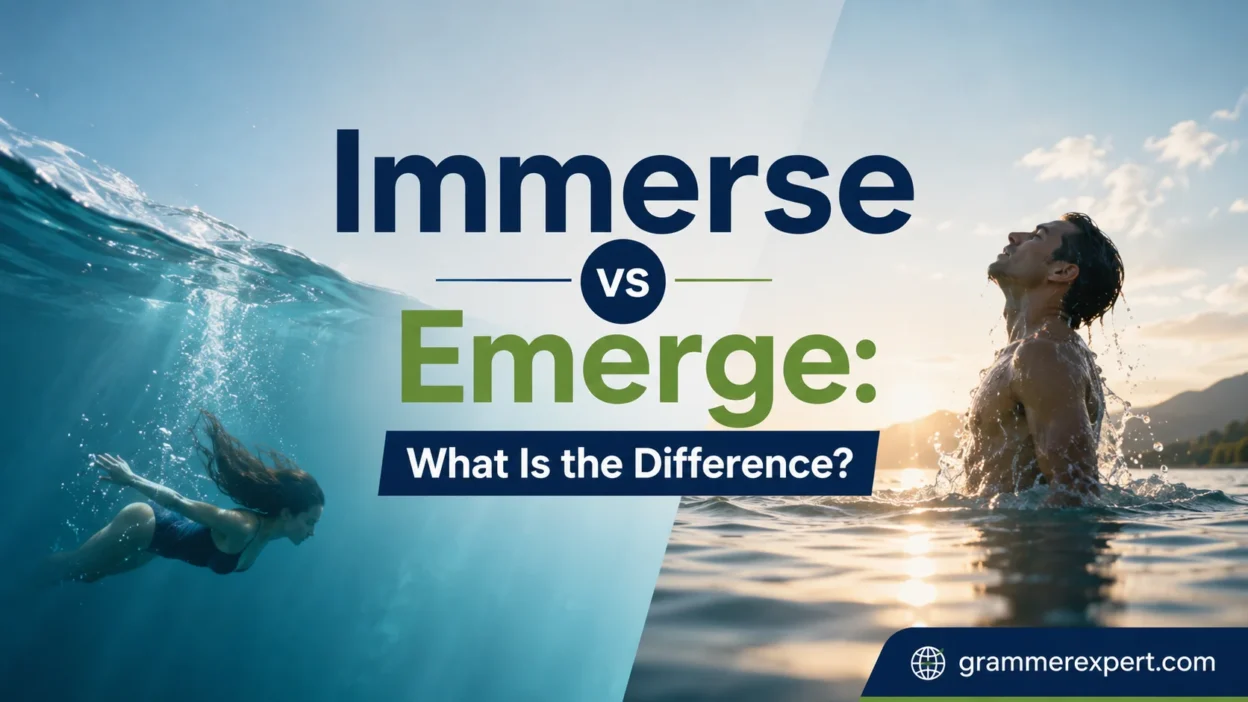
In writing, I once stopped and wondered about Immerse vs Emerse: What Is the Difference? Meaning, Examples, and Correct Usage I was not alone, as many people come across these words and question what they mean because they look the same and sound similar.
To make it simple, this article explains the answer clearly: immerse refers to fully submerging in liquid like water or deeply focusing on an activity, while immerse means rising above the surface, showing completely opposite meanings.
This guide will help you explore real-world examples, situations, and context from science and everyday actions, so you will know when to use each term and choose the correct choice confidently in any situation, improving grammar, clarity, expression, and overall communication.
What Does Immerse Mean?
The word immerse means to place something completely into a liquid or to become deeply involved in an activity, experience, or subject.
In modern English, people often use the figurative meaning more than the literal one.
READ MORE: Arial vs Aerial: What’s the Difference
Definition of Immerse
Immerse (verb):
To dip, place, or involve someone or something deeply into a particular environment, activity, or substance.
The word comes from the Latin term immergere, which means “to plunge into.”
Literal Meaning of Immerse
In its literal sense, immerse refers to putting something entirely under a liquid.
Examples:
- The scientist immersed the sample in water.
- She immersed the painting brush into the paint.
- The diver immersed himself in the ocean.
In each example, something physically goes into another substance.
Figurative Meaning of Immerse
Today, immerse is commonly used in a figurative sense.
Examples include:
- Immersing yourself in a language.
- Immersing yourself in a new culture.
- Immersing yourself in a research project.
- Immersing yourself in a novel.
In these situations, nothing is physically submerged. Instead, a person becomes deeply engaged or absorbed.
How Immerse Is Used in Everyday English
You will often encounter immerse in several areas of life.
Education
Teachers encourage students to immerse themselves in learning.
Examples:
- Immerse yourself in Spanish by speaking it daily.
- Students should immerse themselves in primary source materials.
Entertainment
Books, films, and games often create immersive experiences.
Examples:
- The novel completely immersed me in its world.
- Virtual reality technology immerses users in digital environments.
Travel
Travelers often seek cultural immersion.
Examples:
- She immersed herself in local traditions.
- Living abroad helped him immerse himself in the culture.
Professional Development
Career experts frequently recommend immersion learning.
Examples:
- New employees immerse themselves in company processes.
- Entrepreneurs often immerse themselves in market research.
Examples of Immerse in Sentences
Here are additional examples showing proper usage.
| Sentence | Correct Usage |
| I immersed myself in the history book. | ✓ |
| The chef immersed vegetables in ice water. | ✓ |
| Students should immerse themselves in the language. | ✓ |
| She immersed herself in the project for months. | ✓ |
| New facts immersed during the investigation. | ✗ |
The last sentence is incorrect because “emerged” should be used instead.
What Does Emerge Mean?
While immerse means going deeply into something, emerge means coming out, appearing, or becoming visible.
This opposite movement makes the distinction easier to understand.
Definition of Emerge
Emerge (verb):
To come into view, become known, appear, or come out from a hidden place.
The word originates from the Latin term emergere, meaning “to rise out of.”
Physical Meaning of Emerge
The most straightforward use involves something physically coming out of another place.
Examples:
- The swimmer emerged from the pool.
- The sun emerged from behind the clouds.
- A turtle emerged from the ocean.
In every case, something moves outward.
Figurative Meaning of Emerge
Emerge is also used to describe ideas, trends, discoveries, and developments becoming visible.
Examples:
- New evidence emerged during the trial.
- Several problems emerged after the launch.
- A new leader emerged from the competition.
Common Contexts Where Emerge Appears
News Reporting
Journalists regularly use emerge when discussing newly discovered information.
Examples:
- Details emerged after the investigation.
- New reports emerged overnight.
Business
Companies use emerge when discussing trends and opportunities.
Examples:
- New markets emerged in recent years.
- Several challenges emerged during expansion.
Science
Researchers often describe findings as emerging.
Examples:
- New evidence emerged from the study.
- Emerging technologies continue to reshape healthcare.
Personal Growth
People can emerge stronger after difficult experiences.
Examples:
- She emerged more confident after graduation.
- He emerged as a respected industry expert.
Examples of Emerge in Sentences
| Sentence | Correct Usage |
| The moon emerged from the clouds. | ✓ |
| New opportunities emerged after the merger. | ✓ |
| The athlete emerged as a champion. | ✓ |
| I emerged myself in the book. | ✗ |
| New evidence emerged during the investigation. | ✓ |
Immerse vs Emerge: Side-by-Side Comparison
Although these words look similar, their meanings move in opposite directions.
Quick Comparison Table
| Feature | Immerse | Emerge |
| Basic Meaning | Go deeply into something | Come out or appear |
| Direction | Inward | Outward |
| Common Context | Learning, culture, experiences | Discoveries, visibility, development |
| Part of Speech | Verb | Verb |
| Physical Example | Immerse a cup in water | Emerge from water |
| Figurative Example | Immerse yourself in study | New facts emerge |
Visual Concept
Think about a diver.
Step 1: The diver jumps into the water.
➡ The diver immerses himself.
Step 2: The diver comes back to the surface.
➡ The diver emerges from the water.
This simple image explains the difference perfectly.
The Simplest Way to Remember the Difference
Many people struggle because the words share several letters.
Fortunately, there are easy memory tricks.
Memory Trick #1: Immerse Goes In
Notice the beginning of the word:
IMMERSE = IN
Both start with the letter I.
Whenever you see immerse, think:
Going IN.
Examples:
- Immerse yourself in learning.
- Immerse the object in water.
- Immerse yourself in the culture.
Memory Trick #2: Emerge Comes Out
Think of emerge as appearing.
Whenever something emerges, it becomes visible.
Examples:
- The sun emerges.
- A leader emerges.
- New information emerges.
Simple Formula
IMMERSE = GO IN
EMERGE = COME OUT
This shortcut helps eliminate confusion immediately.
Common Mistakes People Make
Even native English speakers occasionally mix these words up.
Let’s look at the most common errors.
Using Emerge Instead of Immerse
Incorrect:
❌ I emerged myself in the novel.
Correct:
✅ I immersed myself in the novel.
Why?
Because the person is going deeply into the experience of reading.
Using Immerse Instead of Emerge
Incorrect:
❌ New facts immersed during the meeting.
Correct:
✅ New facts emerged during the meeting.
Why?
The facts became known or visible.
Mixing Up Direction
One useful question can solve most confusion.
Ask yourself:
Is something going into an experience or coming out into view?
If it’s going in → use immerse.
If it’s coming out → use emerge.
Confusing Similar Sounds
Many learners focus on spelling similarities.
However, spelling doesn’t determine meaning.
Consider:
- Accept vs Except
- Affect vs Effect
- Adapt vs Adopt
- Immerse vs Emerge
Each pair looks similar but serves a different purpose.
Immerse and Emerge in Academic Writing
Academic writing uses both terms regularly.
Choosing the wrong one can weaken your credibility.
When to Use Immerse in Academic Writing
Researchers and educators use immerse when discussing deep engagement.
Examples:
- Students should immerse themselves in the literature.
- Researchers immersed participants in simulated environments.
- Language learners benefit from immersive experiences.
When to Use Emerge in Academic Writing
Scholars use emerge when discussing findings or developments.
Examples:
- Several themes emerged from the interviews.
- Patterns emerged during data analysis.
- New theories emerged from recent research.
Academic Example
Incorrect:
❌ Several themes immersed from participant responses.
Correct:
✅ Several themes emerged from participant responses.
The second sentence accurately describes information becoming visible.
Immerse and Emerge in Business Communication
Clear communication matters in business. Using the wrong word can create confusion in reports, presentations, and professional emails.
Business Examples Using Immerse
Business leaders often encourage employees to immerse themselves in company goals, customer needs, or industry trends.
Examples:
- New hires should immerse themselves in company culture.
- Successful marketers immerse themselves in customer behavior data.
- Managers often immerse themselves in project planning before launch.
The idea is always the same: deep involvement and engagement.
Business Examples Using Emerge
Emerge appears frequently in reports and market analysis.
Examples:
- Several risks emerged during the audit.
- A new competitor emerged in the marketplace.
- Trends emerged after analyzing customer feedback.
Business professionals use emerge when discussing discoveries, developments, or appearances.
Professional Writing Tip
A simple check can prevent mistakes:
| Ask Yourself | Use |
| Is someone becoming deeply involved? | Immerse |
| Is something becoming visible or known? | Emerge |
Synonyms of Immerse
Sometimes you can replace immerse with a synonym. However, each alternative carries a slightly different meaning. Understanding those differences helps you choose the most precise word.
Common Synonyms of Immerse
| Synonym | Meaning | Best Use Case |
| Submerge | Put completely under liquid | Physical objects and water |
| Engage | Become involved | Work and activities |
| Absorb | Take in fully | Learning and reading |
| Involve | Participate deeply | Projects and tasks |
| Dedicate | Commit time and effort | Long-term goals |
| Embed | Place deeply within | Technology and systems |
When to Use These Synonyms
Submerge
Submerge usually refers to physical immersion.
Examples:
- The submarine submerged beneath the waves.
- The scientist submerged the equipment in water.
Engage
Engage emphasizes active participation.
Examples:
- Employees should engage with customers.
- Students engage more when lessons are interactive.
Absorb
Absorb focuses on learning and understanding.
Examples:
- She absorbed every detail of the lecture.
- Readers absorbed the information quickly.
Involve
Involve highlights participation.
Examples:
- The project involves multiple departments.
- He involved himself in community activities.
Example Comparison
Consider these sentences:
- She immersed herself in French culture.
- She absorbed French culture.
- She engaged with French culture.
All are correct. However, immersed suggests the deepest level of involvement.
Synonyms of Emerge
Like immerse, emerge has several alternatives. Each one works best in specific situations.
Common Synonyms of Emerge
| Synonym | Meaning | Common Usage |
| Appear | Become visible | General situations |
| Surface | Rise into view | Water and information |
| Arise | Come into existence | Problems and opportunities |
| Develop | Grow gradually | Trends and skills |
| Materialize | Become real | Plans and expectations |
| Unfold | Become known over time | Stories and events |
When These Synonyms Work Best
Appear
Examples:
- A rainbow appeared after the storm.
- New information appeared online.
Surface
Examples:
- Additional evidence surfaced later.
- The diver surfaced after several minutes.
Arise
Examples:
- Challenges arose during construction.
- Questions arose after the presentation.
Develop
Examples:
- New trends developed over time.
- The market developed rapidly.
Example Comparison
- New evidence emerged.
- New evidence surfaced.
- New evidence appeared.
Each sentence works, but emerged often sounds more formal and professional.
Can Immerse and Emerge Ever Be Interchanged?
This is one of the most common questions people ask.
The short answer is:
No.
In almost every situation, immerse and emerge have opposite meanings.
Why They Cannot Be Swapped
Immerse describes movement inward.
Emerge describes movement outward.
Think of a swimmer.
- The swimmer immerses himself in the water.
- The swimmer emerges from the water.
Switching the words completely changes the meaning.
Examples Showing the Difference
| Incorrect Sentence | Correct Sentence |
| I emerged myself in the course. | I immersed myself in the course. |
| New facts immersed yesterday. | New facts emerged yesterday. |
| The diver immersed from the ocean. | The diver emerged from the ocean. |
| She emerged herself in research. | She immersed herself in research. |
Real-World Writing Example
Incorrect:
The student emerged herself in historical documents.
Correct:
The student immersed herself in historical documents.
The student became deeply involved in research. She did not come out of research.
Immerse vs Emerge in Real-Life Situations
Understanding how these words work in real contexts makes them easier to remember.
Scenario: Learning a Language
A student wants to become fluent in Spanish.
Correct usage:
She immersed herself in Spanish by speaking it daily.
After years of practice:
She emerged as a fluent Spanish speaker.
Notice how both words can appear in the same story.
First comes immersion.
Then comes emergence.
Scenario: Business Growth
A startup founder spends years studying the market.
Correct usage:
The founder immersed himself in industry research.
After launching successfully:
The company emerged as a market leader.
Again, the pattern remains the same.
Deep involvement happens first.
Visible success emerges later.
Scenario: Scientific Research
Scientists conduct a long-term study.
Correct usage:
Researchers immersed themselves in data analysis.
Eventually:
Several important findings emerged from the research.
This pattern appears frequently in academic journals and scientific publications.
Quick Quiz: Test Your Understanding
Try these questions before checking the answers.
Fill in the Blank
Choose either immerse or emerge.
- Students should ______ themselves in the material.
- New evidence began to ______ during the investigation.
- The swimmer ______ from the lake.
- She decided to ______ herself in local traditions.
- Several opportunities ______ after the merger.
Multiple Choice Questions
Which sentence is correct?
A. I emerged myself in the book.
B. I immersed myself in the book.
Answer: B
Which word means “to become visible”?
A. Immerse
B. Emerge
Answer: B
Which sentence is correct?
A. New information emerged yesterday.
B. New information immersed yesterday.
Answer: A
Answer Key
- Immerse
- Emerge
- Emerged
- Immerse
- Emerged
If you answered all five correctly, you already understand the difference better than many English learners.
FAQs
What is the main difference between immerse and emerse?
The main difference is in their direction and meaning. Immerse means to go into something, like being fully under water or deeply involved in an activity, while immerse means coming out or rising above a surface.
Why do people confuse immerse and emerse?
People often confuse them because they look similar, sound alike, and are close in spelling. Fast pronunciation makes the confusion even more common in everyday communication.
Can immerse and immerse be used in the same context?
Not usually. They have opposite meanings, so using them in the same sentence can change the meaning entirely and lead to wrong understanding.
Where is the word immerse commonly used?
The word immerse is often used in science, especially when talking about underwater plants or objects that rise above the water surface.
How can I remember the correct usage?
A simple trick is: Immerse = In, Immerse = Exit. This helps you quickly choose the right word in any context while writing or speaking.
Conclusion
Understanding Immerse vs Emerge: What Is the Difference? Meaning, Examples, and Correct Usage (Updated 2026) becomes easier with practice. Once you focus on their meanings, usage, and context, you can avoid mistakes and communicate with better clarity and confidence every time.
Emerge means coming out, appearing, or becoming visible. New evidence emerges. Leaders emerge. Trends emerge. Swimmers emerge from the water.
A simple rule can help you remember the distinction forever:
Immerse = Go In
Emerge = Come Out
Whether you’re writing an academic paper, preparing a business report, studying English grammar, or simply trying to improve your vocabulary, understanding this distinction will help you communicate more clearly and confidently.
The next time you encounter these words, think of a diver. The diver immerses into the water and later emerges from it. That image captures the entire difference in a single moment.