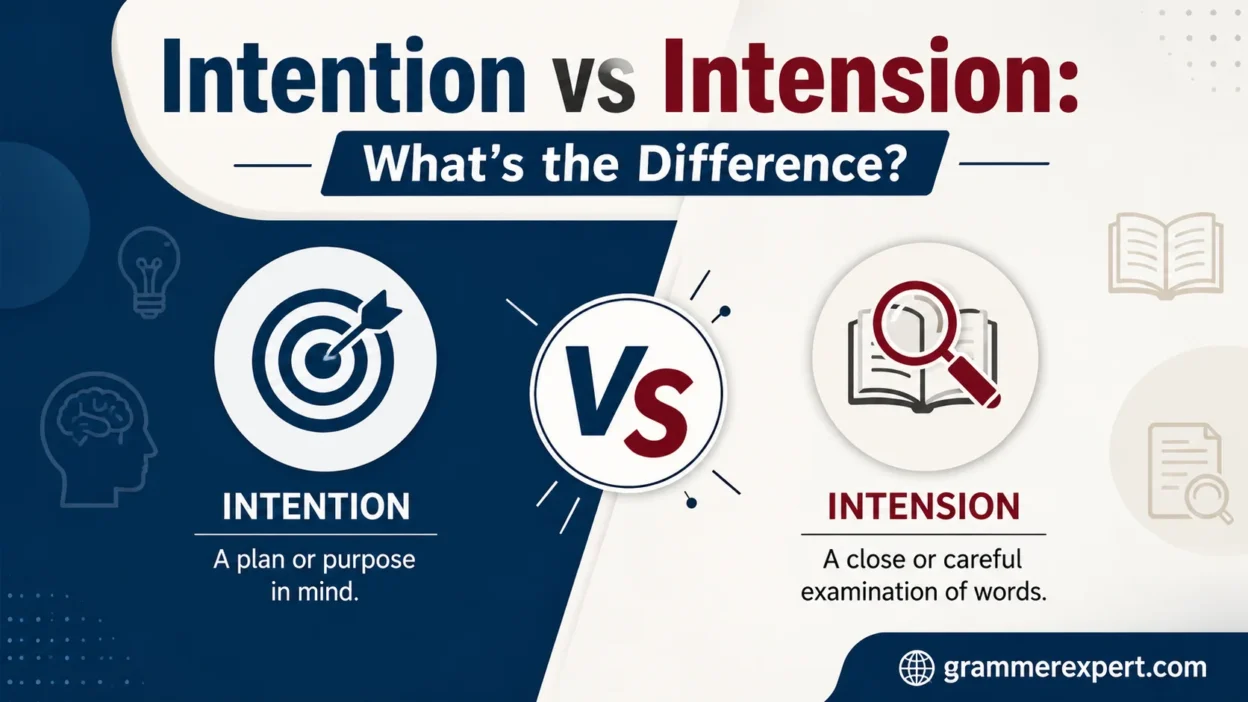
Intention vs Intension: What’s the Difference? explains the difference between two similar words with simple examples for better word choice.
Have you ever wondered while writing whether Intention or Intension is the correct word? At first glance, they look almost identical, sound the same in many accents, yet they have completely different meanings. The distinction becomes clear when you understand the context and contexts where each term is used. Intention refers to a person’s purpose, goal, or plan, making it the word choice you need in most everyday situations. Intension, by contrast, belongs to technical fields and is a technical vocabulary term in logic, philosophy, linguistics, and semantics.
From my editing work, I have stopped several times to double-check this pair because one spelling mistake can be confusing. Fortunately, a simple guide with practical examples explains, describes, highlights, provides, and shares useful advice that will help you choose the right word every time. Intension focuses on the defining characteristics, inherent meaning, concept, and concept meaning of something rather than a personal objective. However, Intention is still the preferred word in academic writing, professional writing, legal writing, and other academic, professional, and legal documents.
Intention vs. Intension: Quick Comparison
| Feature | Intention | Intension |
| Meaning | A purpose, goal, or plan | The defining characteristics or meaning of a concept |
| Part of Speech | Noun | Noun |
| Common Usage | Everyday English | Academic English |
| Primary Fields | Business, education, law, daily conversation | Logic, philosophy, linguistics, semantics |
| Related Word | Intent | Intensional |
| Frequency | Very common | Rare outside academic writing |
| Example | Her intention was to help everyone. | The intension of “bird” includes having feathers and wings. |
Quick Answer: If you’re writing about someone’s purpose or objective, use intention. If you’re discussing the meaning or defining attributes of a concept, use intension.
READ MORE: Tie vs Tye What’s the Difference?
What Does “Intention” Mean?
Definition of Intention
The word intention means a purpose, objective, aim, or plan behind an action. It explains why someone does something or what they hope to achieve.
Simply put, an intention is the reason behind an action. Before people make important decisions, they usually have a clear intention guiding them.
For example:
- She had every intention of finishing the project on time.
- His intention was to help the community.
- Our intention is to provide excellent customer service.
In each sentence, intention refers to a planned goal or desired outcome.
You can often replace intention with words like:
- Purpose
- Goal
- Aim
- Objective
- Plan
If the sentence still makes sense, intention is almost certainly the correct choice.
Origin and Etymology
The word intention comes from the Latin word intentio, meaning a stretching toward, purpose, or design. It entered Middle English through Old French and has remained a core part of the English language for centuries.
Today, it appears in almost every type of writing, including:
- Books
- Newspapers
- Business reports
- Legal documents
- Academic essays
- Personal emails
- Everyday conversations
Because of its broad use, intention is one of the most common nouns used to describe human motivation.
When to Use “Intention”
Use intention whenever you’re talking about:
- A person’s goal
- A planned action
- Someone’s motivation
- A future objective
- The purpose behind a decision
Ask yourself one simple question:
Am I talking about what someone wants to do?
If the answer is yes, the correct word is intention.
For example:
✔ Our intention is to reduce costs this year.
✔ She had no intention of hurting anyone.
✔ The company’s intention is to expand into new markets.
Each sentence describes a goal rather than a definition.
Common Contexts Where “Intention” Appears
Everyday Conversations
People use intention naturally in daily life because nearly every action begins with a purpose.
Examples include:
- I had every intention of calling you yesterday.
- What was your intention?
- His intentions were honest.
- They acted with good intentions.
These expressions appear frequently in spoken English.
Business and Finance
Businesses often announce their intentions before making major decisions.
Common examples include:
- intention to acquire another company
- intention to expand internationally
- intention to increase production
- intention to hire more employees
- intention to launch a new product
These phrases commonly appear in corporate reports and official statements.
Education
Teachers and students regularly discuss intentions when analyzing literature or planning assignments.
Examples include:
- The author’s intention was to persuade readers.
- The teacher explained Shakespeare’s intention.
- Our intention is to improve reading comprehension.
Understanding an author’s intention often helps readers interpret the text more accurately.
Law
In legal settings, intention can determine whether an act was deliberate or accidental.
Lawyers and judges may discuss:
- criminal intention
- intention to deceive
- contractual intention
- intention to commit fraud
A person’s intention sometimes influences legal responsibility and court decisions.
Personal Development
Goal-setting often begins by identifying your intentions.
Instead of focusing only on results, many productivity experts encourage people to establish clear intentions before starting a task.
Examples include:
- daily intentions
- career intentions
- financial intentions
- health intentions
- learning intentions
A clear intention provides direction and helps you stay focused throughout the day.
Examples of “Intention” in Sentences
The following examples demonstrate how naturally intention fits into different situations.
| Situation | Example Sentence |
| Personal Life | My intention is to spend more time with my family. |
| Education | The author’s intention becomes clear in the final chapter. |
| Business | The company announced its intention to open five new stores. |
| Law | The court examined whether there was criminal intention. |
| Healthcare | The doctor’s intention was to reassure the patient. |
| Sports | The coach’s intention was to improve teamwork. |
| Daily Conversation | She had no intention of leaving early. |
Notice that every example describes a purpose, objective, or plan.
What Does “Intension” Mean?
Definition of Intension
Although intension looks very similar to intention, it has a completely different meaning.
Intension refers to the collection of characteristics, qualities, or properties that define a concept.
Instead of describing what someone wants to do, it explains what something means.
For example, consider the word triangle.
The intension of triangle includes these defining characteristics:
- Three sides
- Three angles
- Closed geometric figure
- Polygon
Every triangle must possess these characteristics.
Those defining properties make up the word’s intension.
Origin and Etymology
The word intension originated from Medieval Latin and later became a technical term in philosophy and logic.
Scholars needed a way to distinguish between:
- the meaning of a concept
- the objects represented by that concept
This distinction eventually became known as:
- Intension
- Extension
Today, these terms remain important in philosophy, formal logic, linguistics, and semantics.
How It Differs from Everyday English
Most English speakers rarely encounter the word intension outside universities or research papers.
For example, people usually say:
“Let’s define the word.”
They almost never say:
“Let’s examine the intension of the word.”
Because intension is uncommon, many people assume it’s simply a spelling mistake.
It isn’t.
It is a legitimate English word with a specialized academic meaning.
Where “Intension” Is Used
Philosophy
Philosophers often analyze concepts by identifying their essential characteristics.
Questions might include:
- What defines justice?
- What makes something knowledge?
- What characteristics define beauty?
These discussions focus on intension.
Logic
In formal logic, intension represents the meaning or defining conditions of a concept rather than the individual objects it describes.
This distinction helps philosophers build precise arguments and classifications.
Linguistics
Linguists study how words create meaning.
The intension of a word includes the semantic features that distinguish it from other words.
For example, the intension of mother includes characteristics traditionally associated with motherhood, although the exact definition may vary depending on the linguistic framework.
Semantics
Semantics explores how language conveys meaning.
Within semantics, intension explains the conceptual content behind words and expressions.
For example:
The words doctor and physician generally refer to the same people. However, researchers may still compare their intensions to study differences in nuance, style, or conceptual interpretation.
Examples of “Intension” in Sentences
Although uncommon, these examples illustrate proper usage.
| Field | Example Sentence |
| Philosophy | The professor discussed the intension of justice. |
| Logic | Students analyzed the intension of the logical predicate. |
| Linguistics | The lecture focused on the intension of several abstract nouns. |
| Semantics | Researchers examined the intension of technical vocabulary. |
| Academic Research | The article compares the intension of competing definitions. |
These examples show why intension belongs mainly to academic writing.
The Main Difference Between Intention and Intension
At first glance, intention and intension seem interchangeable because they differ by only one letter. In reality, they describe entirely different ideas.
The easiest way to remember them is this:
- Intention relates to people, plans, goals, and purpose.
- Intension relates to concepts, definitions, and meaning.
Once you understand that distinction, choosing the correct word becomes much easier.
Meaning Comparison
| Intention | Intension |
| Goal | Definition |
| Purpose | Conceptual meaning |
| Plan | Defining characteristics |
| Objective | Semantic properties |
| Human action | Academic concept |
If you’re describing why someone does something, choose intention.
If you’re defining what a concept means, choose intension.
Usage Comparison
The difference becomes obvious when you compare where each word appears.
Intention commonly appears in:
- Emails
- Blogs
- Newspapers
- Business reports
- Legal documents
- Books
- Everyday conversations
Intension usually appears in:
- Philosophy textbooks
- Logic courses
- Linguistics journals
- Semantic research
- Academic papers
For the average English speaker, intention is the word you’ll use thousands of times throughout your life. Intension remains a specialized term that most people encounter only in higher education.
Pronunciation Comparison
Another reason these words are often confused is their pronunciation.
| Word | Approximate Pronunciation |
| Intention | in-TEN-shən |
| Intension | in-TEN-shən |
In standard English, many speakers pronounce both words almost identically. That means readers and listeners usually rely on context, not pronunciation, to understand which word is intended.
Why People Confuse Them
Several factors contribute to the confusion:
- Both words differ by only one letter.
- They often sound exactly the same.
- Spell checkers rarely catch the mistake because both are valid English words.
- Intension is rarely taught outside philosophy, logic, and linguistics.
- Many writers assume intension is an alternative spelling of intention, even though it has a completely different meaning.
A simple memory trick can prevent this mistake:
Intention = Intent = Purpose
Intension = Intensive study of meaning = Definition
Intension vs. Extension in Logic
One of the most important concepts in philosophy, logic, and semantics is the distinction between intension and extension. These terms work together to explain how words convey meaning.
Although they often appear side by side in academic writing, they describe different aspects of a concept.
Think of it this way:
- Intension tells you what a thing means.
- Extension tells you which things belong to that meaning.
Understanding this difference makes technical discussions much easier to follow.
What Is Intension?
The intension of a word consists of the essential characteristics that define it.
For example, consider the word square.
Its intension includes:
- Four equal sides
- Four right angles
- A closed geometric figure
- A type of quadrilateral
These characteristics define what a square is. If a shape lacks one of these defining features, it is no longer a square.
In other words, intension focuses on meaning rather than examples.
What Is Extension?
The extension of a word refers to every object or instance that fits the definition.
Using the same example:
The extension of square includes:
- Every square drawn on paper
- Every square tile
- Every square window
- Every square object that satisfies the definition
Instead of asking “What makes this a square?”, extension asks “Which objects are squares?”
Why This Matters in Philosophy and Semantics
Philosophers often debate definitions rather than individual examples.
For instance, when discussing the concept of justice, scholars ask questions such as:
- What characteristics define justice?
- Which qualities must justice include?
- Can justice exist without fairness?
These questions examine intension.
By contrast, asking whether a specific court decision represents justice concerns extension because it focuses on whether an example belongs to the concept.
Linguists also rely on this distinction when studying meaning, dictionary definitions, and language structure.
Quote: “A definition tells us what a thing is. Examples tell us where we find it.”
How to Remember the Difference Between Intention and Intension
Many writers accidentally swap these words because they differ by only one letter. Fortunately, a few memory techniques make the distinction easy to remember.
Easy Memory Tricks
Connect intention with the word intent.
Both words relate to:
- Purpose
- Goals
- Plans
- Motivation
If you’re discussing what someone hopes to accomplish, you almost certainly need intention.
Now connect intension with intellectual study.
It appears mainly in:
- Philosophy
- Logic
- Linguistics
- Semantics
If you’re analyzing definitions or conceptual meaning, intension is the correct word.
Visual Association
Imagine two different scenes.
Scene One
A woman stands at the starting line of a marathon.
She says,
“My intention is to finish the race.”
She’s talking about her goal.
Scene Two
A professor writes Bird on a whiteboard.
Below it, the professor lists:
- Feathers
- Wings
- Beak
- Warm-blooded
The professor is describing the word’s intension.
One image involves people making plans.
The other involves concepts being defined.
Common Mistakes People Make
Even experienced writers occasionally confuse these words. Most mistakes happen because intension looks like a reasonable variation of intention.
Here are the most common errors.
Using “Intension” Instead of “Intention”
This is by far the most frequent mistake.
❌ My intension is to finish college next year.
✅ My intention is to finish college next year.
The sentence discusses a goal, not a definition.
❌ The company’s intension is to expand overseas.
✅ The company’s intention is to expand overseas.
Businesses announce intentions, not intensions.
Assuming Intension Is a Misspelling
Many people believe intension is simply an incorrect spelling.
It isn’t.
Major English dictionaries recognize intension as a valid word. However, its meaning is specialized, which explains why most people never encounter it outside academic settings.
Ignoring Context
Context always determines which word you need.
Ask yourself:
Am I discussing a person’s goal?
Choose intention.
Am I discussing the defining meaning of a concept?
Choose intension.
That single question prevents nearly every mistake.
Incorrect Usage Examples
The following sentences contain common errors.
| Incorrect Sentence | Correct Sentence |
| My intension is to save money. | My intention is to save money. |
| Their intension was to help. | Their intention was to help. |
| His intension was honest. | His intention was honest. |
| The author’s intension was to entertain readers. | The author’s intention was to entertain readers. |
Every corrected sentence discusses a goal or purpose, so intention is required.
Before-and-After Sentence Corrections
Here are a few more examples.
Before
Our intension is to improve employee satisfaction.
After
Our intention is to improve employee satisfaction.
Before
She explained the intention of the philosophical concept.
After
She explained the intension of the philosophical concept.
Before
His intension was to become a doctor.
After
His intention was to become a doctor.
These examples show how a single letter can completely change a sentence’s meaning.
Intention and Intension in Different Fields
Although both words exist in English, they appear in very different disciplines.
Everyday English
In daily communication, intention dominates.
People discuss:
- Travel plans
- Career goals
- Family decisions
- Personal ambitions
- Future objectives
You could speak English every day for years without ever hearing the word intension.
Academic Writing
Universities use both words, but in different contexts.
For example:
- Literature professors analyze an author’s intention.
- Philosophy professors discuss the intension of abstract concepts.
Both words are correct, yet each serves a unique purpose.
Philosophy
Philosophers investigate definitions with great precision.
Instead of asking whether something exists, they often ask:
- What defines truth?
- What defines morality?
- What defines knowledge?
Those discussions revolve around intension.
Linguistics
Linguists explore how language creates meaning.
When comparing similar words, they may examine:
- semantic features
- conceptual meaning
- lexical relationships
These topics frequently involve intension.
Legal Writing
Legal documents almost always use intention.
Examples include:
- intention to enter into a contract
- intention to commit an offense
- intention to transfer ownership
- intention to terminate employment
Courts regularly examine intention because a person’s purpose may influence legal outcomes.
Intent vs. Intention
These words are closely related.
Intent often refers to a state of mind or determination, especially in legal contexts.
Intention usually emphasizes the overall goal or planned outcome.
Example:
- He acted with criminal intent.
- His intention was to protect his family.
Objective vs. Intention
An objective is a measurable result.
An intention is the purpose behind pursuing that result.
For example:
- Objective: Increase sales by 15%.
- Intention: Grow the business and serve more customers.
Objectives measure success. Intentions explain motivation.
Purpose vs. Intention
These words are often interchangeable.
However, purpose can describe the function of an object as well as a person’s goal.
For example:
- The purpose of a flashlight is to provide light.
- My intention is to buy a flashlight.
Purpose may describe things.
Intention describes human goals and planned actions.
Common Collocations with Intention
Native English speakers often use intention with specific words and phrases. Learning these collocations will make your writing sound more natural and professional.
Common Phrases with “Intention”
Here are some of the most frequently used collocations.
| Collocation | Meaning | Example Sentence |
| Good intentions | Honest or kind motives | She acted with good intentions, even though the plan failed. |
| Bad intentions | Harmful motives | The police found no evidence of bad intentions. |
| Clear intention | An obvious purpose | His clear intention was to improve customer satisfaction. |
| Honest intention | A sincere goal | They appreciated her honest intention to help. |
| Express an intention | State a plan publicly | The company expressed its intention to expand overseas. |
| Declare an intention | Officially announce a goal | The mayor declared his intention to run for another term. |
| Intention to do something | Plan to perform an action | She announced her intention to study abroad. |
| With the intention of | Doing something for a purpose | He visited the office with the intention of signing the contract. |
These expressions appear regularly in newspapers, business reports, and everyday conversations.
Common Academic Uses of “Intension”
Unlike intention, the word intension appears almost exclusively in technical and academic writing.
Common examples include:
- Intension of a term
- Intensional meaning
- Intensional logic
- Intensional definition
- Intensional semantics
- Intensional context
Example sentences:
- The professor explained the intension of the concept.
- Researchers compared the intensional definitions used in different textbooks.
- The course introduces students to intensional logic.
Unless you study philosophy, linguistics, or logic, you are unlikely to use these phrases in daily communication.
Grammar Tips for Using Intention and Intension Correctly
Understanding grammar patterns helps you avoid mistakes and write with confidence.
Is “Intention” Countable or Uncountable?
Intention is usually a countable noun.
Examples:
- She has an intention to improve.
- They shared their intentions during the meeting.
- His intention was clear.
However, it can also function in a broader sense when referring to intention as a general concept.
Example:
- Intention matters just as much as action.
Plural Form
The plural forms are straightforward.
| Singular | Plural |
| Intention | Intentions |
| Intension | Intensions |
Examples:
- The committee discussed its intentions for next year.
- The textbook compares different intensions of the same concept.
Common Prepositions
Certain prepositions naturally pair with intention.
| Phrase | Example |
| Intention to | Her intention to improve was obvious. |
| Intention of | He had no intention of quitting. |
| With the intention of | She traveled with the intention of finding work. |
Using the correct preposition makes your writing sound fluent and natural.
Synonyms of Intension (Context-Specific)
There are few direct synonyms for intension because it is a specialized technical term.
Related words include:
- Definition
- Conceptual meaning
- Semantic content
- Essential properties
- Defining characteristics
- Conceptual attributes
These expressions explain similar ideas, although they are not perfect substitutes in formal philosophical writing.
Words That Are Not Interchangeable
Many writers mistakenly treat these words as synonyms.
| Word | Can Replace “Intention”? | Can Replace “Intension”? |
| Purpose | ✔ Usually | ✘ No |
| Goal | ✔ Usually | ✘ No |
| Intent | ✔ Often | ✘ No |
| Definition | ✘ No | ✔ Often |
| Meaning | ✘ No | ✔ Often |
| Objective | ✔ Usually | ✘ No |
Choosing the wrong word changes the meaning of your sentence, so always consider the context.
Real-Life Examples of Intention vs. Intension
Seeing these words in practical situations makes the difference much easier to remember.
Business Example
A technology company announces:
“Our intention is to improve customer support by introducing 24/7 live chat.”
The company is describing its future goal.
Now imagine a linguistics conference discussing the term artificial intelligence.
Researchers debate the intension of the phrase by identifying the characteristics that define artificial intelligence rather than listing every AI system.
The first example concerns a plan.
The second concerns a definition.
Student Writing Example
A student writes:
“The author’s intension was to entertain readers.”
This sentence is incorrect.
The corrected version is:
“The author’s intention was to entertain readers.”
The sentence discusses the writer’s purpose, not the definition of a concept.
Research Paper Example
A philosophy paper states:
“The intension of justice differs among competing ethical theories.”
Here, intension is correct because the paper examines the defining meaning of the concept.
Conversation Example
Imagine two friends talking.
Friend A: Why did Sarah volunteer?
Friend B: Her intention was to help the community.
Now imagine two professors.
Professor A: How should we define democracy?
Professor B: Let’s first examine the intension of the concept.
Although both conversations use similar-looking words, the meanings are completely different.
Case Study: How One Letter Changes the Meaning
A university student submits an essay containing the sentence:
“The author’s intension was to persuade readers.”
The professor immediately notices the mistake.
The essay discusses the writer’s purpose, not the definition of a concept.
The corrected sentence reads:
“The author’s intention was to persuade readers.”
Why the Mistake Happened
The student made the error because:
- Both words have nearly identical spelling.
- Both words are pronounced similarly.
- Spell-check software accepted the word because intension is a valid English term.
Lesson Learned
Before choosing between intention and intension, ask yourself one question:
Am I discussing someone’s goal or the definition of a concept?
If it’s a goal, choose intention.
If it’s a definition, choose intension.
That simple habit will eliminate nearly every mistake.
Mini Quiz: Test Your Understanding
Choose the correct word for each sentence.
Questions
- My ________ is to complete the project before Friday.
- The philosopher discussed the ________ of freedom.
- She had no ________ of hurting anyone.
- The professor explained the ________ of the term “knowledge.”
- The company’s ________ is to expand into Europe.
Answers
- Intention
- Intension
- Intention
- Intension
- Intention
If you answered all five correctly, you’ve mastered the difference.
Frequently Asked Questions
1. What is the main difference between Intention and Intension?
Intention refers to a person’s purpose, aim, or plan. Intension refers to the inherent meaning or defining characteristics of a concept in fields such as logic, philosophy, linguistics, and semantics.
2. Is Intension a real English word?
Yes. Intension is a correct English word, but it is a technical term mostly used in academic subjects like philosophy, logic, linguistics, and semantics.
3. Which word is more commonly used in everyday writing?
Intention is far more common in everyday conversations, emails, articles, and professional communication. Most people rarely need to use Intension outside academic contexts.
4. Why do people confuse Intention and Intension?
They are often confused because they have very similar spellings and are pronounced the same in many accents. However, their meanings are completely different.
5. Can I use Intension instead of Intention?
No. These words are not interchangeable. Replacing Intention with Intension can change the meaning of your sentence and make your writing incorrect.
6. In which subjects is Intension commonly used?
Intension is commonly used in logic, philosophy, linguistics, semantics, and other fields that study the meaning and properties of concepts.
7. How can I remember the difference between Intention and Intension?
A simple trick is to remember that Intention is connected to a person’s intent or goal, while Intension is connected to the internal meaning or definition of a concept.
8. Which word should I use in business, legal, or academic documents?
In most business, legal, and general academic writing, Intention is the correct choice. Use Intension only when discussing technical concepts related to meaning, logic, or semantics.
Conclusion
Understanding Intention and Intension is easier once you know where each word belongs. Intention is the right choice when talking about a person’s purpose, goal, or plan, while Intension is a specialized term used in logic, philosophy, linguistics, and semantics to describe the meaning or defining characteristics of a concept. Although they look and sound alike, using the correct word makes your writing clearer and more professional. When in doubt, remember that Intention is the word you will use in everyday writing, and Intension is mainly reserved for technical and academic discussions.