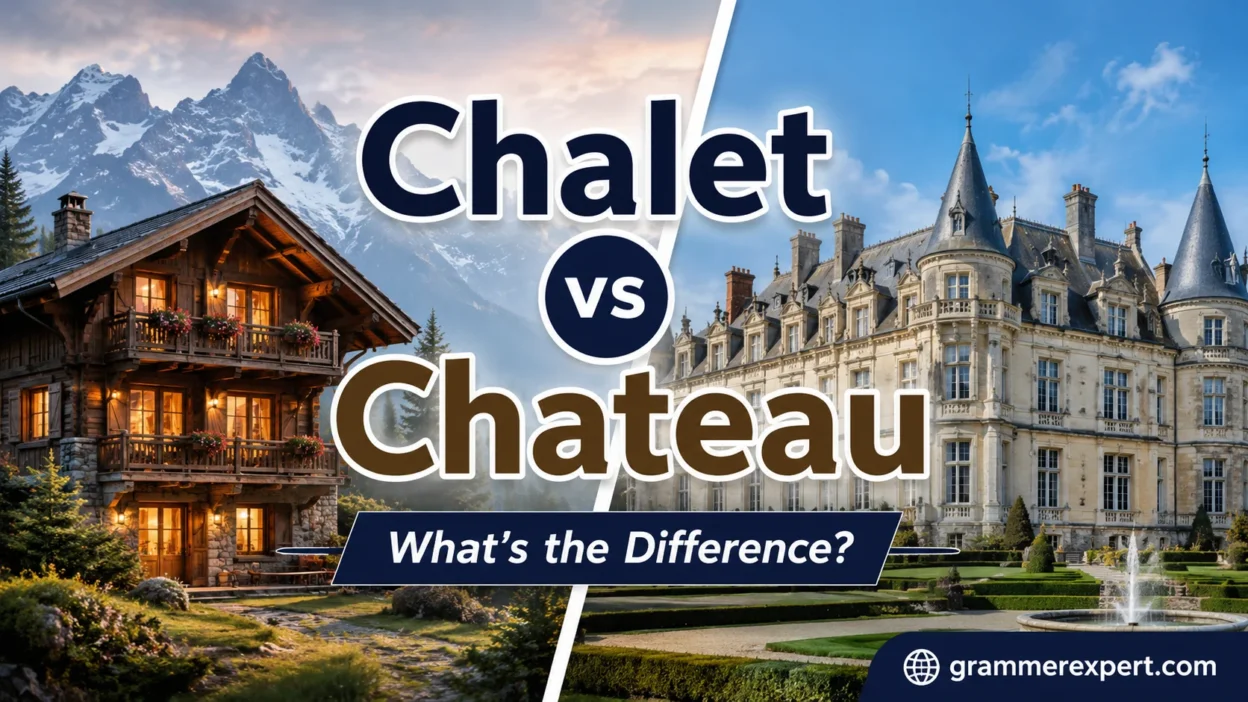
Have you ever seen the words chalet and chateau and wondered whether they mean the same thing? At first glance, they look similar because both come from French and both describe impressive homes. However, that’s where the similarities end.
A chalet is traditionally a wooden mountain house built in the Alpine regions of Europe. People often associate chalets with ski vacations, snowy landscapes, and cozy fireplaces. A chateau, on the other hand, is a grand country estate or castle, most commonly found in France. Many chateaus have centuries of history, elegant gardens, vineyards, and impressive architecture.
Mixing these words up is common, especially in travel articles, real estate listings, and casual conversations. Yet choosing the correct term makes your writing more accurate and helps readers picture the right type of property.
In this guide, you’ll discover the true difference between a chalet and a chateau, learn where each originated, explore their architectural features, compare their modern uses, and see real-world examples. By the end, you’ll know exactly which word fits each situation.
Chalet vs. Chateau at a Glance
Before diving deeper, here’s a quick comparison that highlights the key differences.
| Feature | Chalet | Chateau |
| Meaning | A mountain home or lodge | A grand French country estate or castle |
| Origin | Swiss French | French |
| Typical Location | Mountains, especially the Alps | French countryside |
| Building Material | Mostly wood and stone | Stone, brick, or masonry |
| Architecture | Rustic Alpine style | Grand historic estate style |
| Original Purpose | Shelter for herders and farmers | Residence of nobles or wealthy landowners |
| Modern Use | Vacation homes, ski lodges, luxury rentals | Historic estates, hotels, wineries, museums, private homes |
| Size | Small to large | Usually very large |
| Common Setting | Mountain regions | Countryside, vineyards, large estates |
Quick takeaway: A chalet belongs in the mountains. A chateau belongs on a grand estate.
READ MORE: Stich vs Stitch Complete Guide You Can Trust
What Is a Chalet?
A chalet is a traditional wooden house that originated in the Alpine regions of Switzerland. Although the design has evolved over time, the core idea remains the same: a comfortable home built to withstand cold mountain weather.
Today, the word often describes vacation homes in ski resorts. Modern chalets can be modest cabins or luxurious multi-million-dollar residences with panoramic mountain views.
Unlike ordinary cabins, authentic chalets follow architectural traditions that developed over hundreds of years in Alpine communities.
Definition of a Chalet
The word chalet refers to a wooden dwelling traditionally built in mountainous regions. Early chalets served as seasonal homes for shepherds and dairy farmers.
During the summer months, families moved livestock into higher elevations. Their chalets provided shelter for people, animals, and supplies while protecting everyone from harsh mountain conditions.
Modern dictionaries also define a chalet as a vacation house designed in Alpine style.
Although today’s versions often include luxury amenities, they still preserve many classic design elements.
Origin of the Word Chalet
The word chalet comes from Swiss French.
Linguists trace its roots to the Latin word cala, meaning “shelter” or “protected place.” Over time, Alpine communities adopted the term to describe the wooden houses used by farmers during seasonal grazing.
As tourism expanded throughout Europe in the nineteenth century, visitors admired these charming mountain homes. Architects soon began copying their design, leading to the worldwide popularity of the chalet style.
Today, you can find chalets far beyond Switzerland.
Popular locations include:
- Switzerland
- France
- Austria
- Germany
- Italy
- Canada
- United States
- Japan
- New Zealand
Many luxury ski resorts now feature chalet-inspired homes regardless of whether they’re located in the Alps.
Characteristics of a Chalet
A chalet has several distinctive architectural features that make it easy to recognize.
Steep Sloping Roof
Heavy snowfall demands practical design.
The steep roof allows snow to slide off naturally instead of accumulating and placing excessive weight on the structure.
Wide Roof Overhangs
Large eaves protect wooden walls and balconies from rain, snow, and melting ice.
They also create shaded outdoor spaces during warmer months.
Wooden Construction
Traditional chalets rely heavily on timber.
Builders used locally available wood because it provided excellent insulation and blended naturally with the surrounding forests.
Modern chalets may also include:
- Natural stone
- Glass walls
- Steel framing
- Sustainable materials
Even contemporary versions often maintain wooden exteriors to preserve their Alpine appearance.
Large Balconies
Balconies serve both practical and aesthetic purposes.
Historically, families dried herbs, firewood, and clothing outside. Today, balconies provide breathtaking mountain views and outdoor relaxation areas.
Open Interior Layout
Modern chalet interiors usually feature:
- High vaulted ceilings
- Exposed wooden beams
- Stone fireplaces
- Large windows
- Open living spaces
These features create a warm and inviting atmosphere while maximizing natural light.
Where Chalets Are Commonly Found
Although chalets originated in Switzerland, they now appear across many mountainous regions.
Some of the world’s most famous chalet destinations include:
| Destination | Why It’s Famous |
| Zermatt, Switzerland | Luxury ski chalets near the Matterhorn |
| Verbier, Switzerland | High-end Alpine resorts |
| Chamonix, France | World-renowned skiing and mountaineering |
| Courchevel, France | Luxury winter vacations |
| St. Anton, Austria | Traditional Alpine villages |
| Whistler, Canada | Modern mountain chalets |
| Aspen, Colorado | Premium ski properties |
| Niseko, Japan | Luxury chalets with world-famous powder snow |
These destinations attract millions of visitors every year because chalets combine comfort, privacy, and spectacular scenery.
Examples of Chalet in Sentences
Understanding how native speakers use the word makes choosing it much easier.
Here are several examples.
Travel
- We rented a beautiful chalet overlooking the snowy mountains.
- Their family spends every winter in a cozy chalet near the ski slopes.
Real Estate
- The company specializes in luxury Alpine chalets.
- Buyers often look for a modern chalet with panoramic mountain views.
Daily Conversation
- The fireplace made the chalet feel incredibly warm.
- Our vacation chalet had large windows facing the valley.
Notice that every example relates to mountain living or Alpine architecture.
Chalet vs. Chateau: Why People Confuse These Words
Despite their different meanings, many people accidentally use these terms interchangeably.
Several reasons explain the confusion.
Both Words Come From French
The similar spelling leads many readers to assume the meanings are related.
However, their histories developed in different contexts.
- Chalet refers to mountain life.
- Chateau refers to aristocratic country estates.
Their origins overlap linguistically but not architecturally.
Both Can Describe Luxury Homes
Today’s travel industry often advertises luxury chalets and luxury chateaus.
Because both properties can feature premium amenities, readers sometimes assume they’re interchangeable.
In reality, luxury doesn’t define either word.
Instead, architecture, location, and historical purpose determine the correct term.
Movies and Travel Advertising Blur the Difference
Luxury travel advertisements frequently emphasize elegance instead of historical accuracy.
For example:
- A ski resort may advertise “exclusive mountain chalets.”
- A vineyard hotel may promote “historic chateau accommodations.”
Both sound luxurious, yet they describe entirely different experiences.
Pronunciation Adds to the Confusion
Neither word follows standard English pronunciation.
Many English speakers hesitate when saying them aloud, increasing the chance they’ll confuse one with the other.
Approximate pronunciations include:
- Chalet: sha-LAY
- Chateau: sha-TOH
Once you hear them pronounced correctly, remembering the difference becomes much easier.
Chalet vs. Chateau: Quick Memory Trick
Sometimes the simplest memory trick works best.
Think about the setting.
| Word | Easy Memory Trick |
| Chalet | Think snowy chalet on a mountain. |
| Chateau | Think of a French castle surrounded by vineyards. |
Another helpful comparison is this:
A chalet belongs beside ski slopes. A chateau belongs beside vineyards and formal gardens.
That single image helps many people remember the distinction instantly.
Key Facts About Chalets
Here are some interesting facts that many readers don’t know.
- Traditional chalets were working farmhouses before becoming vacation homes.
- Many Alpine chalets are over 150 years old.
- Modern luxury chalets may include indoor pools, private cinemas, wine cellars, and spa facilities.
- The chalet architectural style inspired mountain homes around the world.
- Wood remains the defining material even in contemporary chalet construction.
“Architecture should belong to its environment where it naturally grows.” This idea perfectly reflects the design philosophy behind traditional Alpine chalets.
What Is a Chateau?
A chateau is a large country house, manor, or castle, traditionally found in France. Unlike a chalet, which developed as a practical mountain home, a chateau was built to display wealth, power, and prestige. Many chateaus served as the residences of nobles, wealthy landowners, or members of the French aristocracy.
Today, the word still refers primarily to grand estates in France. Some remain private homes, while others have become luxury hotels, museums, wineries, or event venues.
Although English speakers sometimes use chateau to describe any luxurious mansion, that isn’t technically correct. The term has a specific historical and architectural meaning.
Definition of a Chateau
A chateau is a stately residence located in the countryside. Depending on its history and design, it may resemble:
- A castle
- A fortified manor house
- A palace-like estate
- A historic mansion
Unlike medieval castles built purely for defense, many later chateaus focused on elegance and comfort. Their owners wanted impressive homes that reflected their social status.
Some famous French chateaus date back more than 500 years and remain among Europe’s most visited landmarks.
Origin of the Word Chateau
The word chateau comes from the Old French word chastel, which evolved from the Latin castellum, meaning castle or fortified place.
During the Middle Ages, many French nobles built fortified residences across the countryside. As warfare declined and architecture evolved, these buildings became more refined. Defensive walls gave way to decorative facades, landscaped gardens, and luxurious interiors.
Eventually, the word chateau came to describe elegant country estates rather than military fortresses.
Today, France has thousands of historic chateaus spread across nearly every region.
Characteristics of a Chateau
Although every chateau is unique, most share several recognizable features.
Large Stone Construction
Unlike chalets, which primarily use timber, chateaus rely on durable materials such as:
- Limestone
- Granite
- Sandstone
- Brick
- Masonry
These materials allowed builders to create massive structures designed to last for centuries.
Elegant Architecture
A traditional French chateau often includes:
- Decorative towers
- Symmetrical facades
- Ornate windows
- Grand staircases
- Formal entrances
- Slate roofs
- Decorative chimneys
Many famous examples combine Gothic, Renaissance, Baroque, and Classical architectural styles.
Extensive Grounds
A chateau rarely stands alone.
Most occupy large estates that include:
- Formal gardens
- Vineyards
- Forests
- Lakes
- Courtyards
- Horse stables
- Guest houses
Some estates cover hundreds or even thousands of acres.
Luxurious Interiors
Walking inside a historic chateau often reveals:
- Marble fireplaces
- Crystal chandeliers
- Painted ceilings
- Antique furniture
- Private libraries
- Ballrooms
- Art collections
These homes were designed to impress visitors while providing comfortable living spaces for noble families.
Where Chateaus Are Commonly Found
France remains the heart of chateau architecture.
Some of the country’s most famous regions include:
| Region | Why It’s Famous |
| Loire Valley | Hundreds of Renaissance chateaus |
| Bordeaux | Wine-producing chateau estates |
| Burgundy | Historic vineyard properties |
| Dordogne | Medieval castles and estates |
| Normandy | Historic manor houses |
| Champagne | Vineyard chateaus producing sparkling wine |
The Loire Valley alone contains more than 300 historic chateaus, earning its reputation as one of France’s greatest cultural treasures.
Outside France, the word sometimes appears in Canada, Belgium, and the United States, though these buildings usually borrow the French architectural style rather than carrying the same historical significance.
Examples of Chateau in Sentences
Using the word correctly becomes much easier with practical examples.
History
- The royal family spent summers at the magnificent chateau.
- Historians restored the medieval chateau after decades of preservation work.
Travel
- We toured a beautiful chateau surrounded by vineyards.
- The hotel occupies a restored seventeenth-century chateau.
Real Estate
- The investor purchased a historic French chateau.
- Their dream vacation included staying at a luxury chateau in the Loire Valley.
Notice that every example refers to a grand estate rather than a mountain retreat.
Chalet vs. Chateau: Side-by-Side Comparison
Although both words describe distinctive homes, they differ in nearly every meaningful way.
| Feature | Chalet | Chateau |
| Meaning | Mountain house or lodge | Grand French estate or castle |
| Origin | Swiss Alps | France |
| Traditional Purpose | Shelter for farmers and herders | Residence for nobility |
| Building Material | Wood and stone | Stone and masonry |
| Setting | Mountains | Countryside |
| Roof Design | Steep sloping roof | Decorative slate or tile roofs |
| Size | Small to large | Usually very large |
| Interior Style | Cozy and rustic | Elegant and luxurious |
| Modern Use | Vacation home or ski lodge | Hotel, winery, museum, estate |
| Atmosphere | Warm and casual | Formal and historic |
This comparison shows why the terms shouldn’t replace one another.
The Biggest Differences Between a Chalet and a Chateau
Understanding the details helps you choose the correct word every time.
Architecture
A chalet embraces practicality.
Builders designed it to survive harsh Alpine winters with steep roofs, wooden walls, and compact layouts.
A chateau emphasizes grandeur.
Architects focused on symmetry, decorative details, and impressive proportions that reflected wealth and influence.
Building Materials
Traditional chalets rely heavily on timber because wood insulates well and was readily available in mountain forests.
Chateaus use stone and masonry, allowing the buildings to stand for centuries while showcasing craftsmanship.
Location
Location may be the easiest way to distinguish the two.
A chalet belongs in mountainous areas.
A chateau belongs in the countryside, often surrounded by farmland, vineyards, forests, or formal gardens.
Historical Purpose
Originally, chalets supported everyday agricultural life.
Farmers lived in them seasonally while caring for livestock.
Chateaus served an entirely different audience.
French nobles built them as permanent residences that displayed power, wealth, and family heritage.
Lifestyle
Life inside a chalet centers around comfort and outdoor recreation.
Visitors often enjoy:
- Skiing
- Hiking
- Snowboarding
- Mountain biking
- Relaxing by the fireplace
Life at a chateau traditionally revolved around:
- Estate management
- Formal entertaining
- Hunting
- Wine production
- Social gatherings
The experiences couldn’t feel more different.
Modern Purpose
Today’s chalets have become popular vacation rentals.
Many include:
- Hot tubs
- Home theaters
- Floor-to-ceiling windows
- Heated ski rooms
- Wellness spas
Modern chateaus often operate as:
- Luxury hotels
- Wedding venues
- Museums
- Boutique wineries
- Cultural attractions
Many still remain private family estates.
Investment Value
Luxury chalets command premium prices in world-famous ski destinations.
Properties in places like Aspen, Verbier, and Courchevel often sell for several million dollars because land is limited.
Historic French chateaus vary widely in price.
Some smaller estates sell for less than luxury city apartments due to restoration costs. Others, especially fully restored landmark properties with vineyards, sell for tens of millions of dollars.
The purchase price often reflects maintenance needs as much as prestige.
Tourism Appeal
Both property types attract travelers, but for different reasons.
People visit chalets to experience:
- Winter sports
- Mountain scenery
- Cozy accommodations
- Outdoor adventures
Visitors choose chateaus to enjoy:
- Historic architecture
- Wine tasting
- Fine dining
- Gardens
- Cultural heritage
Each offers a unique travel experience.
Similarities Between Chalets and Chateaus
Despite their obvious differences, these buildings share a few characteristics.
Both Have European Origins
Both architectural styles developed in Europe and continue to influence home design around the world.
Both Reflect Local Traditions
Each building evolved to meet regional needs.
Chalets adapted to mountain climates.
Chateaus reflected French history, politics, and aristocratic culture.
Both Can Be Luxury Properties
Modern buyers often invest millions in high-end chalets and restored chateaus.
Luxury doesn’t define either term, but both property types have become symbols of premium real estate.
Both Attract Tourists
Thousands of visitors travel every year to stay in authentic Alpine chalets or tour famous French chateaus.
These experiences combine architecture, history, and regional culture.
Chalet vs. Chateau in Real Estate
Real estate professionals use these terms carefully because they describe specific property styles.
Buying a Chalet
People usually purchase chalets for:
- Vacation homes
- Ski holidays
- Rental income
- Seasonal retreats
Demand remains especially strong in world-class mountain resorts.
Buying a Chateau
Owning a chateau often requires a larger long-term commitment.
Buyers should consider:
- Restoration expenses
- Historic preservation rules
- Property taxes
- Estate maintenance
- Landscaping costs
Many owners transform historic chateaus into successful hotels, vineyards, or event venues.
Case Study: A restored Loire Valley chateau that once stood vacant now operates as a boutique hotel and wedding venue. By preserving its historic architecture while adding modern amenities, the owners created a thriving tourism business that attracts visitors from around the world.
Chalet vs. Chateau in Travel
Travel guides often mention both chalets and chateaus, yet they promise completely different experiences. Choosing the right accommodation depends on the type of vacation you want.
If your dream trip includes snow-covered mountains, skiing, and evenings beside a crackling fireplace, a chalet is the better choice. If you prefer history, elegant architecture, vineyards, and countryside views, a chateau offers a memorable stay.
When to Choose a Chalet
A chalet is ideal if you enjoy nature and outdoor adventures. Most are located in mountain regions where every season brings something unique.
Choose a chalet if you want to:
- Stay close to ski slopes.
- Enjoy hiking and mountain biking.
- Relax in a private hot tub with mountain views.
- Spend evenings around a fireplace.
- Experience traditional Alpine architecture.
- Escape busy cities.
Many luxury chalets now include modern features such as:
- Private spas
- Heated indoor pools
- Home theaters
- Wine cellars
- Floor-to-ceiling windows
- Concierge services
Despite these upgrades, they still preserve the cozy atmosphere that makes chalets so popular.
When to Choose a Chateau
A chateau offers an entirely different experience. Instead of mountain adventures, you’ll enjoy history, art, and French culture.
A chateau is an excellent choice if you want to:
- Tour historic estates.
- Visit famous vineyards.
- Explore Renaissance architecture.
- Stay in a luxury countryside hotel.
- Enjoy gourmet French cuisine.
- Attend weddings or special events.
Many restored chateaus now operate as boutique hotels that combine historic charm with modern comfort.
Guests often enjoy:
- Wine tastings
- Garden tours
- Fine dining
- Cooking classes
- Guided history tours
- Spa treatments
Each stay feels like stepping into another era.
Common Mistakes People Make
Even experienced travelers and writers occasionally confuse these terms. Avoiding a few common mistakes will help you use each word correctly.
Calling Every Luxury House a Chateau
A large mansion isn’t automatically a chateau.
The word traditionally refers to historic French country estates or buildings inspired by that architectural style.
Simply being expensive doesn’t qualify a property as a chateau.
Assuming Every Mountain Cabin Is a Chalet
Many cabins resemble chalets, but not every cabin follows Alpine architecture.
A true chalet usually features:
- Steep roofs
- Wide eaves
- Wooden construction
- Large balconies
- Mountain design principles
Small log cabins or lakeside cottages generally aren’t considered chalets.
Ignoring Location
Location offers one of the easiest clues.
A chalet belongs in mountainous regions.
A chateau belongs to a large countryside estate.
Although modern builders sometimes copy these styles elsewhere, their origins remain important.
Mispronouncing the Words
Because both words come from French, their pronunciation often surprises English speakers.
Learning the correct pronunciation helps you sound more confident when traveling or discussing architecture.
Pronunciation Guide
| Word | IPA Pronunciation | Easy Pronunciation |
| Chalet | /ʃæˈleɪ/ | sha-LAY |
| Chateau | /ʃæˈtoʊ/ | sha-TOH |
The endings make the biggest difference.
- Chalet ends with “lay.”
- Chateau ends with “toe.”
Chalet vs. Chateau: Which Word Should You Use?
Choosing the correct word becomes simple once you focus on the property’s purpose and setting.
Use “Chalet” When…
Use chalet if you’re describing:
- A mountain home.
- A ski lodge.
- An Alpine-style vacation house.
- A wooden retreat.
- A snowy mountain getaway.
Examples
- We booked a luxury chalet in the Swiss Alps.
- Their chalet overlooks a beautiful ski valley.
- The family spent Christmas in a cozy mountain chalet.
Use “Chateau” When…
Use chateau if you’re referring to:
- A French country estate.
- A historic manor.
- A castle-like residence.
- A vineyard estate.
- A grand countryside property.
Examples
- We toured a seventeenth-century chateau in the Loire Valley.
- The wedding took place at a magnificent French chateau.
- Several famous wineries operate from historic chateaus.
Can a Chalet Also Be a Chateau?
Generally, no.
The two words describe different architectural traditions, different locations, and different historical purposes.
A chalet remains a mountain residence rooted in Alpine culture.
A chateau remains a grand French estate associated with nobility and historic country living.
However, modern architecture occasionally blends styles.
For example, a luxury estate in the mountains might borrow decorative elements from French chateaus while still functioning as a chalet. Likewise, a contemporary mansion could include Alpine-inspired interiors without becoming a traditional chalet.
These examples are architectural influences rather than true definitions.
Related Terms You Should Know
Many people confuse chalets and chateaus with other types of homes. Understanding these related terms makes the differences even clearer.
| Term | Meaning |
| Cabin | A small, simple house, usually located in forests or rural areas. |
| Cottage | A cozy countryside home, often modest in size. |
| Lodge | A large accommodation used by travelers, hunters, or skiers. |
| Villa | A spacious private residence, often found in warm climates. |
| Manor | A historic country house associated with landed estates. |
| Castle | A fortified building built primarily for defense. |
| Estate | A large property containing land and one or more buildings. |
| Mansion | A very large and luxurious private home. |
Knowing these distinctions improves both your writing and your understanding of architecture.