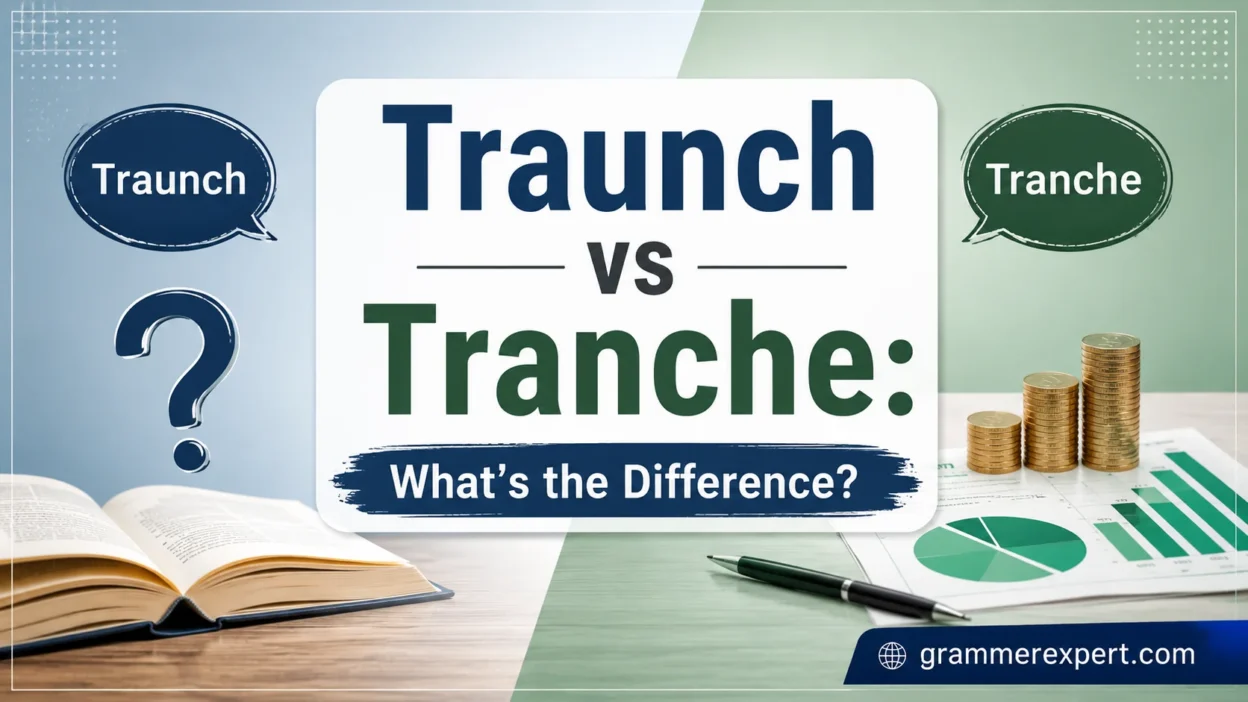
If you’ve searched for “traunch vs tranche,” you’re not alone. Thousands of people type “traunch” into search engines every month, wondering whether it’s a legitimate English word or simply a misspelling. The confusion makes sense because tranche isn’t a word you hear in everyday conversations. It appears most often in finance, investing, banking, and business documents, which makes it unfamiliar to many readers.
Here’s the short answer: tranche is the correct spelling. Traunch is almost always a spelling mistake.
Although they look similar, only one belongs in professional writing. Whether you’re reading about mortgage-backed securities, venture capital funding, or government grants, you’ll encounter tranche, not traunch.
This guide explains everything you need to know. You’ll learn the meaning of tranche, why people misspell it, how professionals use it, and simple tricks to remember the correct spelling forever.
Quick Answer: Is It “Traunch” or “Tranche”?
The correct word is tranche.
The spelling traunch isn’t recognized as a standard English word in major dictionaries. In nearly every situation, it’s simply a typo or spelling error.
Here’s a quick comparison.
| Feature | Traunch | Tranche |
| Correct English spelling | ❌ No | ✅ Yes |
| Recognized in dictionaries | ❌ No | ✅ Yes |
| Part of speech | None | Noun |
| Used in finance | ❌ No | ✅ Yes |
| Should you use it? | ❌ Never | ✅ Yes |
If you’re writing an email, business report, financial article, or academic paper, always choose tranche.
READ MORE: Bearable vs. Bareable What’s the Difference?
What Does “Tranche” Mean?
Definition
A tranche is a portion, section, or share of something larger. The word usually describes money, investments, loans, securities, or funding that someone divides into separate parts.
Instead of giving or receiving everything at once, organizations often release resources in tranches. Each tranche follows its own schedule, conditions, or level of risk.
For example:
- A company raises $100 million through three funding tranches.
- A government releases aid in multiple tranches.
- A bank approves a construction loan in stages rather than paying the full amount immediately.
In each example, tranche simply means one part of a larger whole.
Origin and Etymology
The word tranche comes from French, where it originally meant a slice or portion cut from something.
English later adopted the term, especially in business and finance. While the original idea referred to physical slices, modern English mainly uses tranche for dividing money, investments, debt, or funding.
The underlying concept hasn’t changed.
Whether you’re slicing bread or dividing a billion-dollar investment fund, the idea remains the same: breaking one large thing into smaller parts.
Common Pronunciation
Many English speakers hesitate when they first see tranche because the spelling doesn’t match typical English pronunciation.
The standard pronunciation is:
trahnsh
Phonetic pronunciation:
/trɑːnʃ/
The ending sounds like:
- Blanche
- Avalanche (last sound)
- Cache
The final letters “che” produce a soft “sh” sound rather than a hard “ch.”
Why the Word Is Used in Finance
Finance often involves enormous amounts of money. Instead of moving billions of dollars at once, lenders and investors reduce risk by dividing transactions into manageable sections.
Each tranche may have:
- Different repayment terms
- Different interest rates
- Different maturity dates
- Different risk levels
- Different investor priorities
This structure makes investments easier to manage while giving investors choices based on their risk tolerance.
What Does “Traunch” Mean?
Is It an English Word?
No.
Traunch isn’t recognized as a standard English word by major dictionaries or style guides.
When someone writes traunch, they almost always intended to write tranche.
Unlike many spelling variants such as color/colour or organize/organise, traunch isn’t an accepted alternative in either American or British English.
Why It Appears Online
If traunch isn’t a real word, why does it appear so often in search results?
There are several reasons.
Many people have only heard tranche spoken aloud. Because the pronunciation sounds unusual, they guess the spelling based on how it sounds.
Others accidentally type traunch because the letters “au” appear in many English words such as:
- Launch
- Haunch
- Gaunt
As a result, their brains naturally substitute familiar spelling patterns.
Search engines understand this behavior and often redirect users toward tranche.
Common Misspelling Causes
Several factors contribute to the mistake.
- The word comes from French.
- It isn’t commonly taught in school.
- Most people encounter it only in financial news.
- English pronunciation doesn’t match the spelling.
- Autocorrect doesn’t always catch the error immediately.
The good news is that once you understand the origin of the word, remembering the correct spelling becomes much easier.
Traunch vs Tranche: Side-by-Side Comparison
The differences become obvious when viewed together.
| Feature | Traunch | Tranche |
| Correct spelling | ❌ No | ✅ Yes |
| Dictionary entry | No | Yes |
| Origin | None | French |
| Meaning | Misspelling | Portion or share |
| Used professionally | No | Yes |
| Finance term | No | Yes |
| Appears in legal documents | No | Yes |
| Acceptable in academic writing | No | Yes |
The comparison couldn’t be clearer.
Whenever you mean a portion of funding, investment, or debt, the correct word is tranche.
How to Pronounce “Tranche”
Phonetic Spelling
Most dictionaries write the pronunciation as:
/trɑːnʃ/
An easy pronunciation guide is:
trahnsh
Avoid saying:
- Tran-chee
- Tran-ch
- Traunch
The final sound is always “sh.”
American Pronunciation
In American English, speakers usually stress the first syllable.
TRAHNSH
The vowel sounds similar to the a in father.
British Pronunciation
British English uses almost the same pronunciation.
Although the vowel quality may differ slightly depending on the accent, the ending remains the same “sh” sound.
Tips to Remember the Pronunciation
Here are a few memory tricks.
- Think of tranche as rhyming with blanche.
- Remember that it’s a French loanword.
- Ignore the final “che.” It sounds like “sh.”
- Listen to financial news presenters. They consistently pronounce it trahnsh.
Practice saying it aloud a few times.
Soon it will sound completely natural.
When to Use “Tranche”
In Banking and Finance
Banks frequently release loans in several tranches instead of providing the full amount immediately.
For example, imagine a construction company receives a $20 million loan.
Rather than transferring the entire amount on day one, the bank may divide the loan into several tranches tied to construction milestones.
Each payment arrives after inspectors confirm that work has progressed according to plan.
This approach protects both the lender and the borrower.
In Investing
Investment firms also rely heavily on tranches.
Suppose an investment fund plans to invest $50 million in a growing technology startup.
Instead of providing the entire investment upfront, the firm releases funding in stages.
The startup receives additional tranches only after meeting agreed performance goals.
This strategy encourages responsible growth while reducing investment risk.
In Loans and Credit Facilities
Businesses often negotiate revolving credit facilities with banks.
Rather than drawing every available dollar immediately, they access separate tranches whenever operational needs arise.
For example:
- Expansion funding
- Equipment purchases
- Inventory financing
- Emergency cash flow
Each tranche may have unique repayment schedules and interest rates.
In Business Transactions
Large acquisitions rarely happen through a single payment.
Instead, buyers often divide payments into multiple tranches based on contractual milestones.
For example:
- Initial payment upon signing
- Payment after regulatory approval
- Final payment after successful integration
This arrangement protects both parties throughout the acquisition process.
In Government Funding
Governments commonly distribute public funding in tranches.
Infrastructure projects, education initiatives, healthcare improvements, and disaster recovery programs often receive staged funding rather than one lump-sum payment.
Officials monitor progress before approving the next tranche.
Doing so increases accountability and reduces financial waste.
In International Aid
International organizations frequently release humanitarian assistance in multiple tranches.
Instead of sending every dollar immediately, funding follows measurable milestones such as:
- Project completion
- Financial reporting
- Independent audits
- Community outcomes
This process ensures that aid reaches its intended purpose efficiently.
Real-World Examples of “Tranche”
Understanding the word becomes easier when you see it in context.
Mortgage-Backed Securities
One of the best-known uses of tranche appears in mortgage-backed securities (MBS).
Banks combine thousands of mortgages into one investment product.
Instead of selling identical investments, they divide the product into several tranches.
Each tranche carries a different level of risk and expected return.
For example:
| Tranche | Risk Level | Expected Return |
| Senior | Low | Lower |
| Mezzanine | Medium | Moderate |
| Equity | High | Highest |
Conservative investors often prefer senior tranches because they receive payments first.
Aggressive investors may choose equity tranches for the possibility of higher returns.
Venture Capital Funding
Startups rarely receive every investment dollar on the first day.
Instead, venture capital firms often release funding in stages.
Imagine a software startup raising $12 million.
The investment agreement might look like this:
| Funding Stage | Amount |
| Initial tranche | $3 million |
| Product launch tranche | $4 million |
| Revenue milestone tranche | $5 million |
Each release depends on achieving measurable business goals.
Corporate Bond Issuance
Large corporations sometimes issue bonds in several tranches instead of offering one uniform investment.
Different tranches may include varying:
- Interest rates
- Maturity dates
- Currency denominations
- Investor requirements
This flexibility attracts a wider range of investors.
Continuing the article from the previous section. This part maintains the same formatting, tone, and SEO focus while using only one H1 in the complete article and bold H2 and H3 headings throughout.
Real-World Examples of “Tranche”
Private Equity Investments
Private equity firms often structure investments in multiple tranches rather than transferring the entire amount at once. This approach allows investors to manage risk while giving companies the capital they need to grow.
For example, a private equity firm may acquire a manufacturing business for $80 million. The agreement could include:
- An initial tranche to complete the purchase
- A second tranche for factory expansion
- A third tranche tied to revenue growth targets
- A final tranche for international market expansion
Each payment depends on agreed milestones. As a result, both the investor and the company share responsibility for success.
Government Grants
Government agencies often distribute grants in phases. Instead of giving an organization the full grant amount upfront, they release funds in tranches after progress reports and audits.
Consider a city receiving $25 million for infrastructure improvements:
| Grant Phase | Amount | Purpose |
| First tranche | $5 million | Planning and permits |
| Second tranche | $10 million | Construction start |
| Third tranche | $7 million | Mid-project completion |
| Final tranche | $3 million | Final inspections and reporting |
This method improves accountability and helps ensure public funds are used effectively.
Example Sentences Using “Tranche”
Everyday Examples
Although tranche appears mainly in finance, you can still use it in broader contexts when discussing portions of a larger amount.
Examples:
- The foundation released the next tranche of scholarships after reviewing applications.
- The company delivered the first tranche of products in June.
- The nonprofit received a second tranche of donations to continue its work.
- The publisher released the book rights in several tranches to different regions.
These examples show that tranche means a clearly defined portion of something larger.
Business Examples
In business communication, the word appears frequently in contracts and reports.
Examples:
- The board approved the first tranche of investment for the new project.
- The company expects to receive the second tranche of funding next quarter.
- Management tied the final tranche to specific performance metrics.
- The merger agreement included several payment tranches spread over two years.
Financial Examples
Financial professionals use the term with precision.
Examples:
- Investors purchased the senior tranche because it carried lower risk.
- The bank structured the debt into multiple tranches with different interest rates.
- The equity tranche offered higher potential returns along with greater risk.
- The lender released the final tranche after the borrower met all conditions.
Why People Misspell “Tranche” as “Traunch”
Pronunciation Confusion
English spelling can feel like a maze with missing signs. You hear trahnsh and naturally expect to see traunch because words like launch and haunch follow that pattern.
However, tranche follows French pronunciation rules rather than standard English spelling conventions.
Typing Errors
Some mistakes happen because of speed rather than misunderstanding. A writer may know the correct word yet accidentally type traunch during a fast drafting session.
That’s why editing matters. Even experienced writers make small mistakes.
Lack of Familiarity With French Loanwords
English contains thousands of borrowed words from French:
- Résumé
- Genre
- Ballet
- Cache
- Tranche
These words often keep their original pronunciation patterns. Once you recognize tranche as a French loanword, the spelling becomes easier to remember.
Autocorrect and Search Behavior
Search engines have become smarter. If you type traunch, many search engines automatically suggest tranche because they recognize it as the intended term.
Still, autocorrect isn’t perfect. It’s always wise to proofread professional documents before sending them.
Words Commonly Confused With “Tranche”
Branch vs Tranche
The words look similar but mean very different things.
| Word | Meaning | Example |
| Branch | A division of an organization or part of a tree | The company opened a new branch in Dallas. |
| Tranche | A portion of money or an investment | The bank approved the first tranche of funding. |
Launch vs Tranche
Many people type traunch because they unconsciously connect the word to launch.
| Word | Meaning | Example |
| Launch | To begin or introduce something | The startup will launch its new app next month. |
| Tranche | A portion of a larger amount | The startup received another tranche of funding. |
Trench vs Tranche
Another source of confusion comes from trench, which sounds similar.
| Word | Meaning | Example |
| Trench | A long narrow ditch | Workers dug a trench for the water line. |
| Tranche | A share or portion | The lender released a second tranche of the loan. |
Transit vs Tranche
These words share some letters yet have no relationship.
| Word | Meaning | Example |
| Transit | The act of moving from one place to another | Public transit helps reduce traffic. |
| Tranche | A divided share of funding or assets | The investment arrived in three tranches. |
Similar Financial Terms You Should Know
Installment
An installment is a scheduled payment made over time. While a tranche refers to a portion of funding or investment, an installment usually refers to a payment obligation.
Example:
- You receive a tranche of funding.
- You pay a loan in installments.
Allocation
An allocation is the act of distributing resources among different people, projects, or investments.
Example:
- A portfolio manager determines the allocation.
- The fund may then release the money in tranches.
Portion
A portion is a general term that means part of a whole. Tranche is more specific and appears mostly in finance, law, and business.
Segment
A segment refers to a distinct section of something, such as a market segment or customer segment.
Share
A share can mean ownership in a company or simply a part of something larger.
Allocation vs Tranche
The distinction matters in professional communication.
| Term | Meaning | Primary Use |
| Tranche | A specific portion released or structured separately | Finance, lending, investments |
| Allocation | The process of distributing resources | Management, investing, budgeting |
| Installment | A payment made at intervals | Loans, consumer finance |
| Share | A portion of ownership or distribution | Investing, general use |
Quick takeaway: Think of an allocation as the plan, a tranche as the released portion, and an installment as the repayment.