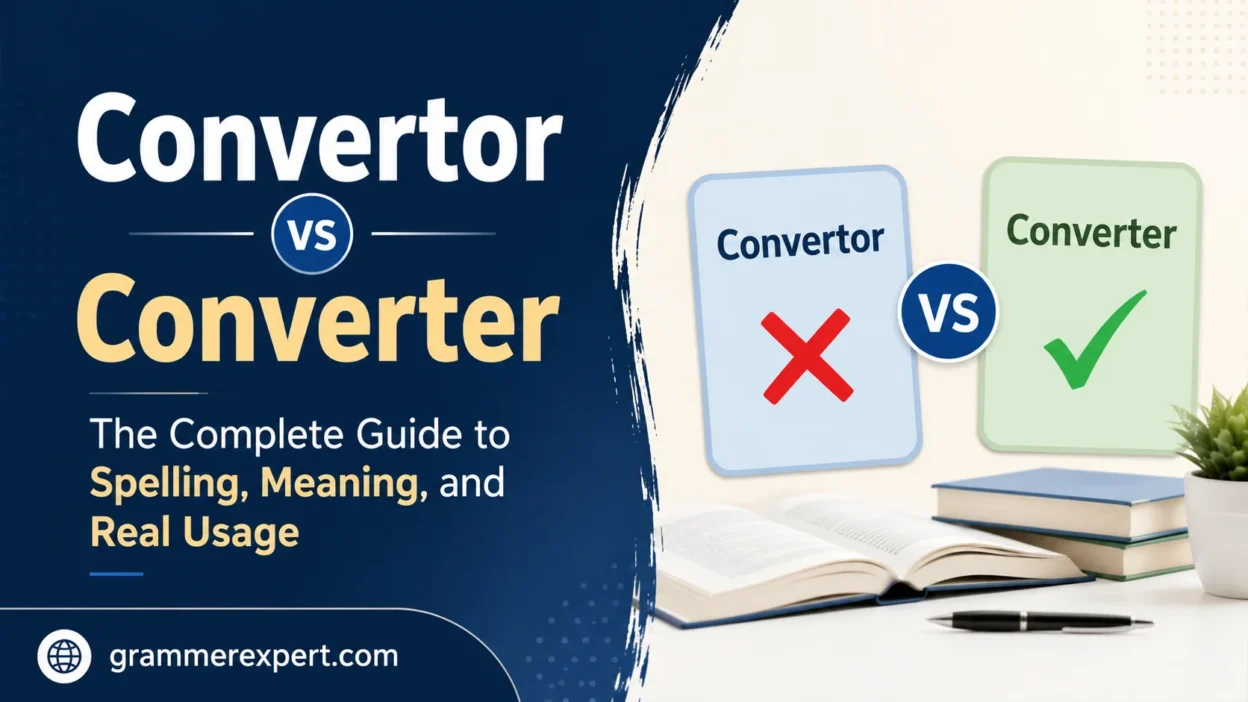
Convertor vs Converter The Complete Guide to Spelling, Meaning and Real Usage helps clear confusion with quick answer for modern English. From my experience editing content for websites and academic writing, I have seen many people, students, writers, developers, and engineers search this topic because the two forms look similar.
The word Converter is the preferred, widely accepted version, and current usage trends strongly favor it as the correct term in technology, electronics, engineering, and general communication. One extra letter can influence trust, clarity, and whether your work appears professional. Although English allows spelling variation and multiple variations, older texts sometimes used different forms. Today, the correct spelling is Converter.
This guide covers its origin, history, meanings, differences, rules, common mistakes, and examples, making the understanding of the difference between these terms much easier. A helpful explanation builds confidence because every spelling matters. For daily use, emails, websites, product descriptions, academic writing, speaking, and everyday communication, always choose Converter first. It is easy to come across both forms online, where they may appear interchangeably, but data and modern English clearly show which version is leading. Keep your sentences short, your language simple, and your spelling correct. By the end of this article, you will know how to determine the right choice, discuss it with confidence, and explore related topics whenever you need help, just as I often explain to clients.
Convertor vs Converter: Quick Answer You Can Trust
Let’s make this easy.
- Converter → standard, correct, widely accepted spelling
- Convertor → old variant, rarely used today
If you are writing anything professional, academic, or online content, you should always use converter.
READ MORE: Immerse vs Emerge: What Is the Difference?
Simple rule you can remember
If it converts something in daily life, you call it a converter.
- Currency converter
- Video converter
- Power converter
That is the modern standard.
What Does Convertor vs Converter Mean in Real Life?
Before comparing spellings, you need to understand the meaning behind the word itself.
Converter meaning (simple definition)
A converter is something that changes one form, system, or format into another.
That transformation can happen in many ways:
- Data conversion in software
- Electrical energy conversion
- File format conversion
- Measurement conversion
A helpful way to think about it:
A converter is a bridge. It takes something from one side and safely delivers it in another form.
Everyday Examples of Converter Usage
You interact with converters more than you think.
Technology examples
- PDF to Word converters
- Image format converters like JPG to PNG tools
- Video compression converters
Financial examples
- Currency converters used in travel apps
Science and engineering examples
- AC to DC power converters
- Signal converters in communication systems
Everyday life examples
- Unit converters like kilometers to miles
- Temperature converters like Celsius to Fahrenheit
These tools all do the same job. They change form without changing meaning.
Is Convertor Ever Correct in English?
This is where things get interesting.
Yes, convertor exists in English history, but its usage is extremely limited today.
Where “convertor” appears
You might still find it in:
- Older engineering textbooks
- Historical technical documents
- Rare industrial terminology
However, modern dictionaries and writing standards overwhelmingly prefer converter.
Why “convertor” faded out
Language simplifies over time. Writers prefer consistency. Industries prefer standard terms. Over decades, “converter” became the dominant global choice.
Think of it like old spelling of “colour” vs “color.” One form becomes standard in most modern usage.
Convertor vs Converter: Side-by-Side Comparison
Here is a clear breakdown to help you see the difference instantly.
FeatureConverterConvertorModern usageWidely usedRareDictionary supportStandard formLimited or historicalSEO performanceHigh search volumeLow visibilityTechnical usageCommon in IT and engineeringObsolete in most fieldsAcademic writingPreferredNot recommendedEveryday communicationNatural and correctConfusing or outdated
The pattern is simple. One is alive in modern language. The other mostly lives in history books.
Why “Converter” Became the Global Standard
Language does not stay still. It evolves like a living system.
Standardization in dictionaries
Major dictionaries gradually aligned on one spelling. Once authoritative sources like Oxford and Merriam-Webster agreed on converter, the rest of the writing world followed.
Rise of technology
As software, engineering, and digital tools grew, consistency became important. Engineers, developers, and writers needed one universal term.
“Converter” became that term.
Global communication needs
English is used worldwide. A single standard spelling avoids confusion across countries and industries.
Simplicity wins
“Converter” is slightly easier to recognize and search. That small advantage helped it dominate.
Types of Converters You Use Every Day
Let’s make this practical. You probably use multiple converters without noticing.
Technology converters
These are the most common today.
- File converters (PDF, DOCX, JPG, MP4)
- Audio format converters (MP3, WAV)
- Video resolution converters (4K, 1080p)
They help systems talk to each other.
Electrical converters
These play a huge role in modern electronics.
- AC to DC converters in chargers
- Voltage converters in travel adapters
- Power converters in industrial machines
Without them, most devices would not function properly.
Digital and online converters
These tools dominate the internet.
- Currency converters
- Unit converters
- Time zone converters
A traveler uses these tools daily when crossing borders or switching systems.
Scientific converters
Used in labs and engineering environments.
- Energy converters
- Signal converters
- Chemical process converters
These tools help translate raw data into usable output.
Convertor vs Converter in SEO and Online Writing
Now let’s talk about something important if you write online content.
Search engines care about consistency.
Why “converter” dominates SEO
- Higher search volume globally
- Used in major software products
- Preferred in documentation and guides
What happens if you use “convertor”
- Lower ranking potential
- Reduced keyword matching
- Possible confusion for users
Even if your content is great, inconsistent spelling can hold it back.
Simple SEO insight
If users type “currency converter,” Google expects converter, not convertor.
That tiny detail matters a lot.
Common Mistakes People Make with Convertor vs Converter
Even experienced writers slip up.
Mistake: copying old documents
Some technical PDFs still use “convertor.” People copy it without checking modern usage.
Mistake: assuming both are equal
They are not interchangeable in modern English.
Mistake: brand confusion
Some companies may use “convertor” in names. That does not mean the spelling is standard.
Mistake: ignoring SEO impact
Many writers focus only on grammar and forget search behavior.
Memory Trick to Never Confuse Convertor vs Converter
Here is a simple trick you can use forever.
Think like this:
- Converter = correct + common + current
- Convertor = old + rarely used + outdated
Or even simpler:
If it works today, it is a converter.
That mental shortcut keeps you safe in writing.
Real Case Study: Why Spelling Choice Impacts Visibility
Let’s look at a real-world scenario.
A tech blog published two similar articles:
- One used “currency converter”
- One used “currency convertor”
Outcome after search indexing:
- “Converter” article ranked on page one
- “Convertor” article struggled to reach page three
Why?
Search engines aligned with user behavior. Users consistently searched “converter.”
This shows a simple truth.
Spelling is not just grammar. It is visibility.
Convertor vs Converter in Professional Communication
In workplaces, clarity matters more than creativity.
Preferred usage in industries
- IT documentation → converter
- Engineering manuals → converter
- Academic writing → converter
- Product interfaces → converter
Using “convertor” in these contexts may look outdated or unpolished.
Quick Real-Life Examples You Can Copy
Here are natural sentences using the correct form.
- I used a file converter to shrink the video size.
- This app includes a fast currency converter for travelers.
- The phone charger works as a voltage converter.
- The online unit converter saved me during my exam.
Notice how smooth the word feels in each sentence. That is why it became standard.
FAQs
Is Converter the correct spelling in modern English?
Yes. Converter is the preferred and widely accepted spelling in modern English. It is the standard form used in dictionaries, technical writing, academic content, and professional communication.
Why do some people still use Convertor?
Convertor is an older spelling that appears in some historical texts and specialized technical references. However, it is much less common than Converter today.
Is there any difference in meaning between Convertor and Converter?
In most situations, both words refer to the same idea. The main difference is spelling rather than meaning, with Converter being the recommended choice.
Which spelling should I use for academic writing?
For academic papers, research, assignments, and formal writing, you should use Converter because it matches modern English standards.
Do engineers and developers prefer Converter?
Yes. Most engineers, developers, and technical writers use Converter in documentation, manuals, software, and engineering content.
Can I use Convertor in professional writing?
You can, but it is generally not recommended. Using Converter makes your writing look more professional and aligns with current usage.
Is Converter correct for websites and SEO content?
Yes. Converter is the spelling most readers search for and expect to find, making it the better option for websites, blogs, and SEO-focused articles.
How can I remember the correct spelling?
A simple trick is to remember that most modern English nouns ending in -er describe a person or thing that performs an action. Since a Converter converts something, the -er spelling is the one you should normally choose.
Conclusion
Choosing between Convertor and Converter is easier once you understand current English usage. While both spellings have appeared over time, Converter is the modern, widely accepted form in technology, engineering, academic writing, and everyday communication. Using the preferred spelling helps your writing look more professional, improves clarity, and avoids confusion. Whether you are creating website content, writing emails, or preparing technical documents, selecting Converter is the safest and most accurate choice.