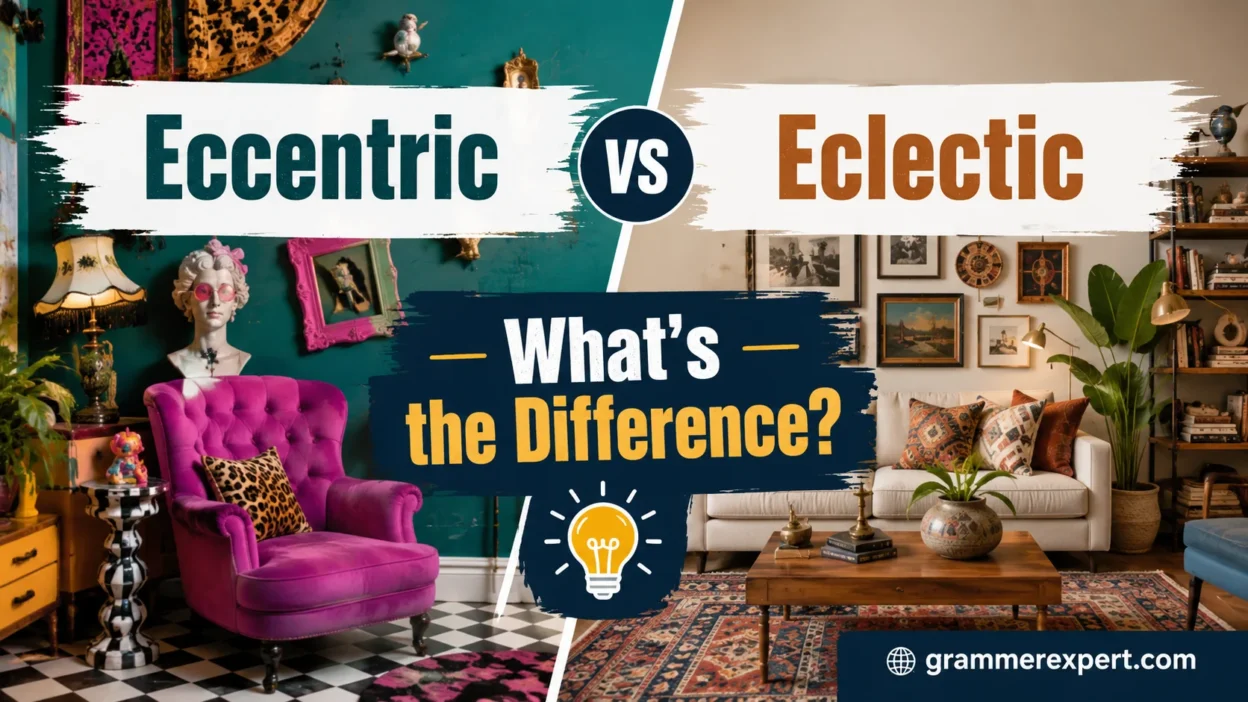
Many people feel confused, but Eccentric vs Eclectic: What’s the Difference? becomes easy when you understand each meaning clearly. Confusion often happens because eccentric and eclectic sound similar and are used interchangeably in conversations, even though they have distinct meanings. This guide in plain English will help you learn, clarify the difference, and remember which word fits each situation. From my own everyday writing and speech, I have seen that a few practical ways, simple examples, and a clear distinction make everything more accurate and easy to follow.
An eccentric person or someone stands outside the ordinary norm because of unconventional, quirky, unusual, or odd behavior, habits, and dress. The term implies an extreme departure from convention, while eclectic focuses on a mix of different, diverse, and varied ideas, styles, taste, interests, influences, and sources taken from more than one place. An artist, fashion, interior design, design, or art project can be made up of a wide range of collections, showing variety, diversity, and creativity instead of one fixed style. This change matters because it helps describe something, personalities, personality, and traits more correctly and properly.
Eccentric vs. Eclectic at a Glance
| Feature | Eccentric | Eclectic |
| Meaning | Unconventional or unusual in behavior | Choosing ideas or styles from many different sources |
| Part of Speech | Adjective | Adjective |
| Usually Describes | People, habits, behavior | Taste, collections, design, interests |
| Main Focus | Individual uniqueness | Variety and diversity |
| Tone | Neutral to slightly negative depending on context | Usually positive |
| Common Contexts | Personality, fashion, behavior | Music, art, interior design, education |
| Example | An eccentric inventor | An eclectic music collection |
Quick rule:
- Eccentric = unusual person or behavior
- Eclectic = mixed styles or influences
That simple distinction solves most confusion.
READ MORE: Cheer vs Chear: What’s the Correct Spelling and Meaning?
What Does “Eccentric” Mean?
Definition
The adjective eccentric describes someone or something that differs noticeably from what society considers normal or expected. An eccentric person often behaves in unusual ways, dresses differently, or follows habits that seem odd to others.
Being eccentric doesn’t automatically mean someone is strange in a negative sense. Many eccentric individuals are admired for their originality, creativity, and willingness to ignore social expectations.
Modern dictionaries define eccentric as:
Unconventional and slightly strange in behavior, appearance, or beliefs.
The key idea is departure from convention.
The Origin of “Eccentric”
The word comes from the Greek word ekkentros, meaning out of the center.
Originally, astronomers used the term to describe celestial bodies whose paths did not share the same center. Over time, English speakers borrowed the idea to describe people whose actions fell “outside the center” of normal social behavior.
Today, the astronomical meaning still exists, although everyday English almost always refers to personality or behavior.
When to Use “Eccentric”
Use eccentric whenever you’re describing unusual behavior, appearance, lifestyle, or personality.
Common situations include:
- Someone with unusual hobbies
- An inventor who ignores social norms
- A wealthy collector with strange habits
- An artist known for unpredictable behavior
- Fashion choices that intentionally stand out
For example:
- The professor wore colorful socks with every suit.
- The millionaire filled his mansion with antique mechanical toys.
- Their neighbor painted every fence in a different bright color.
Each example highlights behavior that falls outside ordinary expectations.
Characteristics of an Eccentric Person
Many eccentric people share certain qualities.
They often:
- Think independently
- Ignore social pressure
- Develop unique routines
- Express themselves creatively
- Care less about fitting in
- Pursue unusual interests
Interestingly, many inventors, artists, writers, and entrepreneurs have been described as eccentric because innovation often requires independent thinking.
That doesn’t mean every creative person is eccentric. Creativity and eccentricity frequently overlap, yet they aren’t identical.
Examples of “Eccentric” in Sentences
Everyday examples:
- My uncle has an eccentric habit of eating breakfast at midnight.
- Everyone admired her eccentric fashion sense.
- His eccentric personality made every family gathering entertaining.
Professional examples:
- The CEO became famous for his eccentric leadership style.
- The architect designed an eccentric home filled with spiral staircases.
Literary examples:
- The novel’s eccentric detective solved crimes using unusual methods.
- Every memorable character had an eccentric trait that readers remembered.
Is “Eccentric” Positive or Negative?
The answer depends on context.
Sometimes it’s complimentary.
Someone might say:
“She’s delightfully eccentric.”
Here, the word suggests originality, creativity, and confidence.
Other times it carries mild criticism.
For example:
“His eccentric behavior worried everyone.”
Context determines the tone.
Common Collocations with “Eccentric”
You’ll often see these word combinations:
- Eccentric personality
- Eccentric millionaire
- Eccentric inventor
- Eccentric genius
- Eccentric artist
- Eccentric habits
- Eccentric behavior
- Eccentric lifestyle
- Eccentric character
- Eccentric fashion
Learning these natural combinations makes your writing sound more fluent.
Real-Life Case Study: The Eccentric Collector
Imagine a retired engineer who spends decades collecting antique telephones from around the world.
His house contains hundreds of restored models.
He answers visitors wearing Victorian clothing.
He insists every clock in his home runs five minutes fast.
His collection isn’t what makes him eccentric.
His unusual routines and personal habits do.
The word eccentric focuses on how he behaves, not what he owns.
What Does “Eclectic” Mean?
Definition
The adjective eclectic describes someone or something that combines ideas, styles, traditions, or influences from many different sources.
Instead of following one consistent style, an eclectic approach embraces variety.
Modern dictionaries define eclectic as:
Deriving ideas, tastes, or styles from a broad and diverse range of sources.
The keyword here is selection.
Unlike eccentric, eclectic doesn’t describe unusual behavior.
It describes diverse choices.
The Origin of “Eclectic”
The word comes from the Greek term eklektikos, meaning to choose carefully or to select.
That origin perfectly matches today’s meaning.
An eclectic person chooses the best ideas from many places rather than following a single tradition.
When to Use “Eclectic”
Use eclectic whenever someone mixes influences together.
Common examples include:
- Interior decorating
- Music preferences
- Clothing styles
- Reading habits
- Academic research
- Art collections
- Restaurant menus
- Architectural design
Think of eclectic as carefully curated diversity.
Examples of Eclectic Taste
Someone with eclectic taste might:
- Read mystery novels, biographies, and science fiction.
- Listen to jazz, country, rock, classical music, and K-pop.
- Decorate their home with modern furniture beside antique artwork.
- Wear vintage jackets with contemporary sneakers.
- Cook recipes inspired by Italian, Japanese, Mexican, and Indian cuisine.
Nothing here describes unusual behavior.
Instead, everything reflects wide-ranging preferences.
Examples of “Eclectic” in Sentences
Everyday examples:
- She has an eclectic taste in music.
- Their living room features an eclectic mix of modern and vintage furniture.
- His bookshelf reflects an eclectic range of interests.
Professional examples:
- The museum showcases an eclectic collection of international artwork.
- The restaurant serves an eclectic menu inspired by several cultures.
- The university encourages an eclectic approach to learning.
Creative examples:
- The designer combined Scandinavian simplicity with Moroccan patterns to create an eclectic interior.
- The festival offered an eclectic lineup of performers from around the world.
Characteristics of Eclectic Style
People often describe eclectic style using words like:
- Diverse
- Varied
- Curated
- Layered
- Creative
- Broad
- Balanced
- Personalized
Notice that none of these words imply oddness.
An eclectic home can still look elegant.
An eclectic wardrobe can still appear sophisticated.
An eclectic playlist can sound perfectly organized despite drawing from dozens of genres.
Eclectic Doesn’t Mean Random
This is one of the biggest misunderstandings.
Many people assume eclectic means throwing unrelated things together.
That’s incorrect.
True eclectic style is intentional.
For example:
Random decorating:
- A broken chair
- Neon wallpaper
- Medieval armor
- Plastic lawn ornaments
That simply looks disorganized.
Eclectic decorating:
- Mid-century furniture
- Persian rugs
- Modern lighting
- Contemporary artwork
- Natural wood accents
Each piece comes from a different style, yet together they create a cohesive design.
An eclectic collection feels thoughtfully assembled rather than accidental.
Common Collocations with “Eclectic”
These combinations appear frequently in English.
- Eclectic taste
- Eclectic collection
- Eclectic style
- Eclectic design
- Eclectic playlist
- Eclectic influences
- Eclectic menu
- Eclectic background
- Eclectic approach
- Eclectic interests
These phrases appear regularly in design magazines, travel writing, music reviews, and lifestyle publications.
Case Study: An Eclectic Home
Imagine walking into a home with:
- Scandinavian furniture
- Japanese ceramics
- African sculptures
- French paintings
- Modern lighting
- Handmade Mexican textiles
Nothing feels out of place.
Every item complements the others.
The homeowner didn’t follow one decorating style.
Instead, they selected favorite elements from many cultures and design traditions.
That’s the perfect example of eclectic design.
The house isn’t eccentric.
It’s eclectic.
The Main Difference Between Eccentric and Eclectic
At first glance, eccentric and eclectic seem closely related because both describe something that stands out. However, they answer two completely different questions.
- Eccentric answers “How does this person behave?”
- Eclectic answers “Where did these ideas or styles come from?”
One word focuses on individual behavior, while the other focuses on diverse influences.
Think of it this way:
- An eccentric person surprises people with unusual habits.
- An eclectic person appreciates a wide range of styles, cultures, or ideas.
Someone who collects vinyl records from dozens of music genres has eclectic taste. Someone who insists on wearing a top hat every day regardless of the weather may be eccentric.
The distinction becomes much easier once you remember what each word actually describes.
Personality vs. Selection
This is the easiest way to separate the two words.
Eccentric describes personality or behavior.
Examples include:
- Strange routines
- Unusual beliefs
- Distinctive clothing
- Unexpected habits
- Quirky lifestyle
Eclectic describes selection or preference.
Examples include:
- Music playlists
- Home décor
- Art collections
- Reading choices
- Educational methods
Here’s a simple comparison.
| Situation | Correct Word | Why? |
| A woman who decorates with Japanese, French, and Scandinavian furniture | Eclectic | She combines multiple design styles. |
| A man who wears formal suits while gardening | Eccentric | His behavior is unconventional. |
| A chef who blends recipes from several countries | Eclectic | The menu draws from different cuisines. |
| An inventor who sleeps only during daylight hours | Eccentric | The unusual habit defines the person. |
Behavior vs. Variety
Another helpful distinction is the idea of behavior versus variety.
An eccentric person may actually have very simple tastes.
For example, someone might:
- Wear the same unusual hat every day.
- Eat identical meals for years.
- Follow a rigid daily routine.
Their behavior makes them eccentric even though nothing about their preferences is particularly diverse.
Meanwhile, an eclectic person doesn’t need unusual habits.
They may simply enjoy:
- Classical music and hip-hop
- Modern art and Renaissance paintings
- Camping and luxury travel
- Science books and historical fiction
Their interests span different categories without making them unconventional.
Why People Confuse These Words
Several factors contribute to the confusion.
Both words:
- Begin with the letter E
- Sound somewhat similar
- Describe things that differ from the ordinary
- Often appear in creative fields
However, that’s where the similarity ends.
Many people also assume that “different” always means “eccentric.”
That’s not true.
Someone can enjoy diverse interests without behaving unusually.
Likewise, someone can behave in unconventional ways while having very traditional tastes.
Side-by-Side Comparison Table
| Aspect | Eccentric | Eclectic |
| Primary Meaning | Unusual behavior or personality | A mix of different styles or ideas |
| Describes | People, habits, actions | Taste, collections, design, interests |
| Focus | Individual uniqueness | Diversity and selection |
| Common Subjects | Inventors, artists, neighbors, relatives | Homes, music, books, fashion |
| Emotional Tone | Neutral or slightly negative depending on context | Usually positive |
| Related Idea | Quirkiness | Variety |
| Example Sentence | She has an eccentric personality. | She has eclectic taste in music. |
Eccentric vs. Eclectic in Everyday English
In Conversation
Native English speakers usually use eccentric when discussing someone’s personality.
Examples:
- “Our neighbor is a little eccentric.”
- “He’s an eccentric billionaire.”
In contrast, eclectic often describes interests.
Examples:
- “She has an eclectic playlist.”
- “His taste in movies is eclectic.”
Although both words appear in everyday speech, eclectic is especially common in lifestyle, travel, and design discussions.
In Writing
Professional writers choose these words carefully because they create different impressions.
For example:
Incorrect:
She has an eccentric taste in architecture.
While this isn’t grammatically wrong, eclectic communicates the intended meaning much more naturally if you’re referring to varied architectural preferences.
Better:
She has an eclectic taste in architecture.
Similarly:
Incorrect:
He has an eclectic personality.
Unless you’re describing someone whose personality combines many influences, this sounds awkward.
Better:
He has an eccentric personality.
In Business
Businesses often use eclectic in marketing because it has a positive, sophisticated tone.
You’ll frequently see phrases such as:
- Eclectic menu
- Eclectic collection
- Eclectic boutique
- Eclectic workspace
- Eclectic product range
Companies rarely describe themselves as eccentric, although advertising sometimes uses the word to emphasize creativity or originality.
In Art and Design
Design professionals love the word eclectic.
An eclectic room might combine:
- Industrial lighting
- Vintage furniture
- Handmade pottery
- Contemporary paintings
- Natural textures
Everything works together despite coming from different design traditions.
An eccentric room, however, might include upside-down furniture, brightly painted ceilings, or intentionally bizarre decorations.
One reflects thoughtful variety.
The other reflects unconventional choices.
In Education
Teachers sometimes encourage an eclectic approach to learning.
Instead of relying on one teaching method, they combine:
- Discussion
- Reading
- Hands-on activities
- Videos
- Group projects
- Independent research
This flexible strategy draws from multiple educational philosophies.
The word eccentric almost never appears in this context.
Can Someone Be Both Eccentric and Eclectic?
Absolutely.
The two qualities describe different aspects of the same person.
Imagine a famous artist who:
- Dresses in bright handmade clothing.
- Paints at midnight.
- Lives in a converted lighthouse.
- Collects artwork from dozens of countries.
- Enjoys every genre of music.
Their unusual lifestyle makes them eccentric.
Their wide-ranging artistic interests make them eclectic.
These traits don’t compete with one another.
They simply describe different characteristics.
Real-Life Scenario
Consider a successful chef.
She decorates her restaurant with Scandinavian furniture, Mexican pottery, Japanese artwork, and French lighting.
That’s eclectic design.
Outside work, she arrives each morning wearing a vintage cape and insists on greeting every customer in rhyme.
That’s eccentric behavior.
One person.
Two different adjectives.
Common Mistakes People Make
Using “Eccentric” Instead of “Eclectic”
This is the most common mistake.
Incorrect
She has an eccentric taste in music.
Better
She has eclectic taste in music.
Music preferences involve variety rather than behavior.
Assuming Both Words Mean “Unique”
Although both words suggest something different from the ordinary, they don’t mean the same thing.
An unusual person may have ordinary tastes.
Someone with broad interests may behave quite normally.
Always ask yourself:
Am I describing behavior or preferences?
The answer usually reveals the correct word.
Forgetting the Context
Context matters.
Look at these examples.
Correct
- An eccentric professor
- An eclectic library
- An eccentric millionaire
- An eclectic wardrobe
- An eccentric inventor
- An eclectic restaurant
Changing the adjective changes the meaning.
Synonyms and Related Words
Synonyms for Eccentric
Depending on context, you might use:
- Quirky
- Unconventional
- Offbeat
- Odd
- Idiosyncratic
- Unorthodox
- Curious
- Peculiar
- Individualistic
- Unusual
Each word carries a slightly different tone, so choose carefully.
Synonyms for Eclectic
Useful alternatives include:
- Diverse
- Varied
- Wide-ranging
- Multifaceted
- Mixed
- Broad
- Inclusive
- Cross-cultural
- Assorted
- Versatile
These words emphasize variety rather than personality.
Words That Are Not Synonyms
People sometimes confuse these words with:
- Weird
- Random
- Chaotic
- Bizarre
- Strange
None of these accurately replace eclectic in most situations.
Likewise, eccentric doesn’t necessarily mean irrational or disorganized.
Precision matters.
Eccentric vs. Eclectic in Grammar
Parts of Speech
Both words function primarily as adjectives.
Examples:
- An eccentric scientist
- An eclectic collection
Related Nouns
Each adjective has a related noun.
| Adjective | Noun |
| Eccentric | Eccentricity |
| Eclectic | Eclecticism |
Examples:
- His eccentricity became legendary.
- The designer embraced eclecticism throughout the project.
Common Collocations
Eccentric
- Eccentric personality
- Eccentric behavior
- Eccentric millionaire
- Eccentric genius
- Eccentric inventor
Eclectic
- Eclectic taste
- Eclectic style
- Eclectic playlist
- Eclectic menu
- Eclectic design
- Eclectic collection
Learning these natural pairings makes your English sound more fluent.
Memory Trick to Remember the Difference
Easy Mnemonic
Think of the first few letters.
EcceNtric = N for Nature of a person.
It describes someone’s character or behavior.
EcleCtic = Collection.
It describes a collection of different influences.
Visual Association
Picture two people.
The first wears pajamas to a formal wedding.
That’s eccentric.
The second decorates their home with furniture from five different countries.
That’s eclectic.
One image represents behavior.
The other represents variety.
Simple.
Memorable.
Quick Rule You’ll Remember
People behave eccentrically. Collections become eclectic.
If you can remember that single sentence, you’ll rarely confuse these words again.
Real-Life Examples
Famous Eccentric Personalities
History is filled with individuals known for unusual habits.
Examples include:
- Inventors with unconventional routines
- Artists who rejected social norms
- Entrepreneurs famous for quirky lifestyles
Their originality often contributed to their success, even when others considered them unusual.
Eclectic Interior Design
Modern designers frequently recommend an eclectic approach.
Instead of matching every piece, they combine:
- Wood
- Metal
- Glass
- Vintage accents
- Contemporary artwork
- Handmade textiles
The result feels personal rather than predictable.
Eclectic Music Taste
Someone might enjoy:
- Classical
- Jazz
- Rock
- Hip-hop
- Folk
- Electronic
- Opera
That broad appreciation reflects eclectic taste, not indecision.
Eccentric Fashion Choices
Imagine someone wearing:
- Bright orange boots
- A Victorian coat
- Neon gloves
- A silk top hat
Those choices attract attention because they’re unconventional.
That person appears eccentric, not eclectic.
Frequently Asked Questions
1. What is the main difference between eccentric and eclectic?
Eccentric describes someone or something that is unusual, quirky, or unconventional. Eclectic describes a mix of ideas, styles, tastes, or influences from different sources.
2. Can eccentric and eclectic be used interchangeably?
No. Although they are sometimes confused, the two words have different meanings. Using the wrong one can change the meaning of your sentence.
3. Is an eclectic person the same as an eccentric person?
Not necessarily. An eclectic person enjoys a wide variety of interests or styles, while an eccentric person is known for unusual behavior or habits.
4. Can someone be both eccentric and eclectic?
Yes. A person can have unconventional habits while also enjoying a diverse mix of fashion, art, music, or design styles.
5. Which word is better for describing fashion or interior design?
Eclectic is usually the better choice because it refers to combining different styles and influences into one cohesive look.
6. Is eccentric always a negative word?
No. Eccentric is usually neutral. It simply means someone behaves in an unusual or unconventional way, although the context may affect how it is understood.
7. How can I remember the difference between eccentric and eclectic?
Think of eccentric as describing unusual people or behavior, while eclectic describes a collection or mix of different ideas, styles, or influences.
8. Why is it important to know the difference between eccentric and eclectic?
Knowing the difference helps you choose the right word, avoid common mistakes, and communicate more clearly in both writing and everyday conversations.
Conclusion
Understanding Eccentric vs Eclectic: What’s the Difference? is easier once you know the core idea behind each word. Eccentric describes a person, behavior, or habit that is unusual or unconventional, while eclectic refers to a thoughtful mix of different styles, ideas, or influences. Although the words are sometimes confused because they sound alike, they have distinct meanings and should not be used interchangeably. Choosing the correct term makes your writing, speech, and everyday communication clearer and more accurate. The more you practice using them in real examples, the more naturally you will recognize which word fits the situation.