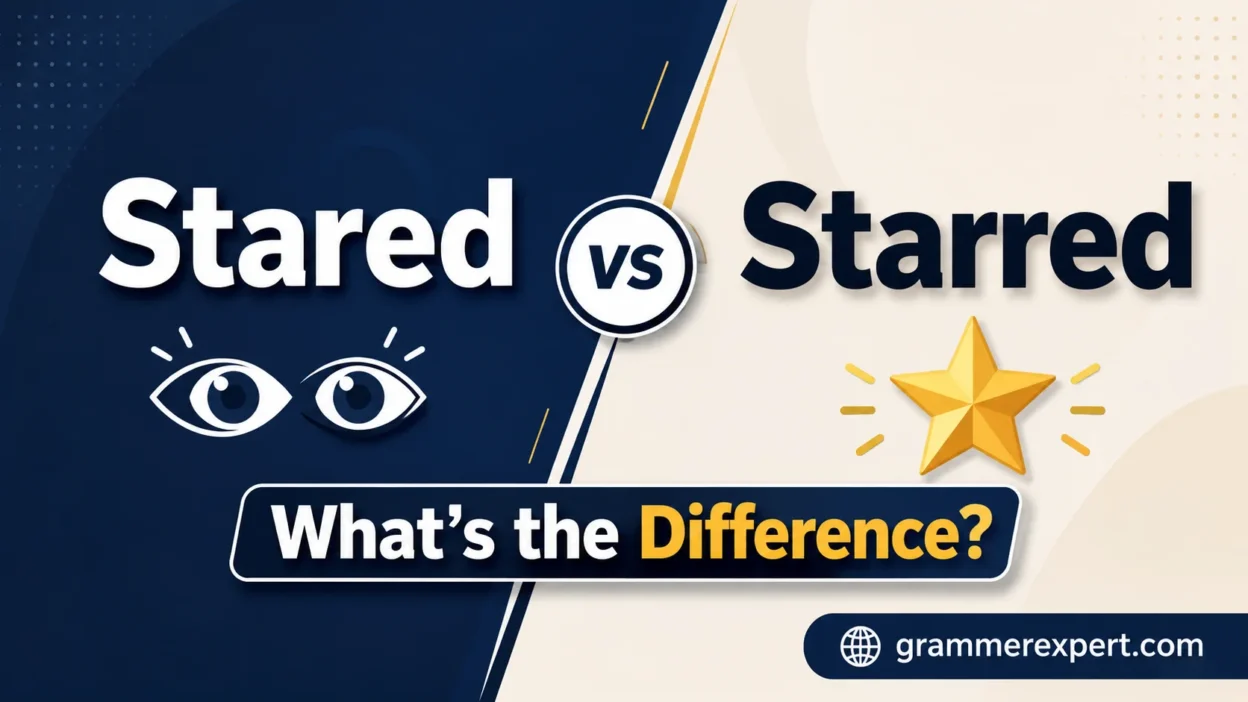
If you have ever paused while writing, Stared vs Starred: What’s the Difference? is the guide that helps you understand this tricky English pair. These words sound exactly alike because they are spoken the same way, but they have different, distinct meanings. Before you decide or choose, remember that selecting the wrong word can change the meaning of an entire sentence and confuse readers who immediately notice the mistake.
A simple example makes the difference easy to see. Imagine someone looking fixedly and intently at a beautiful sunset. In that context, stared is the proper word because it relates to the act of watching something with focus and emotion. Now think about actors in a movie or movies who star in leading roles. They are starred because the term is connected with recognition, a mark of excellence, achievement, or marking, often shown by stars. Choosing the correct word keeps your message clear, natural, and easy to follow.
As a student, teacher, writer, editor, or learner, you will become more confident every time you use these terms correctly. This article offers simple definitions, grammar, comparison tables, and memory tricks to help you avoid common mistakes. Once you clearly know what each word means, you will stop mixing them in an instant. Even though their pronunciation is identical, the confusions disappear with practice, making every example easier to follow and every sentence make more sense.
Stared vs Starred: Quick Answer
If you only need a quick explanation, this table summarizes the key differences.
| Feature | Stared | Starred |
| Base Verb | Stare | Star |
| Meaning | Looked fixedly at someone or something | Marked with a star or performed as the lead actor |
| Part of Speech | Verb | Verb |
| Common Context | Looking, watching, observing | Favorites, emails, movies, TV shows |
| Example | She stared at the ocean. | I starred the email. |
The easiest way to remember the difference is:
- Stared = Looked with your eyes.
- Starred = Marked with a ⭐ or appeared as the main performer.
Whenever you’re unsure, ask yourself one simple question:
Is someone looking at something?
If the answer is yes, choose stared.
If the sentence is about marking something as important or acting in a movie or show, choose starred.
CLICK HERE: Manuel vs Manual What’s the Real Difference
What Does “Stared” Mean?
The word stared is the past tense and past participle of the verb stare. It describes looking at someone or something steadily for a longer time than usual. Unlike a quick glance, staring involves focused attention. People often stare because they’re surprised, curious, confused, impressed, or deep in thought.
Think about watching fireworks for the first time. Most people don’t take a quick look and move on. Instead, they stare because the display captures their full attention. The same thing happens when someone sees breathtaking scenery, receives unexpected news, or studies a complicated problem.
Definition of “Stared”
In simple terms, stared means:
Looked fixedly, steadily, or intently at someone or something.
The action usually lasts longer than a normal look and often reflects emotion or concentration.
When to Use “Stared”
Use stared whenever you’re describing someone looking carefully or continuously.
Common situations include:
- Looking at a beautiful sunset
- Watching fireworks
- Looking through a window
- Staring at a painting in a museum
- Looking at a difficult exam question
- Watching an exciting sports game
- Looking at someone in surprise
- Gazing into space while thinking
- Watching an animal in the wild
- Looking at the stars on a clear night
A useful rule is that if you can replace the word with looked, watched, or gazed, then stared is usually the correct choice.
Examples of “Stared” in Sentences
These examples show how stared is used in everyday English.
- She stared at the painting for nearly ten minutes.
- We stared at the stars until midnight.
- He stared through the classroom window during the lecture.
- Everyone stared when the magician performed his final trick.
- I stared at the instructions before assembling the desk.
- The child stared at the enormous dinosaur skeleton.
- They stared in disbelief after hearing the announcement.
- She stared into space while thinking about her future.
- My dog stared at the kitchen door, waiting for dinner.
- The audience stared at the stage before the concert began.
- He stared at the computer screen, trying to solve the problem.
- We stared across the lake as the sun slowly disappeared behind the mountains.
Notice that stared is often followed by words like at, into, or across, which describe where someone’s attention was directed.
What Does “Starred” Mean?
Unlike stared, the word starred has two common meanings.
The first meaning refers to marking something with a star symbol (⭐) to show that it’s important, useful, or worth saving for later. This meaning is common in email apps, productivity tools, messaging platforms, and websites.
The second meaning relates to entertainment. When an actor, actress, or performer starred in a movie, television show, or play, they played one of the leading roles.
Although these meanings are different, both suggest importance. A starred email stands out because it’s marked as important. A starred actor stands out because they play a major role.
Definition of “Starred”
Starred means:
- Marked something with a star to identify it as important or favorite.
- Performed as the lead actor or featured performer in a production.
The surrounding sentence usually makes the intended meaning clear.
Common Uses of “Starred”
Today, millions of people use starred every day without even thinking about grammar.
You can star:
- Emails
- Messages
- Documents
- Notes
- Browser bookmarks
- GitHub repositories
- Calendar events
- Favorite contacts
- Online articles
- Projects
The entertainment industry also uses starred frequently.
Actors and performers can star in:
- Movies
- Television series
- Theater productions
- Broadway shows
- Streaming originals
- Commercials
- Documentaries
In both situations, starred refers to something important or featured.
Examples of “Starred” in Sentences
These examples illustrate both meanings.
- I starred the email so I could find it later.
- She starred the project as high priority.
- We starred our favorite recipes.
- The developer starred several GitHub repositories.
- He starred the important message before logging out.
- They starred the customer request for immediate attention.
- Tom Hanks starred in many award-winning films.
- Emma Stone starred in several critically acclaimed movies.
- The young actor starred in his first television series.
- She starred in the school’s annual musical.
- The athlete starred in a national advertising campaign.
- They starred in a documentary about wildlife conservation.
Unlike stared, none of these examples involve looking at something. Instead, they describe marking an item or appearing as the featured performer.
Stared vs. Starred: Side-by-Side Comparison
Even after learning the definitions, it helps to compare these words directly.
| Feature | Stared | Starred |
| Base Verb | Stare | Star |
| Main Meaning | Looked fixedly | Marked with a star or featured in a production |
| Related Action | Using your eyes | Saving, highlighting, acting |
| Common Objects | Person, object, scenery | Email, document, repository, movie |
| Common Phrase | Stared at the sky | Starred the email |
| Memory Tip | Think about eyes | Think about the ⭐ symbol |
A quick mental test can save you from making a mistake.
Ask yourself:
- Is someone looking? Use stared.
- Is something being marked or is someone the lead performer? Use starred.
That simple question works almost every time.
Why People Confuse Stared and Starred
Many English words have similar spellings, but stared and starred are especially confusing because they differ by only one letter. They also sound nearly identical in many accents, which makes it easy to choose the wrong spelling while writing quickly.
Another reason is that spell-check tools usually won’t catch the mistake. Both stared and starred are correctly spelled English words, so grammar software often accepts either one even when the sentence doesn’t make sense.
For example:
- ❌ I starred at the painting.
- ❌ She stared the email.
Neither sentence is correct, yet most spell-checkers won’t highlight either mistake because both words exist in the dictionary.
The best way to avoid confusion is to think about the action being described rather than the spelling alone. If the sentence involves someone’s eyes, stared is correct. If it involves a favorite, a bookmark, or a leading performer, starred is the right choice.
Grammar Rules You Should Know About Stared vs. Starred
Learning the grammar behind these two words makes them much easier to remember. Although stared and starred are both regular verbs, they follow different spelling rules because they come from different base words.
Once you understand how each verb changes into the past tense, you’ll rarely confuse them again.
Grammar Rules for “Stared”
The verb stare ends with the letter e. When a regular verb already ends in e, you simply add d to form the past tense.
Here’s how the verb changes:
| Verb Form | Example |
| Base Verb | Stare |
| Third-Person Singular | Stares |
| Present Participle | Staring |
| Past Tense | Stared |
| Past Participle | Stared |
Here are a few examples in different tenses:
- I stare at the mountains every morning.
- She stares at the painting whenever she visits the museum.
- They are staring at the fireworks.
- We stared at the ocean until sunset.
- He has stared at the same puzzle for hours.
Notice that stared almost always appears with a word like at, into, or across because the action involves directing your eyes toward something.
Grammar Rules for “Starred”
The verb star follows a different spelling rule.
Because star is a one-syllable verb that ends with a vowel followed by a single consonant, English grammar requires you to double the final consonant before adding -ed or -ing.
That’s why:
- Star → Starred
- Star → Starring
Not:
- ❌ Stared
- ❌ Staring (when you mean “mark with a star” or “act as the lead”)
Here’s the complete verb table.
| Verb Form | Example |
| Base Verb | Star |
| Third-Person Singular | Stars |
| Present Participle | Starring |
| Past Tense | Starred |
| Past Participle | Starred |
Examples:
- I star important emails every day.
- She stars her favorite recipes.
- They are starring in a new television series.
- We starred the project as urgent.
- The actor has starred in several blockbuster films.
This doubling rule also appears in other common verbs.
| Base Verb | Past Tense |
| Stop | Stopped |
| Plan | Planned |
| Drop | Dropped |
| Star | Starred |
If you remember this grammar rule, you’ll understand why starred always contains two r letters.
Pronunciation Differences Between Stared and Starred
One of the biggest reasons people confuse these words is that they sound extremely similar.
In casual American English, many speakers pronounce them almost identically. As a result, listeners usually rely on the context of the sentence instead of pronunciation.
For example:
- She stared at the painting.
- She starred in the movie.
Although the pronunciation is similar, the surrounding words immediately reveal the intended meaning.
How Context Changes the Meaning
Consider these examples.
She stared at the audience.
The sentence describes someone looking at people.
Now compare it with this one.
She starred before thousands of audience members.
This sentence describes someone performing.
The pronunciation may sound alike, but the meaning changes completely because of the surrounding words.
Tips for Remembering the Correct Pronunciation
Instead of focusing only on how the words sound, think about the action.
Ask yourself:
- Is someone using their eyes?
- Is someone saving, favoriting, or acting?
Answering that question is much more reliable than relying on pronunciation alone.
Common Examples of Stared vs. Starred in Everyday English
Seeing these words in real-life situations helps you remember them naturally.
At School
Students often stare at the whiteboard while solving difficult problems.
Teachers sometimes stare across the classroom when waiting for an answer.
Schools may also use digital learning platforms where students can star assignments or learning resources for future reference.
Examples:
- The students stared at the science experiment in amazement.
- She starred the online lesson to review it later.
- Everyone stared when the volcano model erupted.
At Work
Office workers use both words regularly.
Employees may stare at spreadsheets while analyzing data.
Managers often star important emails so they don’t lose track of urgent tasks.
Examples:
- We stared at the financial report for over an hour.
- I starred the client’s email before leaving the office.
- The team stared at the presentation while discussing new ideas.
Online and Social Media
Technology has made starred part of everyday vocabulary.
You can star:
- Emails
- Notes
- Messages
- Projects
- GitHub repositories
- Articles
- Calendar events
- Contacts
Meanwhile, stared still refers only to looking.
Examples:
- She starred the conversation to read later.
- He stared at the loading screen after the app froze.
- We starred several useful tutorials.
Movies and Entertainment
The entertainment industry uses starred constantly.
When someone starred in a movie, they played one of the leading roles.
Examples include:
- Tom Hanks starred in Forrest Gump.
- Emma Stone starred in La La Land.
- Leonardo DiCaprio starred in Inception.
Now compare those with stared.
- The audience stared at the stage before the curtain opened.
- Everyone stared in amazement during the final performance.
Everyday Conversations
Both words appear naturally in daily conversations.
Examples:
- She stared at me without saying a word.
- I starred your message so I wouldn’t forget it.
- We stared at the beautiful sunset.
- The actress starred in three award-winning films.
- My dog stared at the dinner table.
- He starred the document before closing his laptop.
Reading examples like these makes the difference much easier to remember.
Stared vs. Starred in Technology
Technology has dramatically increased the use of the word starred over the past two decades. Today, millions of people use the star feature every day without realizing they’re also using a specific English verb.
Starred Emails
Many email services let you mark important messages with a star.
People usually star emails to:
- Find them quickly later
- Remember important tasks
- Save travel confirmations
- Keep receipts organized
- Highlight urgent conversations
Instead of searching through hundreds of emails, you can simply open your Starred folder.
Starred Messages
Messaging apps often include a feature that lets you star individual messages.
This is useful for saving:
- Addresses
- Phone numbers
- Meeting details
- Shopping lists
- Important reminders
- Password hints
Rather than scrolling through an entire conversation, you can instantly access your starred messages.
Starred GitHub Repositories
Software developers frequently star GitHub repositories.
Starring a repository allows them to:
- Save useful projects
- Support open-source developers
- Discover popular software
- Return to valuable code later
For developers, starring repositories is similar to bookmarking a webpage.
Starred Documents and Notes
Many productivity apps let users star documents, notes, and files.
This feature helps organize information by giving quick access to frequently used content.
Whether you’re managing work projects or personal tasks, starring items saves time and keeps important information within easy reach.
Idioms and Common Expressions Using Stared and Starred
Neither word appears in many traditional idioms, but both occur in common English expressions.
Common Expressions with “Stared”
You’ll often hear phrases like:
- Stared blankly
- Stared into space
- Stared in disbelief
- Stared silently
- Stared wide-eyed
- Stared someone down
- Stared at the ceiling
- Stared out the window
Examples:
- He stared blankly after hearing the shocking news.
- She stared into space while thinking about her future.
- The competitors stared each other down before the championship match.
These expressions emphasize emotion, concentration, or determination.
Common Expressions with “Starred”
Although starred doesn’t appear in many traditional idioms, it has become a common part of everyday English, especially in technology and entertainment.
You’ll often see or hear these expressions:
- Starred email
- Starred message
- Starred document
- Starred contact
- Starred repository
- Starred item
- Starred review
- Starred performer
- Starred actor
Examples:
- I checked my starred emails before starting work.
- She saved the address in her starred messages.
- The developer shared several starred repositories with the team.
- The actor starred in one of the year’s biggest films.
In each example, starred highlights something important, featured, or saved for easy access.
Synonyms and Related Words for Stared and Starred
Sometimes you may want to avoid repeating the same word throughout your writing. Choosing the right synonym improves readability and makes your sentences more engaging.
Synonyms for “Stared”
These words have similar meanings, although each carries its own nuance.
| Synonym | Best Used When |
| Gazed | Looking with admiration or wonder |
| Glared | Looking angrily |
| Peered | Looking carefully or with difficulty |
| Gawked | Looking with surprise or curiosity |
| Watched | Observing something happening |
| Observed | Looking carefully and thoughtfully |
| Eyed | Looking with interest or suspicion |
| Studied | Examining something closely |
For example:
- She gazed at the waterfall in awe.
- He glared at the driver who cut him off.
- The scientist observed the experiment closely.
Each synonym changes the tone slightly, so choose the one that best fits your sentence.
Synonyms for “Starred”
The best synonym depends on how you’re using the word.
If starred means marked with a star, these alternatives work well:
- Favorited
- Bookmarked
- Saved
- Highlighted
- Flagged
- Marked
If starred means performed as the lead actor, consider these options:
- Featured
- Headlined
- Led
- Appeared
- Performed
- Took the lead role
Examples:
- I bookmarked the article for later.
- The actress featured in an award-winning drama.
While these words are similar, starred remains the most accurate choice when referring to a leading performer or marking an item with a star.
Common Mistakes to Avoid When Using Stared and Starred
Because these words are so similar, even experienced writers occasionally mix them up. Fortunately, the mistakes are easy to fix once you understand the difference.
Here’s a comparison of the most common errors.
| Incorrect Sentence | Correct Sentence | Why It Matters |
| I starred at him. | I stared at him. | Looking requires stared. |
| She stared the email. | She starred the email. | Emails are marked with a star. |
| He starred in surprise. | He stared in surprise. | Surprise affects how someone looks, not acts. |
| We stared the document. | We starred the document. | Documents can be starred but not stared. |
| She starred at the sunset. | She stared at the sunset. | A sunset is something you look at. |
A good proofreading habit is to replace the word in your sentence mentally.
- If looked makes sense, use stared.
- If saved, favorited, or featured makes sense, use starred.
This quick test works in almost every situation.
Memory Tricks to Never Confuse Stared and Starred
A simple memory trick can help you choose the correct word instantly.
Think About Your Eyes
The word stared relates to seeing.
If someone’s eyes are involved, stared is almost certainly the right choice.
Example:
- She stared at the painting.
You can’t replace stared with starred because no one is marking the painting with a star.
Think About the ⭐ Symbol
Whenever you see a star icon on a website, app, or email, think of starred.
Examples:
- I starred the email.
- She starred the document.
- We starred the project.
The star symbol is your biggest clue.
Remember the Double “R”
The extra R in starred can remind you of:
- Rating
- Repository
- Reminder
- Record
- Review
Many digital platforms use stars to rate, save, or organize information.
A Simple Formula
Remember this:
Eyes = Stared
Star ⭐ = Starred
That formula solves almost every question about these two words.
Practice Quiz: Test Your Understanding of Stared vs. Starred
Choose the correct answer for each sentence.
Questions
She _____ at the mountain for several minutes.
- Stared
- Starred
I _____ the email so I wouldn’t forget it.
- Stared
- Starred
The actor _____ in a successful television series.
- Stared
- Starred
Everyone _____ when the fireworks began.
- Stared
- Starred
She _____ the important message before closing the app.
- Stared
- Starred
The children _____ at the magician in amazement.
- Stared
- Starred
He _____ the project as a favorite.
- Stared
- Starred
We _____ through the window during the storm.
- Stared
- Starred
The actress _____ in three blockbuster movies.
- Stared
- Starred
I _____ at the instructions because they were confusing.
- Stared
- Starred
Answers
| Question | Correct Answer |
| 1 | Stared |
| 2 | Starred |
| 3 | Starred |
| 4 | Stared |
| 5 | Starred |
| 6 | Stared |
| 7 | Starred |
| 8 | Stared |
| 9 | Starred |
| 10 | Stared |
If you answered most of them correctly, you’ve already mastered the difference.
Practice Sentences
Fill in the blanks with either stared or starred.
- She ______ at the beautiful waterfall.
- I ______ the document for future reference.
- The audience ______ silently before the performance began.
- He ______ in an award-winning film.
- We ______ at the night sky for hours.
- The developer ______ the repository.
- They ______ at each other without speaking.
- She ______ the email because it contained important information.
- Everyone ______ in surprise after hearing the announcement.
- The actor ______ in several popular television dramas.
Answers
- Stared
- Starred
- Stared
- Starred
- Stared
- Starred
- Stared
- Starred
- Stared
- Starred
Frequently Asked Questions
1. What is the main difference between stared and starred?
Stared is the past tense of stare, which means to look at someone or something for a long time. Starred is the past tense of star, meaning to have the main role in a movie, show, or play, or to be marked with a star.
2. Is “stared” related to looking?
Yes. Stared always refers to looking fixedly or intently at a person, object, or scene. It describes a person’s action of focusing their eyes on something.
3. When should I use “starred”?
Use starred when talking about someone who had a leading role in a film, TV show, or play. It can also describe something that has been marked with a star for importance or recognition.
4. Why do people confuse stared and starred?
People often mix them up because they sound exactly the same when spoken. However, they have different meanings and are used in completely different contexts.
5. How can I remember the difference easily?
Think of stared as being connected to your eyes and looking. Remember starred by linking it with movie stars, leading roles, or star ratings.
6. Are stared and starred interchangeable?
No. They cannot replace each other because each word has its own meaning. Using the wrong one can change the meaning of your sentence.
7. Can “starred” refer to something other than movies?
Yes. Besides acting roles, starred can also describe an item, note, or section that has been marked with a star to show importance or highlight it.
8. How can I avoid making this grammar mistake?
Practice reading and writing sentences with both words. Checking the context before choosing the word will help you use stared and starred correctly every time.
Conclusion
Understanding Stared vs Starred: What’s the Difference? becomes simple once you focus on each word’s meaning. Stared is about looking closely or intently, while starred refers to leading roles or something marked with a star. Although they sound identical, their meanings are completely different. By remembering the context and practicing with examples, you can avoid common mistakes and choose the correct word confidently in every piece of writing.