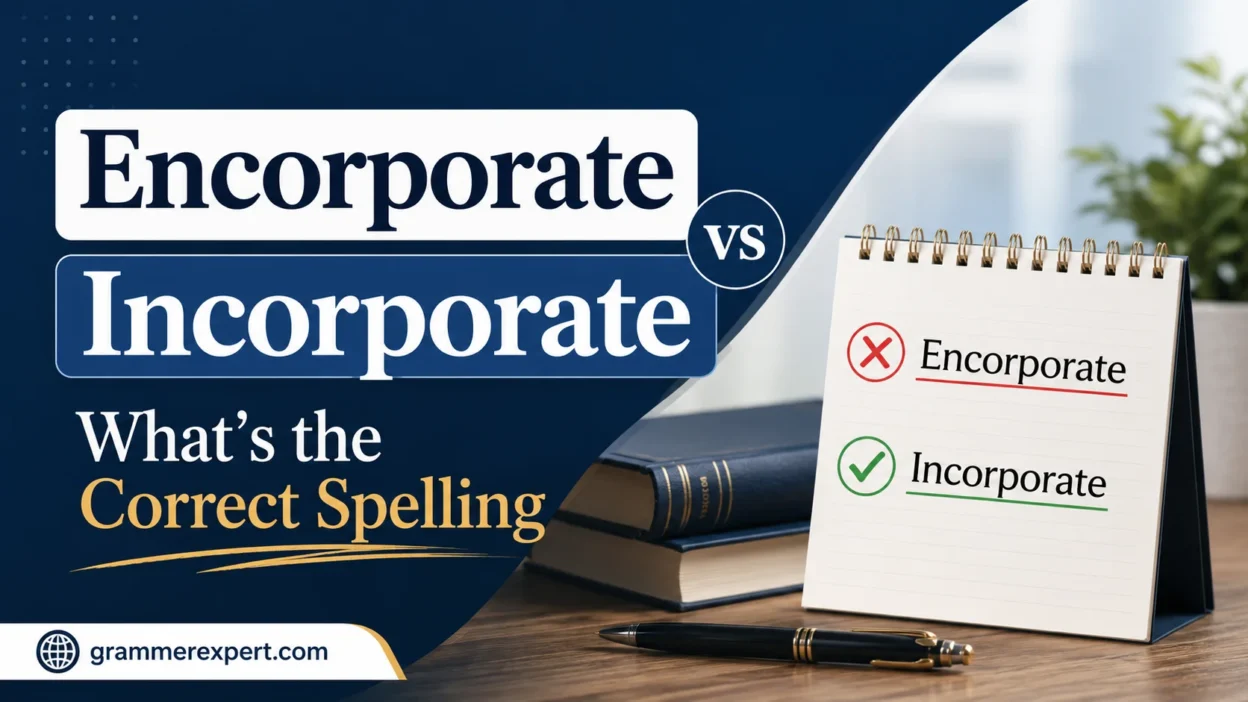
In Encorporate vs Incorporate: What’s the Correct Spelling Meaning and Business Usage?, I still remember the moment I typed a sentence and paused, thinking about encorporate vs incorporate, a confusing mix-up that feels right yet leaves many unsure.
I remember how this confusion usually comes from how similar the words sound, which makes it easy to choose the wrong form without noticing. You’re not alone in facing these moments, because both words look correct and still leave doubt. The good news is that there is a simple fix once you understand what is actually going on. This guide will help you clearly see the difference, learn which word is correct, and walk away confident in using it the right way every time you write.
You may have seen both forms used online in writing, but only one follows English rules. This happens because people often assume a spelling pattern or mishear it in conversation. The word incorporate means to include something as part of a whole or combine different elements together. For example, a teacher will use videos in a lesson to make it more engaging, and you should build healthy habits into your daily routine. In contrast, encorporate is incorrect, does not exist in standard usage, and is a common mistake caused by pronunciation or assumption that it starts with en instead of in.
A simple way to remember this is to think of IN as putting something inside a bigger system or idea. This understanding helps you avoid errors and improves your accuracy in business, education, and everyday communication. English has plenty of tricky words that can trip people, and mistakes often happen as others spread the wrong version repeatedly, which falls into common categories of confusion.
Is It Encorporate or Incorporate?
Let’s get straight to the point.
- Correct spelling: Incorporate ✅
- Incorrect spelling: Encorporate ❌
“Encorporate” is not a real English word. You won’t find it in any standard dictionary. It appears because of pronunciation confusion, not because it has legitimate usage.
READ MORE: Arial vs Aerial: What’s the Difference
Why the Confusion Happens
English pronunciation can blur sounds. The prefix “in-” sometimes sounds like “en-” when spoken quickly.
Think about these words:
- Encourage
- Enable
- Enforce
Because these start with “en,” people often assume “encorporate” follows the same pattern. It doesn’t.
Quick takeaway: If you’re writing anything formal, professional, or even casual, always use “incorporate.”
What Does “Incorporate” Mean?
The word “incorporate” carries more weight than it first appears. It works in both everyday writing and legal business contexts.
Simple Definition
Incorporate means:
- To include something as part of a whole
- To form a legal company or corporation
Two meanings. Same word. Different contexts.
Real-World Meaning in Everyday Language
In daily writing, incorporate means to blend or include something into something else.
Examples:
- “You should incorporate feedback into your draft.”
- “The designer incorporated modern elements into the layout.”
- “She incorporated humor into her presentation.”
In each case, the idea is simple. Something new gets added into an existing structure.
Real-World Meaning in Business
In business, incorporate has a precise legal meaning.
It refers to forming a company as a corporation. This creates a separate legal identity distinct from its owners.
Examples:
- “They decided to incorporate their startup this year.”
- “The company was incorporated in Delaware.”
This isn’t just language. It’s a legal process with financial and operational consequences.
Why “Encorporate” Is Incorrect
Let’s clear this up once and for all.
“Encorporate” fails on every level:
- It does not appear in any major dictionary
- It has no recognized definition
- It is never correct in formal or informal writing
Why People Still Use It
Despite being incorrect, “encorporate” shows up often. Here’s why:
- Phonetic confusion: It sounds similar to “incorporate”
- Pattern assumption: People copy “en-” words like “encourage”
- Typing habits: Fast typing leads to unnoticed errors
- Weak spellcheck: Some tools fail to flag it
The Real Risk
Using “encorporate” can:
- Reduce your credibility
- Signal lack of attention to detail
- Hurt professional communication
In business writing, that’s not a small issue. It can cost trust.
How to Use “Incorporate” Correctly
Using “incorporate” properly isn’t difficult. You just need clarity about context.
Using “Incorporate” in Everyday Writing
When writing casually or professionally, use incorporate to mean “include.”
Examples:
- “Try to incorporate more examples in your article.”
- “The recipe incorporates fresh herbs.”
- “We incorporated user feedback into the update.”
Notice how the word blends ideas together. That’s the core meaning.
Using “Incorporate” in Business and Legal Contexts
In business, the word becomes more formal.
Examples:
- “They plan to incorporate their company next quarter.”
- “The business was incorporated as a private limited company.”
- “Incorporating protects personal assets.”
Here, the word refers to a legal transformation. It’s not just language. It’s structure.
Incorporate in Business: What It Actually Means
When you hear “incorporate a business,” it’s not just paperwork. It’s a strategic move.
What Happens When You Incorporate
You create a separate legal entity. That entity can:
- Own assets
- Enter contracts
- Pay taxes
- Be sued independently
Key Steps to Incorporate a Business
While exact rules vary by country, the process generally includes:
- Choosing a unique business name
- Filing incorporation documents
- Appointing directors
- Issuing shares
- Registering for taxes
Benefits of Incorporation
Here’s where it gets interesting.
Incorporation offers:
- Limited liability: Your personal assets stay protected
- Tax flexibility: Corporations often enjoy lower tax rates
- Credibility: Clients trust incorporated businesses more
- Continuity: The business survives ownership changes
Case Study: Small Startup Transformation
A freelance designer operates under their personal name. They earn $50,000 annually. Everything seems fine until a client dispute arises.
Without incorporation, the designer faces personal liability.
Now consider the same scenario after incorporation:
- The business becomes a separate entity
- Legal risks stay within the company
- Personal savings remain protected
That’s the difference one word can represent.
Common Mistakes and How to Avoid Them
Even experienced writers slip up. Let’s fix that.
Frequent Errors
- Writing “encorporate” in emails
- Confusing pronunciation with spelling
- Trusting autocorrect blindly
- Mixing “incorporate” with “include” incorrectly
Simple Fixes That Work
Use these quick strategies:
- Think “in = inside” → incorporate means bring inside
- Slow down when typing
- Proofread business documents carefully
- Use reliable grammar tools
Pro Tip
Say the word slowly: in-cor-po-rate
Breaking it into parts helps you spell it correctly every time.
Encorporate vs Incorporate: Side-by-Side Comparison
FeatureEncorporate ❌Incorporate ✅Valid wordNoYesDictionary useNot listedFully definedUsageIncorrectStandardContextNoneWriting + BusinessProfessional useNeverEssential
This table removes all doubt. Only one belongs in your writing.
Quick Memory Trick That Actually Works
Here’s a simple trick you won’t forget.
- “Incorporate” starts with “in” → think “include in.”
Now connect it to real life:
- You incorporate ingredients into food
- You incorporate ideas into writing
- You incorporate a business into the system
Same pattern. Same logic.
When People Commonly Search “Encorporate vs Incorporate”
This confusion doesn’t appear randomly. It shows up in specific situations.
Common Scenarios
- Writing formal emails quickly
- Drafting legal or business documents
- Learning English as a second language
- Using voice typing tools
Why It Matters More Than You Think
Spelling errors in casual messages might slide.
In business or professional writing? They stand out.
A single incorrect word can:
- Break reader trust
- Make content look unpolished
- Reduce authority
That’s why mastering small details pays off.
Deep Dive: Incorporate vs Include
These words overlap. Still, they aren’t identical.
Key Difference
- Include: General and flexible
- Incorporate: Structured and deliberate
Example Comparison
- “The report includes charts.”
- “The report incorporates charts into its analysis.”
The second sentence feels more intentional. More refined.
When to Use Each
Use include when:
- You list items
- You speak casually
Use incorporate when:
- You describe integration
- You write formally
- You want precision
Practical Writing Examples
Let’s bring this to life.
Correct Usage Examples
- “We incorporated customer insights into our strategy.”
- “The app incorporates AI-driven features.”
- “They incorporated the company in 2023.”
Incorrect Usage Examples
- “We encorporated new ideas into the plan.” ❌
- “The firm was encorporated last year.” ❌
These mistakes look small. They aren’t.
Expert Insight
“Precision in language reflects precision in thinking.”
This applies directly here. Using the correct word signals clarity and professionalism.
FAQs About Encorporate vs Incorporate
1. Is “encorporate” ever correct in English?
No, encorporate is always incorrect and does not exist in standard English. It is a common mistake caused by pronunciation and wrong assumptions.
2. What does “incorporate” mean?
The word incorporate means to include something as part of a whole or combine different elements together in a clear and meaningful way.
3. Why do people confuse “encorporate” vs “incorporate”?
The confusion usually comes from how similar they sound, and people often mishear them in conversation or assume the wrong spelling pattern.
4. How can I remember the correct spelling?
A simple way is to think of IN as putting something inside a system or idea, which helps you remember the correct form.
5. Is “incorporate” used in business writing?
Yes, incorporate is widely used in business, law, marketing, and branding, where it appears in many professional contexts.
6. Can spelling mistakes affect professionalism?
Yes, spelling mistakes can affect professionalism, reduce credibility, and harm your SEO, especially in business and academic writing.
7. Who commonly makes this mistake?
Many people, including students, writers, marketers, and even professionals, often type the wrong version without realizing it.
8. How often do people search for “encorporate”?
Thousands of users search for it every month, showing how widespread this confusing mix-up really is.
Conclusion
Understanding encorporate vs incorporate helps you avoid a common mistake and improves your writing accuracy in everyday communication. Once you learn the difference and use it correctly, you can write with more confidence, maintain strong credibility, and ensure your message stays clear and professional every time.