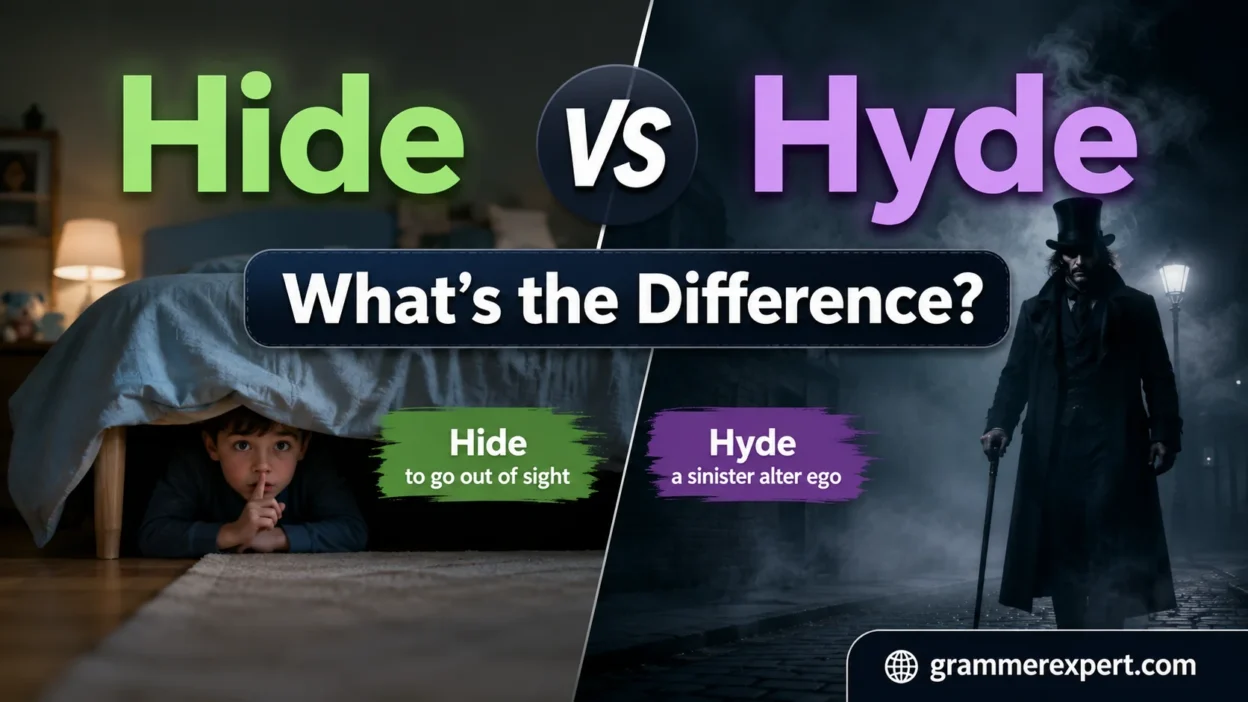
Hide vs Hyde: What’s the Difference? explains how these homophones differ in meaning, usage, context, and everyday English writing for learners.
Hide and Hyde are commonly confused words because they sound exactly alike, but their meanings and uses are completely different. In the English language, Hide is a commonly used verb meaning to conceal, cover, or keep something out of sight, as in hide your keys, hide the truth, or hide behind the door. Hyde is usually a proper noun used as a surname, family name, place name, location, or name, including the literary characters Dr. Jekyll and Mr. Hyde. It can also be an actual word, though it is less common and may be archaic. This comparison makes the difference easy to remember and helps you know when to use each spelling. In writing, an email, essay, social media post, casual message, or story, choosing the wrong word can change the meaning of a sentence, causing spelling mistakes, grammar errors, awkward sentences, and other mistakes.
Many writers mix up these words in everyday writing, everyday conversations, and professional communication. A simple guide is to remember that Hide describes an action, while Hyde refers to a specific person, recognized title, surname, place name, or other proper noun and should be capitalized. This distinction supports correct context, correct word choice, writing accuracy, English writing, grammar, spelling, vocabulary, and clear communication, while building confidence, precision, professionalism, and credibility in academic settings and casual settings. When learning these homophones, simple memory tricks, examples, common examples, definitions, usage, real-life usage, and exercises can help you avoid confusion and stop second-guessing your word choice. This understanding strengthens writing skills, language skills, reading comprehension, English vocabulary, communication, and overall communication, giving English learners a useful clarification for recognizing the context and using each spelling correctly without common grammar mistakes.
Hide vs. Hyde: Quick Difference
The easiest way to understand hide vs. Hyde is to compare their everyday roles.
| Word | Type | Main meaning or use | Example |
| hide | Verb | To conceal or keep out of sight | “Hide the gift before she arrives.” |
| hide | Noun | Animal skin | “The leather came from cowhide.” |
| hide | Noun | A concealed observation shelter | “We waited inside the bird hide.” |
| hide | Noun | Historical unit of land | “The document refers to a hide of land.” |
| Hyde | Proper noun | Surname | “Mr. Hyde lives nearby.” |
| Hyde | Proper noun | Part of a place name | “They visited Hyde Park.” |
| Hyde | Proper noun | Fictional character | “Mr. Hyde appears in the novella.” |
There’s one important detail to remember: Hyde isn’t simply a misspelling of hide. It has legitimate uses as a proper name. The capital letter matters because proper nouns normally retain their established capitalization.
READ ALSO: Seak vs Seek: What’s the Difference?
What Does “Hide” Mean?
Hide as a Verb
As a verb, hide means to put something out of sight or prevent someone from seeing or finding it. It’s one of the most common meanings of the word.
You can hide an object, hide yourself, hide information, or even hide an emotion. The idea stays broadly similar: something remains concealed from view, knowledge, or discovery.
For example:
- “Please hide the birthday present.”
- “The children hid behind the curtains.”
- “She tried to hide her disappointment.”
- “Don’t hide the truth from your parents.”
The verb has several forms that can sometimes cause additional confusion. Its common forms are hide, hid, hidden, and hiding. Merriam-Webster lists hide as an Old English verb whose history reaches back before the 12th century.
That means the sentence “She hid the keys” is correct. “She hyde the keys” isn’t.
Hide as a Noun
Hide can also work as a noun. In one major sense, it means the skin of an animal, especially a large animal’s skin, whether raw or prepared for use.
Consider these examples:
- “The craftsman treated the animal hide carefully.”
- “The boots were made from cow hide.”
- “The buffalo’s hide was thick and durable.”
The word also appears in the expression save your hide, which means to protect yourself from danger, trouble, or harm.
Merriam-Webster traces this noun sense to Old English hȳd.
Hide as a Wildlife Observation Shelter
In British English, hide has another specialized noun meaning. It can refer to a concealed structure where people watch wildlife without disturbing the animals.
Birdwatchers commonly use hides to observe birds from a discreet position.
For example:
“We spent two hours in the hide watching herons.”
This meaning has nothing to do with a person’s surname. It is simply another established meaning of the lowercase word hide.
Hide as an Old Unit of Land
There’s also a historical meaning that’s easy to overlook. Hide was an old English unit or assessment of land.
Merriam-Webster records hide as a historical unit of land and gives 120 acres as a traditional figure while noting that the term covered different historical units and contexts.
The historical reality is more complicated than saying every hide always equaled exactly 120 modern acres. The amount could vary depending on the period and local conditions. Historically, the term related to land considered capable of supporting a household.
This older sense helps explain why hide appears in historical records, surnames, and place names.
What Does “Hyde” Mean?
Hyde as a Surname
Hyde is most commonly encountered today as a proper name, especially a surname.
For example:
- “Sarah Hyde joined the meeting.”
- “Mr. Hyde lives across the street.”
- “The Hyde family owns the property.”
Because Hyde identifies a particular person or family, it normally begins with a capital H.
You wouldn’t normally write “Mr. hyde.” The same capitalization principle applies to other surnames such as Smith, Brown, or Carter.
The spelling Hyde also has historical connections with the Old English word hīd, associated with a unit or amount of land. The relationship between historical land terms, place names, and surnames is one reason the spelling has survived as a proper name.
Hyde in Place Names
Hyde also appears in geographical names. One of the most recognizable examples is Hyde Park in London.
Here, Hyde isn’t functioning as the everyday verb hide. It’s part of a fixed place name, so its spelling must remain Hyde.
This distinction becomes particularly useful when proofreading. If you write “Hide Park” when referring to the London location, you’ve changed the established name.
The same principle applies to streets, neighborhoods, parks, towns, and other locations containing Hyde.
Hyde in Dr. Jekyll and Mr. Hyde
Literature provides another famous example: Mr. Hyde, the character from Robert Louis Stevenson’s Strange Case of Dr Jekyll and Mr Hyde.
The novella was published in 1886 and introduced one of English literature’s most recognizable fictional names. Stevenson’s character helped make “Jekyll and Hyde” a lasting expression for a person who seems to possess sharply contrasting sides.
The spelling is Hyde, not Hide, because it’s the character’s established name.
That makes “Mr. Hide” incorrect when referring to Stevenson’s character.
Hide vs. Hyde Pronunciation
One reason hide vs. Hyde causes so much confusion is pronunciation.
In standard English, both are pronounced /haɪd/. They are therefore homophones: words that share pronunciation while differing in spelling and meaning.
| Word | Pronunciation | Meaning |
| hide | /haɪd/ | Conceal, animal skin, observation shelter, etc. |
| Hyde | /haɪd/ | Usually a proper name |
Think of the words there, their, and they’re. Hearing them aloud doesn’t tell you which spelling belongs on the page. Context does the heavy lifting.
The same thing happens with hide and Hyde. If someone says, “I met Hyde yesterday,” you need additional context to know whether Hyde is someone’s surname or whether the speaker is referring to something else.
Hide vs. Hyde: Key Differences
Common Word vs. Proper Name
The biggest distinction is grammatical.
Hide is an ordinary English word. It can serve as a verb or noun.
Hyde is generally a proper noun. It’s used in names rather than as the everyday spelling of the verb meaning “conceal.”
Meaning and Context
Context usually gives you the answer immediately.
Compare:
- “Hide the money.” → conceal it.
- “The animal’s hide was thick.” → animal skin.
- “We watched the birds from a hide.” → observation shelter.
- “Mr. Hyde entered the room.” → person’s name.
- “They walked through Hyde Park.” → place name.
The sentence itself acts like a signpost.
Capitalization
Capitalization provides another useful clue.
| Correct form | Why |
| hide the keys | Common verb |
| animal hide | Common noun |
| a bird hide | Common noun |
| Mr. Hyde | Proper name |
| Hyde Park | Proper place name |
Don’t capitalize hide simply because you’re comparing it with Hyde. In normal prose, hide stays lowercase unless it begins a sentence or appears in a title according to the applicable style.
Hide vs. Hyde Examples in Sentences
Correct Uses of “Hide”
Here are several everyday examples:
- “Can you hide this gift in the closet?”
- “The cat hid under the bed.”
- “He couldn’t hide his excitement.”
- “Clouds hid the mountain peak.”
- “She hid the documents in a drawer.”
- “The boots were made from animal hide.”
- “We watched the ducks from a wildlife hide.”
Notice how none of these examples needs the spelling Hyde.
Correct Uses of “Hyde”
Now consider these examples:
- “Mr. Hyde is a famous fictional character.”
- “The Hyde family moved last year.”
- “They visited Hyde Park.”
- “Hyde is her family name.”
- “The street is named Hyde Street.”
Here, the spelling isn’t chosen because the word sounds different. It doesn’t. Hyde is correct because the specific name is spelled that way.
Side-by-Side Examples
| Confusing form | Correct form | Explanation |
| “I need to hyde the present.” | “I need to hide the present.” | The verb means conceal. |
| “We visited Hide Park.” | “We visited Hyde Park.” | The park’s name is Hyde Park. |
| “Mr. Hide appears in the story.” | “Mr. Hyde appears in the story.” | Hyde is the character’s name. |
| “The boots are made from Hyde.” | “The boots are made from hide.” | Here, hide means animal skin. |
Common Mistakes With Hide and Hyde
Mistaking Hyde for an Alternative Spelling of Hide
The most common error is using Hyde whenever you mean the verb hide.
For example:
Incorrect: “Please hyde the keys.”
Correct: “Please hide the keys.”
The sound may be identical, but spelling follows meaning and grammatical context.
Forgetting the Capital Letter in Hyde
Another mistake occurs when writers recognize the name but lowercase it.
Incorrect: “Mr. hyde is the villain.”
Correct: “Mr. Hyde is the villain.”
The capital letter signals that the word is functioning as a proper name.
Choosing Spelling by Sound Alone
English spelling doesn’t always follow pronunciation neatly. Homophones make that especially obvious.
When you hear hide, don’t immediately type either spelling. First ask what the speaker means.
That tiny pause can prevent a surprisingly noticeable writing error.
Why Are Hide and Hyde Confused?
They Sound Exactly Alike
The strongest reason is straightforward: hide and Hyde are pronounced alike.
If you’ve only heard the word, spelling requires context.
Both Forms Appear in Familiar Expressions and Names
Readers encounter hide in common expressions such as “hide and seek.” Meanwhile, Hyde appears in familiar names such as Hyde Park and Mr. Hyde.
That creates two competing visual patterns for the same sound.
English Has Many Homophones
The confusion isn’t unusual. English contains many words that share pronunciation but differ in spelling.
For example:
- right / write
- flower / flour
- sea / see
- brake / break
- there / their / they’re
Hide and Hyde belong to this broader spelling pattern.
How to Remember Hide vs. Hyde
Use “Hide and Seek” as Your Memory Trick
If you mean concealment, think of the familiar phrase hide and seek.
You hide behind the door. You don’t hyde behind it.
Use the Capital Letter for Names
If you’re talking about a person or established place, look for the proper-name clue.
Person: Mr. Hyde
Place: Hyde Park
Family: the Hyde family
Ask One Simple Question
When you’re stuck, ask:
“Am I describing an action or naming something?”
If you’re describing concealment, use hide.
If you’re naming a person, place, or other proper noun spelled Hyde, use Hyde.
It’s a small rule, but it works remarkably well.
Is “Hyde” Ever a Correct Word?
Yes. Hyde is absolutely correct in the right context.
It isn’t the ordinary spelling of the verb hide, but that doesn’t make it an incorrect word.
Hyde is an established proper name. It’s used as a surname and appears in place names and fictional names. The famous Mr. Hyde from Stevenson’s 1886 novella is perhaps its best-known literary example.
There’s also historical depth behind the spelling. Merriam-Webster identifies a separate historical hide as an Old English unit of land and traces that noun to Old English hīgid and hīd.
The important point is not to flatten these histories into one modern definition. Today, hide and Hyde have distinct practical roles even though their pronunciations overlap.
Hide vs. Hyde: Which One Should You Use?
Use this quick guide whenever the spelling slips your mind.
Choose “hide” when you mean:
- conceal something
- stay out of sight
- keep information secret
- animal skin
- a wildlife observation shelter
- the historical land unit
Choose “Hyde” when you mean:
- a person whose surname is Hyde
- a place with Hyde in its official name
- Mr. Hyde from Stevenson’s story
- another established proper name spelled Hyde
The rule is simple: meaning first, spelling second.
Hide vs. Hyde: Quick Decision Guide
Do you mean “conceal”?
→ Use hide.
Do you mean animal skin?
→ Use hide.
Do you mean a wildlife observation shelter?
→ Use hide.
Are you naming a person called Hyde?
→ Use Hyde.
Are you naming a place such as Hyde Park?
→ Use Hyde.
Are you referring to Stevenson’s character?
→ Use Hyde.
Still uncertain?
→ Check the exact name or sentence context rather than relying on pronunciation.
Frequently Asked Questions
1. What is the main difference between Hide and Hyde?
Hide is usually a verb meaning to conceal or keep something out of sight. Hyde is generally a proper noun used as a name, surname, place name, or title.
2. Are Hide and Hyde homophones?
Yes. Hide and Hyde are homophones because they have the same pronunciation but different spellings, meanings, and uses.
3. Is Hyde a correct English word?
Yes, Hyde is a real word, but it’s most often used as a proper noun. It may refer to a surname, location, or literary name such as Dr. Jekyll and Mr. Hyde.
4. When should I use Hide?
Use hide when you mean to conceal something or keep it out of sight. For example, “Please hide the gift before the party.”
5. When should I use Hyde?
Use Hyde when referring to a specific name, person, family, location, or recognized title. It should normally be capitalized.
6. Why do people confuse Hide and Hyde?
People often confuse them because they sound exactly alike. Their different spellings and meanings can easily cause mistakes, especially in quick writing.
7. Is Hide more common than Hyde?
Yes. Hide is much more common in everyday English because it describes an action people frequently discuss. Hyde is mainly found in specific names and proper nouns.
8. What is an easy way to remember Hide vs. Hyde?
Remember that hide describes an action involving concealment, while Hyde is usually a name. This simple distinction can help you choose the correct spelling.
Conclusion
Hide and Hyde sound alike, but they serve different purposes. Use hide when you mean to conceal or keep something out of sight. Use Hyde for a proper name, surname, place, or recognized title. Once you understand this simple difference, you can avoid common spelling and grammar mistakes and write with greater confidence and accuracy.