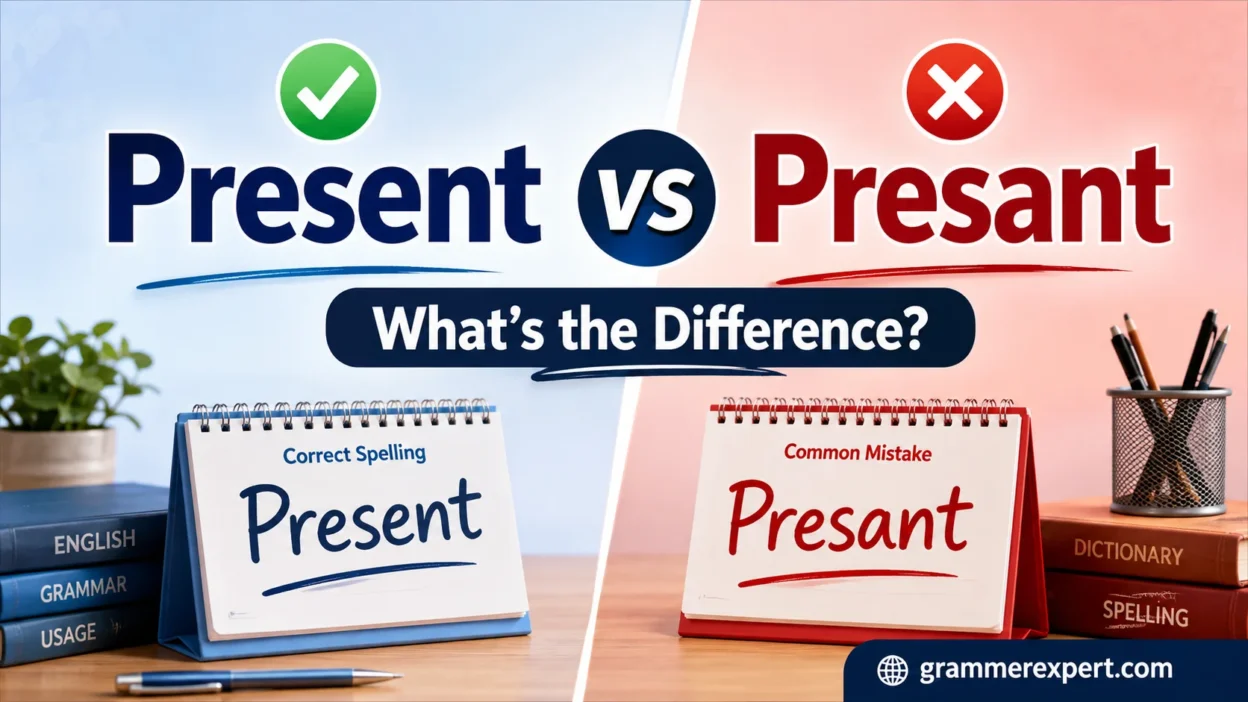
Present vs Presant: What’s the Difference? explains why learners confuse these similar spellings and why present is the correct English form. The present vs presant question can leave learners confused because these words look almost identical when written quickly. They may seem interchangeable, especially for new English learners who depend on sound instead of spelling rules.
Understanding the correct usage of present becomes easier when you learn its multiple meanings and grammatical roles. As a noun, verb, and adjective, the word has different functions based on its meaning and context. You’ll find it in everyday conversations, academic writing, professional communication, and other real-life situations. Even experienced writers can make spelling mistakes because our brains often follow familiar sound patterns, and everyday speech can create confusion between present and presant. A useful way to avoid this error is to remember one simple rule: present is the correct spelling, while presant is a common misspelling.
A simple way to build confidence is to use comparison tables, practical examples, expert writing tips, and memorable spelling techniques instead of second-guessing yourself. These tools help learners recognize present and avoid unnecessary mistakes in emails, assignments, academic settings, real-world settings, and everyday writing.
Present vs. Presant: Quick Answer
The difference between present vs. presant is simple. Present is the standard English spelling. Presant is an incorrect spelling when you mean present.
You might see presant in texts, comments, school assignments, emails, or informal online writing. That doesn’t make it an accepted alternative. It usually reflects a spelling error caused by pronunciation, quick typing, or uncertainty about the vowel sequence.
For example:
- Incorrect: I bought my sister a presant.
- Correct: I bought my sister a present.
Likewise:
- Incorrect: Everyone was presant at the meeting.
- Correct: Everyone was present at the meeting.
The same correction applies when present functions as a verb:
- Incorrect: She will presant her research tomorrow.
- Correct: She will present her research tomorrow.
The important point is that present doesn’t change its spelling according to its meaning. Context tells you what the word means.
READ MORE: Waring vs Wearing: What’s the Difference?
Present Is the Correct Spelling
Present is a well-established English word with several meanings. Merriam-Webster lists it as a noun, verb, and adjective. It also records a separate noun use connected with the present tense.
The word can refer to:
- The current moment or period
- Something given as a gift
- Someone who is in attendance
- Something that exists or happens now
- The act of showing or introducing something
- A formal act of giving or offering something
That range explains why you can encounter present in sentences that seem completely unrelated.
Presant Is a Misspelling
Presant isn’t the standard spelling for any of these common meanings.
If you intend to write about a birthday gift, use present. If you mean someone attended a meeting, use present. If someone plans to show research to an audience, use present again.
The meaning changes. The spelling doesn’t.
Present vs. Presant: Side-by-Side Comparison
A quick comparison makes the distinction crystal clear.
| Feature | Present | Presant |
| Standard spelling | Yes | No |
| Standard English word | Yes | No |
| Noun | Yes | No |
| Verb | Yes | No |
| Adjective | Yes | No |
| Means “gift” | Yes | No |
| Means “now” | Yes | No |
| Means “in attendance” | Yes | No |
| Means “show or introduce” | Yes | No |
| Suitable for formal writing | Yes | No |
Present is the form you should use in academic papers, professional emails, essays, applications, reports, and everyday writing.
If you see presant, mentally correct it to present unless the context clearly indicates a different word or a proper name.
What Does Present Mean?
The easiest way to understand present is to separate its grammatical roles. One spelling can carry several meanings because English frequently allows a single word to function in different ways.
Present as an Adjective
As an adjective, present commonly describes something that exists or happens now.
For example:
“The present situation requires immediate attention.”
Here, present means current. It distinguishes the situation from something that happened previously or might happen later.
The word can also describe someone who is physically there.
“All the students were present.”
In this sentence, present means in attendance or at a particular place. Cambridge gives this sense as being in a particular place.
You can therefore think of two useful adjective meanings:
- Current: the present situation
- In attendance: everyone present
Other examples include:
- “What is your present address?”
- “Several issues are present in the report.”
- “The present system needs improvement.”
- “Only ten members were present.”
Present as a Noun
As a noun, present has two especially common meanings.
First, it can mean a gift.
“She opened her birthday present.”
A present might be a book, watch, toy, card, or anything else given as a gift. Cambridge defines this noun sense as something given, especially on a special occasion or as a thank-you.
Second, the present means the current period of time.
“We should focus on the present.”
Here, the word contrasts with the past and future. Cambridge also identifies the present as the period of time happening now.
Consider the difference:
- “I bought her a present.” → a gift
- “I live in the present.” → the current time
The spelling remains identical.
Present as a Verb
As a verb, present often means to show, introduce, give, or formally put something before someone.
For example:
“She will present her findings tomorrow.”
Here, present means show or explain information to an audience.
You might also say:
- “He presented the award.”
- “The team presented its proposal.”
- “She presented her research to the committee.”
- “The host will present the program.”
- “The lawyer presented evidence to the court.”
Merriam-Webster includes meanings such as giving formally, bringing something before the public, introducing someone, and offering something for viewing.
That makes present especially common in professional and academic settings.
Present in Grammar
There’s another important use: present can describe a verb tense.
The present tense generally relates to actions, states, or situations connected with the current time. For example:
- “She works in a hospital.”
- “They live in Chicago.”
- “I drink coffee every morning.”
The word present here doesn’t mean a gift or a presentation. It describes the grammatical relationship between the verb and time.
This is another reason the word appears in many different contexts.
Why Do People Write Presant Instead of Present?
If present is so common, why does presant appear at all?
The most likely explanation is straightforward: English spelling doesn’t always match pronunciation perfectly.
Someone may hear a word and attempt to reproduce its sounds using familiar spelling patterns. When that happens, a vowel can land in the wrong place.
The mistake may also happen during fast typing. Your brain knows the intended word, your fingers move quickly, and a single vowel slips through. The result can look surprisingly believable.
Pronunciation Can Cause Confusion
The pronunciation of present itself adds another layer.
When present functions as a noun or adjective, it commonly has the pronunciation /ˈprez.ənt/ in American English. Cambridge lists this pronunciation for meanings such as a gift and the current time.
As a verb, however, present commonly shifts its stress:
PREZ-ent → noun/adjective
pri-ZENT → verb
For example:
- “This is my birthday PREZ-ent.”
- “I will pri-ZENT my research.”
Merriam-Webster also distinguishes the noun/adjective pronunciation from the verb pronunciation.
That stress shift doesn’t change the spelling. It simply reflects a common English pronunciation pattern.
Fast Typing and Spelling Habits
Spelling errors often happen when you’re writing under time pressure.
Imagine typing an email before a meeting:
“I will presant the figures at three.”
You probably know exactly what you mean. Still, the incorrect vowel can sneak in because your brain focuses on the message rather than every letter.
The same thing can happen when writing:
- School assignments
- Social media posts
- Work emails
- Text messages
- Meeting notes
- Online comments
A spell checker may catch presant immediately. However, understanding the correct spelling is better than relying entirely on software.
Confusion Between Similar-Looking Words
English contains many words that differ by only one vowel. That can create visual uncertainty.
Compare:
- present
- pleasant
- peasant
- presant
The last three letters can make the incorrect presant seem plausible at first glance. Yet English spelling depends on established word forms rather than simply choosing the letters that look or sound right.
Present vs. Presant Examples in Sentences
Examples make this distinction much easier to remember because they show how present behaves in real sentences.
Correct Examples With Present
Meaning: a gift
“My parents gave me a birthday present.”
Meaning: current time
“The present is all we can control.”
Meaning: in attendance
“Everyone was present during the discussion.”
Meaning: current or existing now
“The present policy needs further review.”
Meaning: show or explain
“The scientist will present the results tomorrow.”
Meaning: formally give
“The director presented the award to the winner.”
Notice something important: the word remains present in every example.
Incorrect Examples With Presant
The following sentences contain the common misspelling:
| Incorrect | Correct |
| I bought a presant for my mother. | I bought a present for my mother. |
| Everyone was presant at lunch. | Everyone was present at lunch. |
| She will presant the report. | She will present the report. |
| This presant problem needs attention. | This present problem needs attention. |
| He opened his Christmas presant. | He opened his Christmas present. |
These examples show why the error can be tricky. The sentence itself may make perfect sense. Only the spelling is wrong.
Present Pronunciation: Why the Word Sounds Different
Pronunciation can make present more interesting than it looks.
Present as a Noun or Adjective
When present works as a noun meaning gift or current time, or as an adjective meaning existing now or in attendance, the stress normally falls on the first syllable:
PREZ-ent
Examples:
- “a birthday present”
- “the present moment”
- “everyone present”
Cambridge lists the American English pronunciation as /ˈprez.ənt/ for these uses.
Present as a Verb
As a verb, the stress normally moves to the second syllable:
pri-ZENT
Examples:
- “I will present the findings.”
- “She will present the award.”
- “They present the proposal tomorrow.”
Merriam-Webster identifies this distinction in its pronunciation information.
Does Presant Have a Different Pronunciation?
No. Writing presant doesn’t create a standard alternative pronunciation of present.
If you mean the standard word, write present.
The difference between the noun, adjective, and verb pronunciation comes from word stress, not from changing the spelling to presant.
Common Mistakes With Present
Because present has several meanings, writers sometimes make more than one kind of mistake.
Using Presant for a Gift
Incorrect:
“I bought a presant for my brother.”
Correct:
“I bought a present for my brother.”
When you mean a gift, always use present.
Using Presant for Attendance
Incorrect:
“All employees were presant.”
Correct:
“All employees were present.”
Here, present means the employees were there.
Using Presant for a Presentation
Incorrect:
“I need to presant my project.”
Correct:
“I need to present my project.”
The verb present means to show or explain something to an audience.
Assuming Different Meanings Need Different Spellings
This is perhaps the easiest mistake to eliminate.
A gift is a present.
Someone who attends a meeting is present.
The current moment is the present.
Someone who explains research presents it.
Four meanings. One spelling.
Present vs. Presant: Which One Should You Use?
When deciding between present vs. presant, use one simple rule:
Use “present.”
There isn’t a standard-English spelling choice between the two forms. You don’t need to analyze the sentence for long.
| If you mean… | Use |
| A gift | present |
| The current time | present |
| Someone who is there | present |
| Something happening now | present |
| Showing information | present |
| Giving something formally | present |
| A grammatical tense | present |
Context changes the meaning. It doesn’t change the spelling.
How to Remember the Correct Spelling of Present
A small memory trick can save you from repeatedly making the same error.
Connect Present With Presentation
Think of the relationship:
present → presentation
Both words begin with presen-.
If you’re writing about presenting a report, presentation, speech, or project, remembering presentation can help you retain the correct spelling of present.
Remember the Gift Connection
Think of a gift and the verb together:
“I received a present, and I presented a thank-you card.”
Both words contain the same core spelling.
Use a Simple Visual Reminder
When in doubt, remember:
✅ present
❌ presant
The correct word contains e after the s:
P-R-E-S-E-N-T
Not:
P-R-E-S-A-N-T
A Practical Case Study: Choosing Present in Context
Consider a short workplace scenario.
A project manager writes:
“All team members were presant, and Maria will presant the quarterly report.”
The intended meanings are clear. However, both instances contain the same spelling mistake.
The corrected version reads:
“All team members were present, and Maria will present the quarterly report.”
Notice how the grammatical role changes:
- were present → adjective meaning “in attendance”
- will present → verb meaning “show or explain”
The spelling remains identical.
This is a useful lesson for editing because it demonstrates that context determines grammar and pronunciation, while spelling stays fixed.
Present vs. Presant: Facts to Remember
Keep these facts handy when you’re proofreading.
- Present is the standard spelling.
- Presant is a misspelling when intended to mean present.
- Present works as a noun, adjective, and verb.
- A present can mean a gift.
- The present can mean the current period.
- Someone who attends an event is present.
- To present something can mean to show or introduce it.
- The verb pronunciation commonly places stress on the second syllable.
- The noun and adjective commonly place stress on the first syllable.
- Different meanings don’t require different spellings.
Merriam-Webster records the word’s noun, verb, and adjective uses and traces its established English history back centuries.
Frequently Asked Questions About Present vs. Presant
Is it present or presant?
Present is correct. Presant is a misspelling. Use present whether you mean a gift, the current time, someone in attendance, or the verb meaning “to show.”
Is presant a word in English?
Presant isn’t the standard spelling of the common English word present. If you intend one of the ordinary meanings discussed here, write present instead.
What does present mean?
Present has several meanings. It can mean now, currently existing, in attendance, a gift, or to show or formally give something. Its meaning depends on how it functions in a sentence.
Why do people spell present as presant?
The error can result from pronunciation, uncertainty about vowel order, or fast typing. Since English spelling doesn’t always follow pronunciation perfectly, some incorrect forms can look convincing.
Is present a noun or a verb?
It can be both. As a noun, present can mean a gift or the current time. As a verb, present can mean to show, introduce, or give something formally. It can also function as an adjective.
How do you spell present correctly?
The correct spelling is:
P-R-E-S-E-N-T
The spelling presant is incorrect when you mean present.
What is the difference between present and presant?
Present is the correct English spelling. Presant is a spelling error. Present can serve several grammatical roles and has multiple meanings, but its spelling doesn’t change.
Can I use presant in formal writing?
No. Use present in formal writing, including academic papers, business documents, resumes, applications, reports, and professional correspondence. Using the standard spelling keeps your writing clear and polished.
Conclusion: Present vs. Presant
The present vs. presant question has a simple answer: present is correct, while presant is a misspelling.
What makes the word confusing isn’t the spelling itself. It’s the number of jobs present can perform. It can describe the current moment, identify someone who is in attendance, refer to a gift, or work as a verb meaning to show or formally give something. It also appears in grammatical terms such as present tense.
The best rule is easy to remember:
When you mean “present,” spell it P-R-E-S-E-N-T.
Whether you’re talking about a birthday gift, a classroom attendance list, a business presentation, or the current moment, present is the spelling you want. Presant may look tempting, but it doesn’t belong in standard English writing.