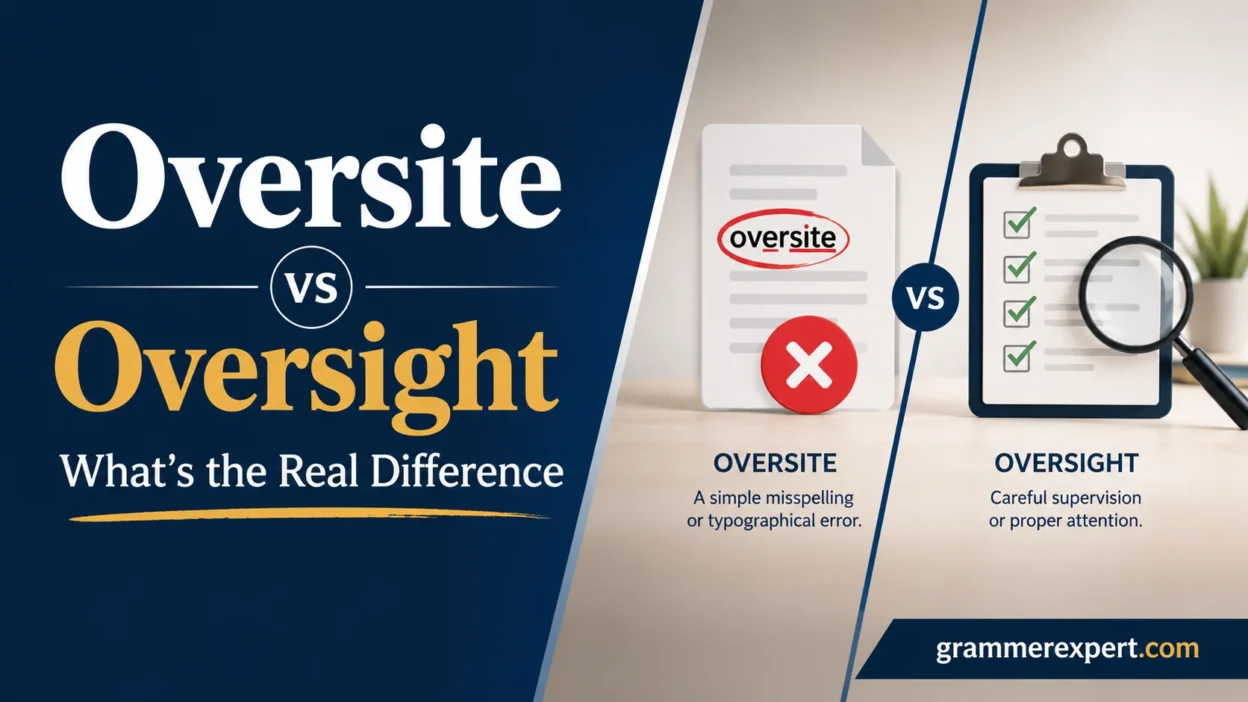
Oversite vs Oversight What’s the Real Difference In professional writing oversight and oversite confusion can damage credibility and meaning quickly.
In professional writing, oversight vs oversite often creates confusion in professional writing, especially in business, law, and academic contexts. At first, the words may seem the same, but only One word is correct, widely accepted, meaningful while The other is almost always an error. This mistake can quietly damage credibility, and it is important to learn the correct usage, grammar rules, and meaning so you can avoid it forever. Language mistakes often sneak into writing, and people do not always realize the errors at first glance, yet they can completely change readers view of your credibility. This is one most common examples, where both terms appear identical, share same opening letters, and sound somewhat similar in fast conversation, but only one belongs standard english situations.
I once confidently typed the wrong term in a report, and that moment made me pause and figure out the real difference. That experience showed me how easily people get confused, even when context feels clear. After I stopped checking properly, I realized tricky English situations need attention. It was a common mix-up, but once understood, you can use the right word with confidence every time without second guessing again.
Oversight vs Oversite: Quick Answer You Can Trust
Let’s cut through the noise.
- Oversight is the correct and widely accepted word
- Oversite is usually a mistake or rare technical term
Here’s a clean comparison:
WordMeaningCorrect UsageFrequencyOversightSupervision or unintentional mistakeYesVery highOversiteRare technical term or typoNo (mostly)Extremely low
If you remember one thing, remember this:
👉 Use “oversight” in almost every situation.
CLICK HERE: Indulgent vs Sober: What’s the Real Difference?
What Does “Oversight” Mean?
The word oversight carries two distinct meanings. That’s where things get interesting.
Oversight as Supervision
In many contexts, oversight means watching over something carefully.
Think management. Think responsibility.
Examples:
- The board provides oversight for company operations
- Government agencies ensure financial oversight
- A manager maintains project oversight
This meaning conveys control, authority, and responsibility.
It appears often in:
- Business reports
- Legal documents
- Corporate communication
- Government policies
Oversight as a Mistake
Here’s the twist. The same word also means the opposite.
Oversight can refer to something you missed.
Examples:
- Missing the deadline was an oversight
- The typo happened due to an oversight
- Forgetting the attachment was an oversight
Now the word signals error, not control.
Why Does One Word Have Two Meanings?
Language doesn’t always play fair.
The dual meaning comes from historical usage. Over time, oversight evolved to reflect both:
- “Seeing over” something (supervision)
- “Overlooking” something (missing it)
Context decides the meaning.
That’s why sentences matter more than definitions.
What Does “Oversite” Mean?
Let’s address the confusing one.
Is “Oversite” a Real Word?
Technically, yes. But here’s the catch.
Oversite is extremely rare.
You’ll almost never see it in everyday writing.
Where “Oversite” Actually Appears
In niche industries, especially construction, oversite has a specific meaning.
It refers to:
- A layer of material, often concrete
- Placed beneath flooring
- Used for stability and support
Example:
- The contractor poured an oversite layer before installing tiles
Outside of that context, the word feels out of place.
Why You Should Avoid Using “Oversite”
In general writing, using oversite creates problems:
- Readers assume it’s a typo
- It reduces trust instantly
- It distracts from your message
Even if you’re technically correct, clarity matters more.
👉 Unless you work in construction, avoid “oversite.”
Oversight vs Oversite: Key Differences Explained Clearly
Let’s simplify things with a side-by-side breakdown.
FeatureOversightOversiteMeaningSupervision or mistakeConstruction-related termUsageCommon in daily writingRare and technicalContextBusiness, education, lawConstruction and engineeringRiskSafe and clearEasily misunderstoodReader ImpactBuilds credibilityCreates confusion
One word builds authority.
The other raises eyebrows.
Common Mistakes People Make with Oversight vs Oversite
Even experienced writers slip up here.
Typing “Oversite” by Accident
This happens more than you’d expect.
Reasons include:
- Fast typing
- Muscle memory errors
- Autocorrect issues
Example:
- ❌ This was an oversite
- ✅ This was an oversight
That small typo changes everything.
Misunderstanding the Meaning of “Oversight”
Some writers avoid oversight because it feels confusing.
They think:
- It only means supervision
- Or only means mistake
But it means both.
Context clears it up.
Using “Oversite” in Formal Writing
This mistake hits hardest in professional settings.
Imagine using oversite in:
- A resume
- A client email
- A business proposal
It signals carelessness.
And in competitive environments, that matters.
Real-Life Examples That Make It Stick
Let’s ground this in real scenarios.
Business Example
The director ensures oversight of all financial operations.
Meaning: supervision.
Clear and professional.
Error Example
The missing data was an oversight.
Meaning: mistake.
Simple and precise.
Incorrect Usage Example
This issue was an oversite.
This looks like a typo.
Even if you meant well, readers won’t see it that way.
Case Study: How One Word Can Damage Credibility
A mid-sized company sent a proposal to a potential client.
The document included this line:
“Any delays were due to an oversite.”
The client noticed immediately.
Here’s what happened:
- The proposal felt rushed
- Attention to detail came into question
- The company lost the contract
One letter cost them a deal.
That’s the real impact of oversite vs oversight confusion.
Easy Memory Trick to Never Get It Wrong
You don’t need to memorize definitions.
Use this simple trick.
Think About “Sight”
- Oversight contains “sight”
- It relates to seeing or missing something
So:
- Watching over something → oversight
- Missing something → oversight
What About “Oversite”?
Think of it like a typo.
Unless you’re pouring concrete, skip it.
When You Can Actually Use “Oversite”
There are rare cases where it fits.
Construction Context
In building projects, oversite refers to:
- A base layer under floors
- Often made of concrete
- Provides structural support
Example:
- The builder completed the oversite before laying tiles
Should You Use It?
Only if:
- You’re writing technical content
- Your audience understands the term
Otherwise, avoid it.
Oversight in Professional Writing
Now let’s talk strategy.
Using oversight correctly strengthens your writing.
Where It Adds Value
- Business communication
- Legal writing
- Academic papers
- Government reports
Why It Works
It signals:
- Authority
- Clarity
- Precision
Strong writing builds trust.
And trust drives results.
Quick Usage Checklist
Before you use either word, ask yourself:
- Am I talking about supervision? → Oversight
- Am I describing a mistake? → Oversight
- Am I writing about construction layers? → Maybe oversite
Still unsure?
👉 Choose oversight.
You’ll almost always be right.
Key Facts You Should Know
- Oversight appears in millions of published documents annually
- Oversite rarely appears outside technical manuals
- Spellcheck tools often miss “oversite” because it’s technically valid
- Professional editors flag “oversite” instantly in general writing
These facts highlight one thing:
👉 Precision matters.
Oversight vs Oversite in SEO and Content Writing
If you create content, this distinction becomes even more important.
Why It Matters for SEO
Search engines prioritize:
- Clear language
- Correct spelling
- User trust
Using the wrong word can:
- Increase bounce rate
- Reduce credibility
- Hurt rankings
Smart Content Strategy
Use variations naturally:
- Oversight meaning
- Oversight examples
- Oversight vs oversite difference
Avoid forcing keywords.
Let them flow.
Quote That Captures the Idea
“Clarity in language reflects clarity in thought.”
That’s why small word choices matter.
FAQs
1. What is the main difference between oversite and oversight?
Oversight is the correct English word, while oversite is generally a spelling error used by mistake.
2. Is “oversite” ever correct in English?
No, in most cases oversite is incorrect and should not be used in professional writing.
3. What does oversight mean?
Oversight means careful supervision or a mistake caused by not noticing something.
4. Why do people confuse oversite and oversight?
They look and sound similar, which creates confusion, especially during fast typing or speaking.
5. Where is the word oversight commonly used?
It is used in business, law, academic work, and management reports.
6. Can using oversite affect my writing?
Yes, using oversite instead of oversight can reduce your credibility in professional writing.
7. How can I avoid this mistake?
You can avoid it by learning that only oversight is correct and by practicing its usage in sentences.
8. Is oversight always about mistakes?
No, oversight can also mean supervision or control, not just an error.
Conclusion
In simple terms, oversight is the correct word used in professional and formal writing, while oversite is usually a spelling mistake. Many people get confused because both words look similar, but only one has real meaning in standard English.
Understanding this difference helps improve your writing accuracy, grammar, and credibility. Once you remember the correct form, you can confidently avoid this common error in emails, reports, and academic work.