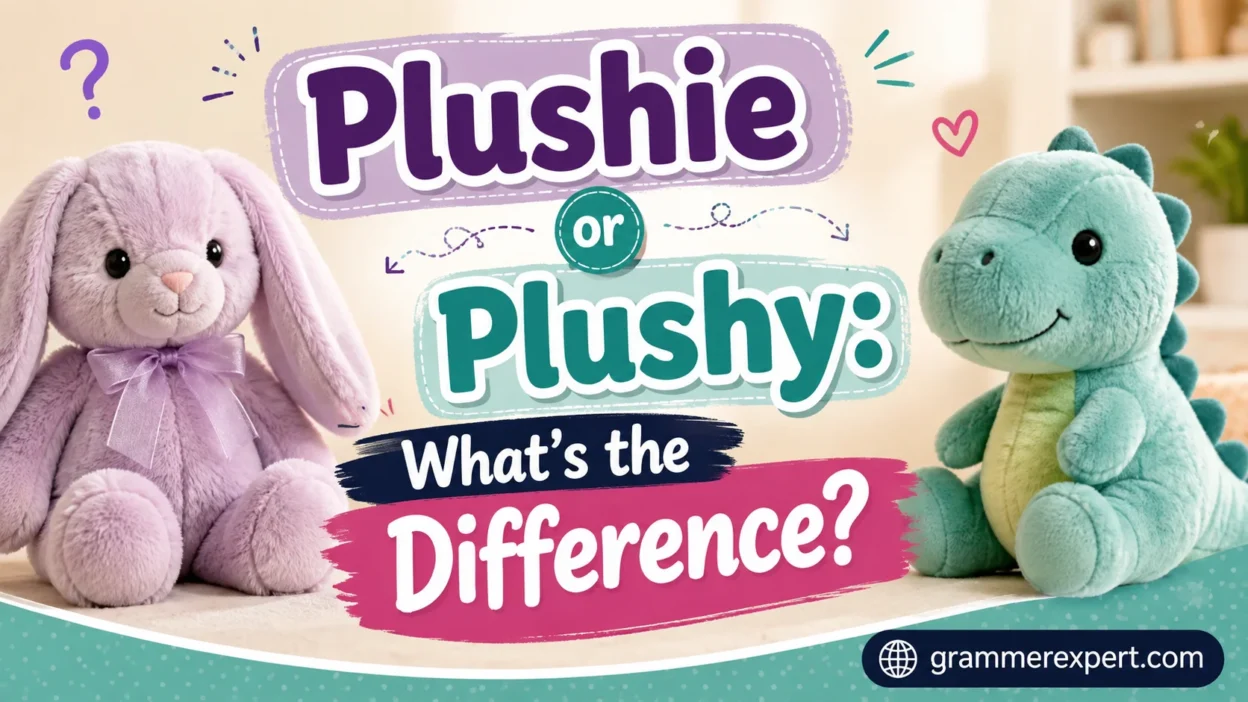
The Plushie or Plushy: What’s the Difference? comes down to grammar, usage, and the role each word plays in a sentence.
Although plushie and plushy may look identical and sound almost the same, their grammatical roles differ. A plushie is a noun for a stuffed toy, soft stuffed toy, stuffed animal, cuddly toy, or plush toy, meaning the toy itself. Plushy, however, is mainly an adjective for describing something that feels soft, has a soft texture, or resembles plush fabric. It can describe a plush-like appearance, texture, softness, comfort, or luxurious feel. In practical language usage, knowing this distinction makes the choice easier.
The meaning becomes clearer when you look at the grammatical role, function, and context. Plushie noun is the usual noun usage, while plushy adjective is the main adjective usage. If you’re naming a toy, plushie noun is the clearest choice. If you’re describing its material, soft texture, or luxurious feel, plushy adjectives work better. Plush can also describe something soft or rich, while plushy is primarily used in a similar descriptive way. Merriam-Webster recognizes plushy as a less common noun variant of plushie, so plushy noun is possible even though it isn’t the commonly used form. This variant also matters when considering spelling, terminology, and vocabulary.
Plushie vs. Plushy: Quick Answer
Here’s the easiest way to separate the two:
| Word | Typical Part of Speech | Main Meaning | Example |
| Plushie | Noun | A soft stuffed toy | “I bought a cute plushie.” |
| Plushy | Adjective | Soft, plush-like, or luxurious | “The blanket feels plushy.” |
| Plushy | Noun, less common | Another term for a plushie | “She collects plushies.” |
| Plush | Noun/Adjective | Soft fabric or something soft/luxurious | “The chair has plush cushions.” |
Cambridge Dictionary defines plushie as a toy made from cloth and filled with soft material. Its examples include animal-shaped toys and crocheted plushies.
Merriam-Webster gives plushy two entries: an adjective describing something having the texture or covering of plush and a less common noun meaning a toy covered in plush fabric.
That means saying “plushie is correct and plushy is wrong” would be too simplistic. Context matters.
READ MORE: Vinal vs Vinyl: What’s the Difference?
What Does “Plushie” Mean?
Plushie Definition and Meaning
Plushie is a noun used for a soft stuffed toy. These toys are often shaped like animals, characters, food, objects, or imaginary creatures.
Think of a teddy bear, stuffed cat, dinosaur, mushroom, or fictional character made with soft fabric and stuffing. Any of these can be called a plushie.
Cambridge Dictionary specifically describes a plushie as a toy made from cloth and filled with soft material so it feels pleasant to hold.
The word has a warm, casual feel. It’s especially natural in conversations about collecting toys, gifts, fandom merchandise, children’s toys, and cute decorative objects.
Examples of “Plushie” in a Sentence
- “I bought a little plushie at the gift shop.”
- “Her favorite plushie is a pink rabbit.”
- “He keeps his character plushies on a shelf.”
- “That dinosaur plushie is surprisingly soft.”
- “My friend gave me a cat plushie for my birthday.”
- “She takes her favorite plushie everywhere.”
Notice something important: in these sentences, plushie names the object. It doesn’t describe the object’s texture.
You can test this with a simple question: What is it?
“It’s a plushie.”
That answer identifies the toy itself.
Is “Plushie” a Real Word?
Yes. Plushie is an established English noun, not merely a misspelling of plushy.
Cambridge Dictionary includes plushie as a noun, while Merriam-Webster lists plushie among its nearby dictionary entries.
The word is informal, but informal doesn’t mean incorrect. English contains countless everyday words that developed outside highly formal writing and later became widely recognized.
For example, kid is informal for child, yet nobody would mistake it for meaningless English. In the same way, plushie has a clear meaning and established usage.
What Does “Plushy” Mean?
Plushy Definition and Meaning
Plushy is most commonly an adjective. It describes something that has the texture or qualities associated with plush.
Merriam-Webster defines the adjective as having the texture of or being covered with plush. It also gives a second sense meaning notably luxurious.
For example:
- “The sofa has plushy cushions.”
- “She wrapped herself in a plushy blanket.”
- “The hotel has a plushy interior.”
- “The fabric feels wonderfully plushy.”
In these sentences, plushy tells you what something is like.
That’s the crucial distinction.
Plushie = the thing.
Plushy = a description of the thing.
Can “Plushy” Describe a Stuffed Toy?
Absolutely.
You can describe a stuffed toy as plushy when you’re focusing on its softness or texture.
Compare these two sentences:
“I bought a plushie.”
“I bought a plushy toy.”
The first sentence identifies the object as a plushie. The second describes the toy as plushy.
Both can make sense, but they communicate slightly different ideas.
A useful comparison would be “pillow” and “soft.” A pillow is an object. Soft describes its texture. Likewise, a plushie is an object while plushy generally describes a quality.
Plushie vs. Plushy: Main Differences
Plushie and Plushy Have Different Grammatical Jobs
Grammar makes the distinction much easier.
Plushie normally functions as a noun:
- “That plushie is adorable.”
- “I ordered two plushies.”
- “Where did you put the plushie?”
Plushy normally functions as an adjective:
- “That toy is plushy.”
- “She bought a plushy blanket.”
- “The cushions are plushy.”
This difference resembles other noun-adjective pairs. Consider “fluff” and “fluffy.” Fluff names something while fluffy describes something.
The same basic pattern helps explain plushie and plushy.
Plushie Names an Object
When you can naturally use a, the, or my directly before the word, plushie often works:
- “a plushie”
- “the plushie”
- “my plushie”
- “her plushie”
- “three plushies”
For example, “I found my plushie under the bed” clearly treats plushie as a noun.
Plushy Describes a Quality
When the word describes texture, comfort, or luxury, plushy generally acts as an adjective:
- “a plushy blanket”
- “a plushy chair”
- “a plushy toy”
- “a plushy surface”
Merriam-Webster also records the adjective’s comparative and superlative forms as plushier and plushiest.
So you might write:
- “This blanket is plushier than the old one.”
- “That’s the plushiest chair in the room.”
Plushie vs. Plush Toy: Are They the Same?
Plushie and Plush Toy Overlap
In everyday English, plushie and plush toy can refer to the same basic kind of object.
Cambridge defines plush toy as a toy usually shaped like an animal that is made from plush or another thick, soft cloth and filled with soft material. It lists soft toy and stuffed animal as related terms.
The main difference is tone and structure.
Plush toy is a straightforward descriptive compound noun.
Plushie is shorter, more casual, and often more affectionate.
Compare:
- “The store sells plush toys.”
- “Look at this adorable plushie!”
The first sounds suitable for a product category. The second sounds more conversational.
Plushie vs. Stuffed Animal: What’s the Difference?
A Plushie Can Be Broader Than a Stuffed Animal
The terms overlap, but they aren’t perfectly identical.
Stuffed animal traditionally refers to a soft toy representing an animal. A teddy bear, stuffed dog, or plush elephant fits naturally into this category.
Plushie, however, can refer to many things that aren’t animals.
For example, you can have:
- A cat plushie
- A dinosaur plushie
- A mushroom plushie
- A food-shaped plushie
- A fictional-character plushie
- A fantasy-creature plushie
- A heart-shaped plushie
That broader range makes plushie useful for modern toy collections and character merchandise.
In other words, every plushie doesn’t need to be an animal.
Is “Plushy” the Same as “Plush”?
Plush Has Several Meanings
Plush is the broader root word behind both terms, but it has its own meanings.
As a noun, plush refers to a thick, soft fabric with a surface resembling short fur. Cambridge also defines plush as an adjective meaning soft to the touch.
As an adjective, plush can also mean expensive, comfortable, or luxurious.
For example:
- “The teddy bear is made from plush fabric.”
- “The hotel has plush carpets.”
- “We sat in plush leather chairs.”
Plushy adds the adjective-forming suffix -y, creating a word that means “like plush” or “having the qualities of plush.”
Plush vs. Plushy vs. Plushie
| Word | Function | Meaning | Example |
| Plush | Noun/Adjective | Soft fabric; soft or luxurious | “The chair is plush.” |
| Plushy | Adjective | Like plush; soft or luxurious | “The chair feels plushy.” |
| Plushie | Noun | A soft stuffed toy | “The chair holds a plushie.” |
This three-way comparison clears up most confusion.
Why Do People Confuse Plushie and Plushy?
The Words Look and Sound Almost Identical
The spelling difference is tiny: -ie versus -y.
Both are pronounced with a similar ending, which makes the distinction harder to hear than it is to see.
There’s another reason, too. Plushy can function as a noun in less common usage. Merriam-Webster explicitly identifies the noun plushy as a less common variant of plushie.
That explains why you might encounter both spellings when people mean the same type of toy.
The language isn’t broken. It’s simply doing what language often does: allowing related forms to coexist.
How to Choose Between Plushie and Plushy
Use “Plushie” When You Mean the Toy
If you’re naming the stuffed object itself, plushie is usually your safest choice.
Examples:
- “I bought a new plushie.”
- “This plushie is from my favorite game.”
- “She has twenty plushies.”
- “Which plushie do you want?”
A quick test works well:
Can you say “a plushie” or “the plushie”?
If yes, you’re probably using the noun correctly.
Use “Plushy” When You’re Describing Something
Choose plushy when you want to describe softness, texture, or a plush-like quality.
Examples:
- “This blanket feels plushy.”
- “The toy has a plushy surface.”
- “She loves the plushy cushions.”
- “The bed has a plushy comforter.”
The word answers a different question:
What is it like?
“It’s plushy.”
That’s the easiest mental shortcut.
Common Mistakes With Plushie and Plushy
Mistake: Treating Plushy as the Only Correct Spelling
That isn’t accurate.
Plushy is a legitimate English word, but it’s primarily an adjective. Merriam-Webster also records its less common noun use.
If you mean a stuffed toy, plushie is generally the clearest noun.
Mistake: Assuming Plushie Is Incorrect
That’s also wrong.
Cambridge Dictionary directly defines plushie as a noun for a soft stuffed toy.
So writing “She bought a plushie” is perfectly understandable and established usage.
Mistake: Confusing a Toy With Its Texture
Compare:
- “I bought a plushie.” → names the toy.
- “I bought a plushy toy.” → describes the toy.
That tiny spelling difference changes the grammatical role.
Plushie or Plushy: Which One Should You Use?
The Best Choice Depends on Your Meaning
Use this simple rule:
| If you mean… | Use… |
| A soft stuffed toy | Plushie |
| Something soft or plush-like | Plushy |
| Soft fabric itself | Plush |
| A luxurious or comfortable setting | Plush / Plushy |
For most everyday references to a stuffed toy, plushie is the most direct option.
If you’re describing texture, plushy works naturally.
If you’re talking about the material or a luxurious environment, plush may be better.
Plushie or Plushy Examples in Everyday Writing
Text Messages and Casual Conversations
In casual messages, plushie sounds especially natural:
- “Look what I found! A tiny frog plushie!”
- “I finally got the plushie I wanted.”
- “Your new plushie is so cute.”
- “This thing is ridiculously plushy.”
The context tells you which word makes sense.
Shopping and Product Descriptions
Product descriptions often need more precise wording.
Consider:
“Cute bunny plushie”
Here, plushie identifies the product.
Now compare:
“Soft, plushy bunny toy”
Here, plushy describes the toy’s feel or appearance.
A retailer might reasonably use both in one description:
“This adorable bunny plushie has a soft, plushy texture.”
That sentence demonstrates the distinction perfectly. One word names the object while the other describes it.
A Simple Memory Trick for Plushie vs. Plushy
Remember: Plushie Is the Thing, Plushy Is the Description
Think of the pair this way:
Plushie → What is it?
Plushy → What is it like?
For example:
“What did you buy?”
“A plushie.”
“How does it feel?”
“It’s plushy.”
This little trick can prevent most spelling mistakes.
FAQs
Is plushie or plushy correct?
Both plushie and plushy are correct, but they usually have different grammatical functions. Plushie is mainly a noun for a soft stuffed toy, while plushy is primarily an adjective describing something soft, cushioned, or plush-like.
What does plushie mean?
Plushie is a noun that means a soft, stuffed toy. It can refer to a stuffed animal, cuddly toy, or other soft plush toy.
What does plushy mean?
Plushy is mainly an adjective that describes something soft, comfortable, or similar to plush fabric. For example, you might describe a blanket as plushy because it has a soft texture.
Is plushy a noun or an adjective?
Plushy is primarily an adjective. However, Merriam-Webster recognizes it as a less common noun variant of plushie, so it can occasionally be used as a noun.
Is a plushie the same as a stuffed animal?
A plushie can be a stuffed animal, but the term is broader. It can describe many types of soft, stuffed toys, including animals, characters, and other shapes.
Can plushy describe a toy?
Yes. Plushy can describe a toy when you want to emphasize its softness, texture, or comfortable feel. For example, “The plushy toy feels incredibly soft.”
Which is more commonly used, plushie or plushy?
Plushie is generally the clearer and more common choice when you’re talking about the toy itself. Plushy is more often used to describe the toy’s texture or appearance.
How do I remember the difference between plushie and plushy?
A simple trick is to remember that plushie usually names a thing, while plushy usually describes a thing. If you’re naming the stuffed toy, use plushie. If you’re describing how soft it feels, plushy is usually the better choice.
Conclusion
The difference between plushie and plushy is mostly about word function. Use plushie when you mean a soft stuffed toy, and use plushy when you’re describing something as soft, cushioned, or plush-like. Although the words look and sound similar, understanding their grammatical roles makes the correct choice much easier.