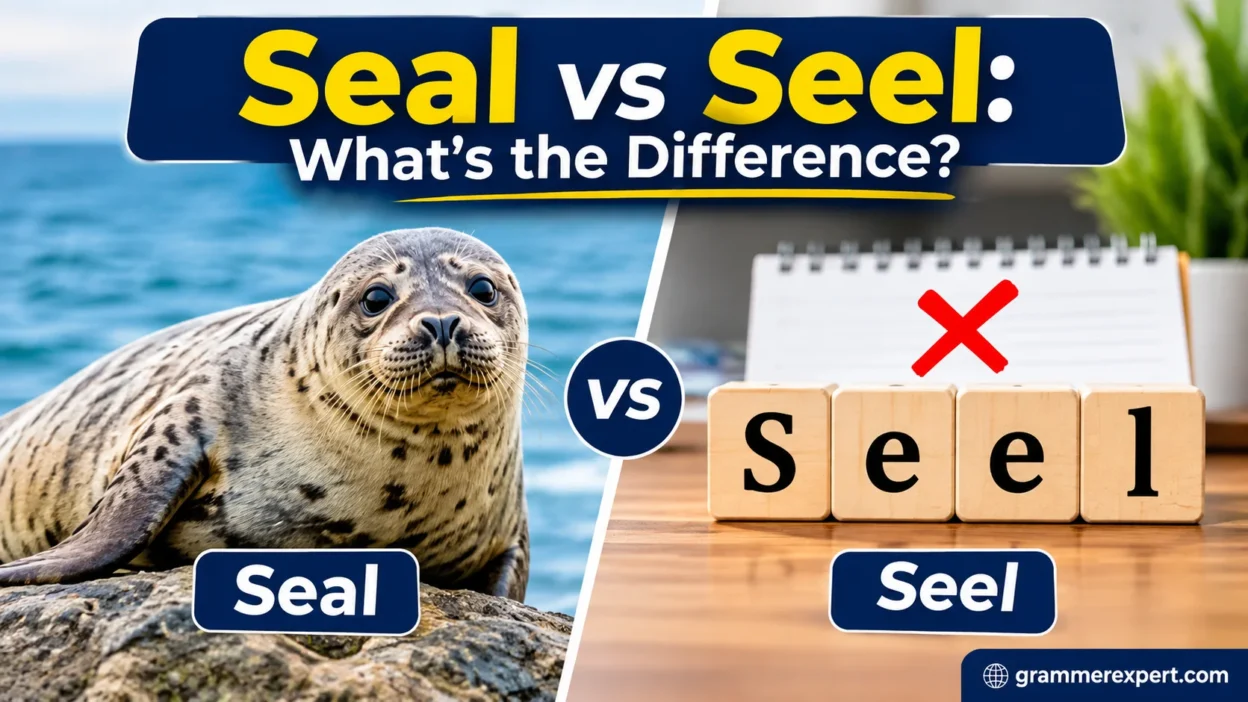
Seal vs Seel: What’s the Difference? helps English learners who confuse seal and seel because they look and sound similar, but have meanings.
These words belong to different contexts and different eras. Seal is common in modern English, while seel is an older term often found in history books. Learning this distinction can improve your vocabulary, writing accuracy, and communication skills. In everyday usage, seal has several familiar meanings, such as an ocean animal or the act of closing something securely, while seel has a much narrower meaning. Understanding this difference makes the seal vs seel meaning easier to remember and use correctly.
A useful guide is to check the context before choosing either word. You may find seal in emails, contracts, or sentences about ocean animals, while seel tends to appear in older writing. This can create confusion, particularly when autocorrect fails to clear up the problem. When writing, reading the entire sentence can help untangle the choice, so you don’t second-guess yourself mid-sentence simply because the words look alike. Once you understand their usage and meaning, you can spot the right word faster and avoid letting autocorrect argue with your writing. This approach also builds stronger understanding, communication, and writing skills.
Seal vs Seel: The Quick Difference
The fastest way to understand seal vs seel is to put their meanings side by side.
| Word | Part of Speech | Main Meaning | Modern Usage |
| Seal | Noun, verb | A marine mammal, official mark, closure, or act of securing something | Very common |
| Seel | Verb | To close a bird’s eyes, especially in historical falconry | Rare and specialized |
Both words are pronounced /siːl/ in the standard dictionary pronunciation. Cambridge gives seal the pronunciation /siːl/, while Merriam-Webster gives the same pronunciation for seel.
That’s why hearing the word won’t always help you choose the spelling. Context does the heavy lifting.
For example, if someone says, “Please seal the envelope,” the intended word is obvious from the action. If a historian writes about a falconer who would seel a hawk, the unusual spelling becomes meaningful because the sentence describes a specialized historical practice.
In everyday communication, seal is overwhelmingly the word you’re likely to need.
READ ALSO: Remanent vs Remnant: What’s the Difference?
What Does Seal Mean?
Seal has several established meanings, which explains why it appears in such a wide range of sentences. Merriam-Webster lists separate noun and verb senses covering animals, authentication, closures, protection, and making something final.
Seal as a Noun
One common meaning refers to a marine mammal. Seals are aquatic mammals that spend part of their lives in the sea and part on land or ice. Cambridge describes a seal as a large mammal that eats fish and lives partly in the sea and partly on land or ice.
For example:
- We saw a seal resting on the rocks.
- A young seal followed its mother into the water.
- The boat passed several seals near the coast.
The word also refers to an official mark placed on a document. Historically, seals could be impressed into wax or another material to authenticate or validate something. Today, the word often refers to an official emblem or mark rather than an actual piece of wax.
For example:
- The certificate carries the state seal.
- The document bears an official seal.
Another important meaning involves closure or protection. A seal can prevent air, gas, water, or another substance from passing through an opening. That’s why you’ll encounter terms such as airtight seal, rubber seal, and broken seal.
For example:
- The bottle has a broken seal.
- The gasket creates a tight seal around the pipe.
Seal as a Verb
As a verb, seal generally means to close, secure, authenticate, or make something final.
You might seal an envelope by closing it. You might seal a crack to stop water from getting through. You might seal an agreement by formally confirming it. You can even say that an event sealed someone’s fate, meaning it determined the final outcome. Merriam-Webster records these different verb senses.
Consider these examples:
- Please seal the envelope before you mail it.
- Workers sealed the crack with waterproof material.
- The signatures sealed the agreement.
- That final goal sealed the team’s victory.
The central idea is often security or finality. Think of a sealed container: once it’s properly closed, something can’t freely enter or escape. The figurative uses build on that same idea of making something secure or settled.
What Does Seel Mean?
Seel is a real English word, but it isn’t a normal substitute for seal. Its modern relevance is narrow because its principal meaning belongs to historical falconry.
Merriam-Webster defines seel as a verb meaning to close the eyes of a bird, such as a hawk, by drawing threads through its eyelids. It also records an archaic meaning meaning to close one’s eyes. The dictionary dates its first known use to the 15th century.
Dictionary.com similarly identifies seel with falconry and records an archaic sense meaning to close or blind the eyes.
Seel in Historical Falconry
The word becomes much easier to understand when you see its historical context.
Falconry developed a specialized vocabulary for handling and training birds of prey. Seel belongs to that old vocabulary. In historical descriptions, the verb referred specifically to closing a hawk’s or falcon’s eyes by sewing through the eyelids.
That practice is far removed from ordinary modern English. You won’t normally need seel when writing an email, school assignment, business report, blog post, or everyday conversation.
For example:
- The historical account describes how falconers would seel a hawk’s eyes.
- The manuscript uses the verb seel in its discussion of falconry.
The word can therefore appear in historical literature or discussions of older falconry practices even though most modern readers rarely encounter it.
Seel as an Archaic Verb
The word also has an archaic meaning connected with closing the eyes. Dictionary.com records meanings involving closing or blinding the eyes.
That distinction matters because modern readers may see seel in an older text and assume it’s a spelling error. It isn’t necessarily an error. Historical English contains many words that have fallen out of everyday use.
So if you encounter seel in an old literary passage, don’t automatically replace it with seal. First consider the context.
Seal vs Seel: Key Differences
Although seal and seel sound identical, their meanings don’t overlap in ordinary modern English.
Their Meanings Are Different
Seal can describe a marine animal, an official mark, a closure, or the action of securing something. Seel refers primarily to a historical falconry practice involving a bird’s eyes.
This is the most important distinction.
| Meaning | Correct Word |
| Marine mammal | Seal |
| Official emblem on a document | Seal |
| Protective closure | Seal |
| Close an envelope | Seal |
| Prevent leakage | Seal |
| Make something final | Seal |
| Historical falconry term involving a bird’s eyes | Seel |
Their Parts of Speech Differ
Seal functions as both a noun and a verb. You can talk about a seal or say that you will seal something.
Seel is chiefly a verb. Merriam-Webster lists the forms seel, seeled, seeling, and seels.
That gives you another useful clue. If you’re trying to name a thing, seel almost certainly isn’t the word you need.
Their Frequency Is Dramatically Different
The difference in everyday usage is enormous.
Seal appears regularly in conversations, news reports, technical writing, legal documents, packaging instructions, and ordinary descriptions of wildlife. Seel is much more specialized and generally appears in historical or literary contexts.
Consequently, when you’re unsure whether to write seal or seel, don’t treat the two spellings as equal alternatives. In normal modern writing, seal is almost certainly correct unless your subject specifically involves the historical verb.
Seal vs Seel: Are They Pronounced the Same?
Yes. Seal and seel are pronounced alike in the relevant standard English pronunciation: /siːl/.
That makes them homophones: words that sound the same but differ in spelling and meaning.
This is exactly where the confusion begins. Imagine hearing someone say:
“The word sounds like ‘seel.’”
Without context, you can’t know whether they mean seal or seel.
Writing requires another step. You must connect the sound to the intended meaning.
If someone is talking about a package, the spelling is seal. If they’re discussing an old falconry text, seel may be appropriate.
In other words, sound tells you how the word is pronounced, while context tells you which spelling belongs on the page.
Seal vs Seel Examples in Sentences
Examples make this distinction much easier to absorb.
Examples With Seal
Here are common modern uses:
- The company sealed the package before shipping it.
- We watched a seal swimming near the shore.
- The official seal appeared at the bottom of the certificate.
- The plumber replaced the damaged seal.
- The team scored late and sealed the victory.
- Make sure you seal the container tightly.
- The broken seal allowed air to enter the package.
Each sentence uses seal because it refers to a common modern meaning.
Examples With Seel
Because seel is rare, its examples naturally sound more historical:
- The manuscript describes how a falconer might seel a hawk.
- The historian explained the old practice of seeling a bird’s eyes.
- The rare verb seel appears in the falconry passage.
These examples don’t treat seel as a normal synonym for seal. That’s an important point.
Side-by-Side Examples
| Sentence | Why It Works |
| Please seal the envelope. | Closing an everyday object |
| The bottle has a tight seal. | A protective closure |
| A seal surfaced beside the boat. | Marine mammal |
| The document bears an official seal. | Authentication |
| The historical text describes how to seel a hawk. | Falconry terminology |
The contrast is simple: seal belongs to ordinary modern English; seel belongs mainly to a specialized historical vocabulary.
Common Mistakes With Seal and Seel
Mistake: Using Seel for Everyday Closing
You wouldn’t normally write:
Please seel the envelope.
That’s incorrect.
The correct sentence is:
Please seal the envelope.
The action involves closing the envelope, which is one of the standard modern meanings of seal.
Mistake: Treating Seel as an Alternative Spelling
The spelling seel isn’t simply an old-fashioned version of seal that you can use whenever you want.
The two words have separate histories and meanings. Merriam-Webster traces seel through Middle English and Anglo-French terms ultimately connected with the Latin word cilium, meaning eyelid or eyelash.
Mistake: Choosing Based Only on Sound
This is perhaps the easiest mistake to make.
Because both words sound like “seel,” spelling by sound won’t reliably work. Instead, ask yourself one question:
What does the word mean in this sentence?
That question usually solves the problem immediately.
Seal vs Seel: Which One Should You Use?
Use seal for almost every ordinary modern situation.
Choose seal when you’re talking about:
- A marine mammal
- An official emblem or mark
- A package or envelope
- A protective closure
- Preventing air or water from escaping
- Making an agreement final
- Making something secure
- Determining an outcome
Use seel only when you specifically mean the rare historical verb involving the closing of a bird’s eyes.
Here’s the simplest decision rule:
Everyday meaning → SEAL
Historical falconry meaning → SEEL
That rule covers the overwhelming majority of situations.
Seal vs Seel: An Easy Memory Trick
A simple memory trick can keep these spellings apart.
Think of SEAL as the everyday word for something you secure.
SEAL = secure, close, authenticate, or marine mammal.
Then remember SEEL as the unusual word connected with eyes in historical falconry.
You don’t need a complicated mnemonic. In fact, a short rule is more useful:
Seal is common. Seel is specialized.
When writing quickly, ask what you’re describing. A jar? Seal. An envelope? Seal. A marine animal? Seal. An old falconry practice involving a hawk’s eyelids? Seel.
Seal vs Seel: Word Forms
The common forms of seal include:
- seal
- seals
- sealed
- sealing
Examples include seal the box, seals the package, sealed the door, and sealing the container.
For seel, Merriam-Webster lists:
- seel
- seels
- seeled
- seeling
Because seel is so uncommon, these forms are much less likely to appear in contemporary everyday writing.
Seal vs Seel: Etymology and History
The histories of these words provide an interesting twist: despite their similar spelling and identical pronunciation, they don’t simply represent one word with two spellings.
History of Seal
The animal sense of seal has a long history in English. Merriam-Webster traces it through Middle English sele to Old English seolh. Its animal sense dates to before the 12th century.
The noun referring to an official mark has a different history. Merriam-Webster traces that sense through Middle English and Anglo-French to Latin sigillum, meaning a seal or small sign. The word later developed related meanings involving authentication, security, and closure.
That’s why modern seal can refer to both a marine mammal and an official mark even though those meanings have different historical roots.
History of Seel
Seel has a separate history connected with the eye.
Merriam-Webster traces it through Middle English and Anglo-French to Latin cilium, meaning eyelid. The dictionary records its first known use in the 15th century.
Dictionary.com similarly traces the word through Middle French terms associated with the eyelid and eyelash.
So the similarity between seal and seel shouldn’t fool you. Their modern forms look almost like twins, but their histories tell different stories.
Seal vs Seel vs Similar-Sounding Words
English contains many words that sound alike while carrying unrelated meanings. Seal vs seel is a particularly tricky example because both spellings look plausible.
| Word | Meaning |
| Seal | Marine mammal, official mark, closure, or act of securing |
| Seel | Rare historical falconry verb |
| See | Perceive something with your eyes |
The key isn’t memorizing every possible homophone. Instead, train yourself to connect each spelling with its meaning.
That habit becomes especially valuable when proofreading. If a word sounds right but looks unfamiliar on the page, stop and check its definition rather than assuming the spelling is interchangeable.
Frequently Asked Questions
1. What’s the main difference between seal and seel?
Seal is a common modern English word with several meanings, while seel is a rare, old-fashioned word mainly found in historical contexts.
2. Is seal or seel correct?
Both are correct words, but they have different usage. Use seal for modern everyday writing and communication. Seel is appropriate only in specific historical or specialized contexts.
3. Are seal and seel pronounced the same?
They can sound similar, which is one reason English learners may confuse them. Their meanings and typical usage, however, are quite different.
4. What does seal mean?
Seal can refer to an ocean animal, closing or securing something, or an official mark. The correct meaning depends on the context and sentence.
5. What does seel mean?
Seel is an uncommon historical term associated with falconry. Because it rarely appears in modern English, you’re more likely to encounter it in history books or older writing.
6. Why do people confuse seal and seel?
People often confuse them because they look and sound similar. Checking the surrounding context can help you spot the correct word.
7. Can autocorrect tell me whether to use seal or seel?
Not always. Autocorrect may recognize both as valid words, so it might not clear up the difference. Understanding their meaning and usage is more reliable.
8. How can I remember the difference between seal and seel?
Think of seal as the familiar modern word you’ll see in everyday writing, emails, contracts, and references to ocean animals. Reserve seel for its rare historical usage.
Conclusion
The difference between seal and seel becomes much easier once you focus on context and meaning. Seal is the word you’ll encounter far more often in modern English, while seel has a narrow and largely historical usage. When you’re unsure, check the sentence, consider the context, and don’t let similar-looking words make you second-guess your writing.