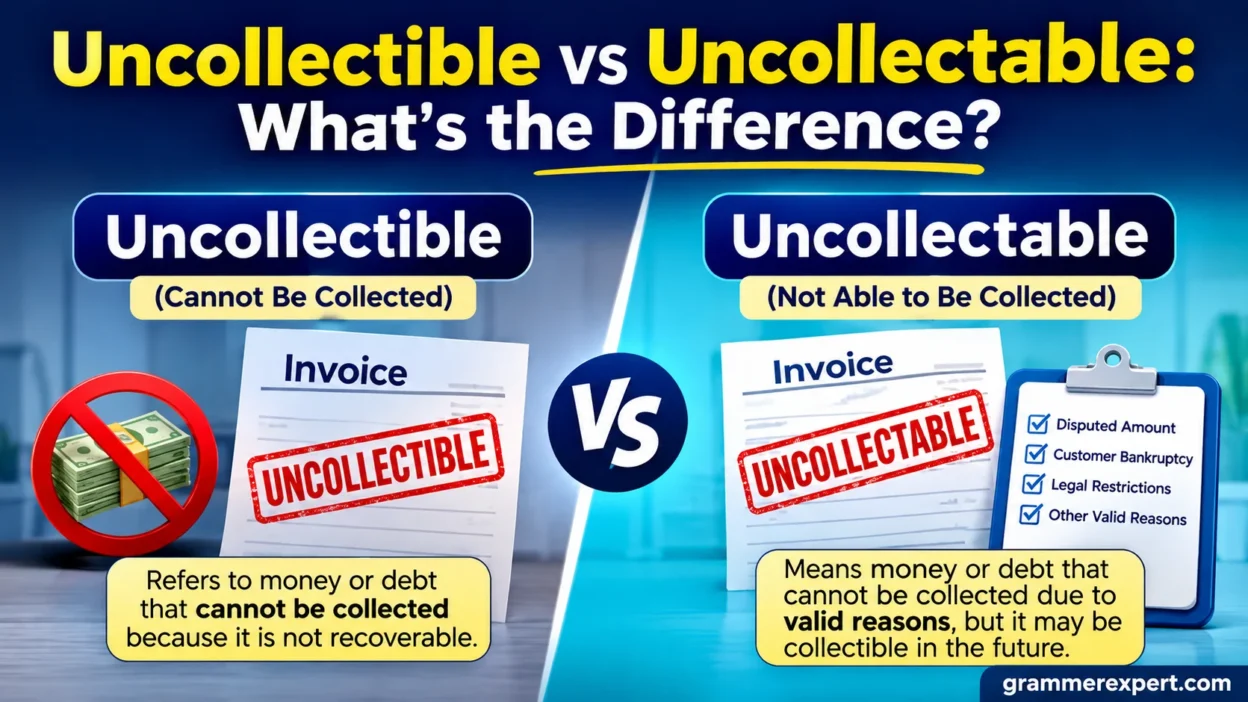
Uncollectible vs Uncollectable: What’s the Difference? This guide makes the spelling confusion simple, clear, and easy to understand for writers.
It’s easy to get confused when uncollectible and uncollectable look almost the same, have nearly identical spelling, and seem identical at a quick glance. Both words sound exactly alike when spoken, so the small difference between their -ible and -able endings can create hesitation. In similar situations, both forms may be used for unpaid bills, debts, or money that cannot be recovered. This can leave writers, students, and editors unsure about choosing the correct spelling.
The real difference is mainly connected to usage, style, audience, and meaning in different types of writing. This guide helps explain the difference between uncollectible and uncollectable in a simple, clear way and shows how to use each word correctly in emails, blogs, and school work. Spellcheck tools may accept both words, which can create doubt, but simple rules, clear examples, and easy tips can clear up the confusion. Whether you’re learning English, studying for exams, or improving an article, understanding the real meaning of both words can make you more confident about using correctly the right spelling in your writing.
For readers searching this keyword, the goal is a clear answer without unnecessary complexity. Knowing the two spellings can help you avoid common mistakes and prevent your writing from sounding careless or unprofessional. The difference becomes easier to remember when you consider your audience and the context. A useful writing habit is to check the surrounding sentence before deciding which form fits best. This practical approach keeps the meaning simple and clear, while easy examples and careful attention to spelling confusion make the distinction easier to manage.
Uncollectible vs. Uncollectable: Quick Answer
The difference between uncollectible and uncollectable is primarily regional rather than semantic. Both adjectives describe something that cannot be collected or recovered.
| Word | Main regional preference | Meaning | Common example |
| Uncollectible | American English | Not able to be collected | uncollectible debt |
| Uncollectable | British English | Not able to be collected | uncollectable debt |
Cambridge Dictionary specifically labels uncollectible as mainly US and uncollectable as mainly UK. Collins likewise recognizes both spellings and identifies uncollectible as the American form while treating it as a variant of uncollectable in British English.
So, neither spelling deserves a red “wrong” stamp.
If you’re writing for American readers, uncollectible is usually the safer choice. For a British audience, uncollectable may sound more natural. The important thing is to match your audience and remain consistent.
READ MORE: Bright vs Brite: What’s the Difference?
What Does “Uncollectible” Mean?
Uncollectible means not capable of being collected. In everyday usage, it can describe something that cannot be gathered or obtained. However, the word appears particularly often in financial contexts involving money that someone owes but won’t pay.
For example, a customer might owe a business $5,000 for unpaid invoices. If the business determines that it has little realistic chance of recovering that money, it may describe the debt as uncollectible.
Merriam-Webster defines uncollectible as something that isn’t capable of or suitable for being collected. It gives examples such as uncollectible loans and uncollectible debt.
Consider these examples:
- The bank classified the loan as uncollectible.
- The company wrote off several uncollectible accounts.
- The agency identified millions of dollars in uncollectible debt.
- The business expects some old invoices to become uncollectible.
In each sentence, the word points toward lack of recoverability. The money may still exist as a recorded obligation, but collecting it has become unlikely or impossible.
Examples of Uncollectible in a Sentence
Here are several natural examples:
The company removed the uncollectible debt from its expected receivables.
After years of unsuccessful attempts, the account became uncollectible.
The bank reviewed its portfolio and identified several uncollectible loans.
The business increased its allowance for potentially uncollectible accounts.
The word doesn’t necessarily mean that collection was never attempted. In fact, an amount often becomes classified as uncollectible after repeated collection efforts fail or circumstances make recovery unrealistic.
What Does “Uncollectable” Mean?
Uncollectable has essentially the same core meaning: not able to be collected or gathered. Cambridge identifies this spelling as mainly UK English while noting uncollectible as the mainly US counterpart.
Collins gives examples involving uncollectable taxes and uncollectable debts, which shows how naturally the term fits financial contexts.
For example:
- The government faced millions in uncollectable taxes.
- Several customers had uncollectable debts.
- The company wrote off an uncollectable account.
- The lender reviewed its list of uncollectable loans.
Notice something important: these sentences don’t communicate a different financial concept from their American-English counterparts. You could replace uncollectable with uncollectible without changing the basic meaning.
Uncollectable Examples in Context
Imagine a small British business that sells equipment on credit. One customer stops responding, moves without leaving contact information, and has no accessible assets. After reasonable collection efforts fail, the company might describe the outstanding invoice as uncollectable.
That word doesn’t tell you precisely why the business can’t recover the money. It simply describes the result: the amount cannot realistically be collected.
This distinction matters because writers sometimes invent a difference between the endings. There isn’t a reliable rule saying uncollectable means “difficult to collect” while uncollectible means “impossible to collect.” Major dictionaries treat the two as variant forms with the same fundamental meaning.
Uncollectible vs. Uncollectable: What’s the Difference?
The clearest answer is that uncollectible and uncollectable mean essentially the same thing. Their most noticeable difference is spelling preference across varieties of English.
Meaning Difference
There is no major meaning difference in ordinary use.
Uncollectible means something cannot be collected.
Uncollectable also means something cannot be collected.
Both can describe debts, loans, accounts, taxes, bills, payments, and other amounts that cannot be recovered.
This makes the comparison much easier than some spelling pairs. You don’t need to memorize two definitions. You mainly need to remember which regional form fits your audience.
Regional Difference
Here’s where the distinction becomes useful:
| Feature | Uncollectible | Uncollectable |
| Meaning | Cannot be collected | Cannot be collected |
| US English | Mainly preferred | Recognized but less typical |
| UK English | Used | Mainly preferred |
| Financial use | Very common | Very common |
| Correct spelling | Yes | Yes |
| Main distinction | Regional preference | Regional preference |
Cambridge’s entries make this regional distinction explicit. Its uncollectible entry labels the word mainly US, while its uncollectable entry labels that spelling mainly UK.
What Dictionaries Say
Dictionary evidence is more useful here than a simplistic spelling rule.
Cambridge recognizes both forms and links them directly to regional usage. Collins does the same. In its American English entry, Collins defines uncollectible as something that cannot be collected and also recognizes uncollectable as an alternative. It also identifies uncollectible as a variant spelling of uncollectable in British English.
That evidence settles an important question: both spellings are valid English words.
Uncollectible vs. Uncollectable in American English
If you’re writing for readers in the United States, uncollectible is generally the better default.
You’ll commonly encounter it in financial discussions involving debt, loans, accounts receivable, and charge-offs. Merriam-Webster lists uncollectible as an adjective and uses financial examples such as uncollectible loans/debt.
For example:
- The company identified $20,000 in uncollectible accounts.
- The bank wrote off the uncollectible loan.
- The accountant estimated the amount of uncollectible debt.
- Several customer balances were considered uncollectible.
Is “Uncollectable” Wrong in American English?
No. Uncollectable isn’t simply a misspelling.
It is a recognized variant. However, if your audience expects standard American English, uncollectible will usually be the more natural choice.
Think of it like choosing a regional spelling in a professional document. The alternative may still be valid, but one form can better match your readers’ expectations.
Uncollectible vs. Uncollectable in British English
British English commonly favors uncollectable. Cambridge explicitly labels it as mainly UK and lists uncollectible as the mainly US counterpart.
For British-facing content, these examples sound natural:
- The company has several uncollectable debts.
- The government attempted to recover uncollectable taxes.
- The business wrote off an uncollectable account.
- Some outstanding payments are now considered uncollectable.
Is “Uncollectible” Wrong in British English?
Again, no.
British English can use uncollectible, and dictionaries recognize it. The issue isn’t grammatical correctness. It’s mainly a matter of regional preference and editorial consistency.
If you’re writing for a British newspaper, university, or company, follow its established style. If no house style exists, uncollectable aligns with the main UK preference.
Why Do “-ible” and “-able” Cause Confusion?
The spelling difference looks small:
- collect + ible → collectible
- collect + able → collectable
- un + collectible → uncollectible
- un + collectable → uncollectable
That visual similarity makes the pair easy to mix up.
However, English doesn’t provide one universal rule that lets you predict whether every word should end in -able or -ible. Many spellings depend on established word forms, history, and usage.
Collins traces uncollectible to un- + collect + -ible, with -ible carrying the sense of being capable or suitable for something.
Why a Simple Suffix Rule Isn’t Enough
You shouldn’t reason, “This word has collect, so it must use -able.”
English is messier than that.
Words such as reversible, deductible, and susceptible use -ible, while comfortable, avoidable, and manageable use -able. Memorizing established forms and checking a reliable dictionary works better than relying on an overly broad suffix rule.
For uncollectible vs. uncollectable, both forms have established dictionary support. That makes this a case where regional usage matters more than trying to force one spelling rule.
Uncollectible vs. Uncollectable in Accounting and Finance
Financial writing is where these words become especially important. A company can record money as owed without knowing whether it will actually receive that money.
Suppose a business has $100,000 in accounts receivable. Customers owe the company that amount, but some customers may fail to pay. If the company expects that part of the balance won’t be recovered, it may identify some receivables as uncollectible.
In British-oriented writing, the same situation may be described as uncollectable.
Uncollectible Accounts
An uncollectible account is an account receivable that a business doesn’t expect to recover.
For example, imagine a retailer sells $10,000 worth of goods to a customer on credit. The customer later shuts down, has no available assets, and doesn’t respond to collection attempts. The retailer may eventually determine that the receivable is uncollectible.
That doesn’t mean the original sale never happened. It means the business no longer expects to collect the amount owed.
Uncollectible Debt and Bad Debt
Uncollectible debt and bad debt often appear in the same financial discussions, but they aren’t always interchangeable in every technical context.
Uncollectible focuses on whether an amount can be recovered.
Bad debt can refer to a debt that a business ultimately treats as a loss because it cannot collect it. Accounting treatment depends on the circumstances and the applicable accounting framework.
So, don’t flatten the two expressions into one universal definition. In ordinary business writing, however, they frequently appear together.
A Simple Financial Example
Consider this scenario:
| Situation | Description |
| Customer owes | $8,000 |
| Invoice becomes seriously overdue | Collection becomes uncertain |
| Customer stops responding | Recovery becomes less likely |
| Collection efforts fail | Debt may be considered uncollectible |
| Business concludes recovery isn’t realistic | Amount may be written off under applicable accounting procedures |
The spelling doesn’t change the financial situation. An American company might call the debt uncollectible. A British company might call it uncollectable.
Common Phrases With Uncollectible and Uncollectable
These expressions appear naturally in financial and business writing:
| American-preferred form | British-preferred form | Meaning |
| uncollectible debt | uncollectable debt | Debt that cannot be recovered |
| uncollectible account | uncollectable account | Amount owed that isn’t expected to be collected |
| uncollectible loan | uncollectable loan | Loan that cannot realistically be recovered |
| uncollectible tax | uncollectable tax | Tax amount that cannot be collected |
| uncollectible bills | uncollectable bills | Bills whose amounts cannot be recovered |
The choice of ending changes the regional flavor, not the underlying concept.
Uncollectible vs. Uncollectable: Common Mistakes
Mistake: Calling “Uncollectable” Incorrect
This is the biggest mistake to avoid.
Uncollectable is a legitimate English spelling. Cambridge and Collins both recognize it.
Calling it “wrong” ignores British English usage.
Mistake: Assuming the Words Have Different Meanings
The two forms don’t have a dependable difference in intensity.
Uncollectible doesn’t automatically mean completely impossible.
Uncollectable doesn’t automatically mean merely difficult.
Both can describe something that isn’t able to be collected.
Mistake: Ignoring Regional English
A writer in the United States may naturally choose uncollectible. A British writer may instinctively reach for uncollectable.
Neither writer has made a spelling mistake.
Mistake: Mixing Forms in One Document
Consistency matters, especially in professional writing.
If you’re preparing a US-focused accounting guide, use uncollectible consistently. If you’re preparing UK-focused material, uncollectable may be the better choice.
Which One Should You Use: Uncollectible or Uncollectable?
Use this quick guide:
- Writing for Americans? Choose uncollectible.
- Writing for Britons? Choose uncollectable.
- Writing for an international audience? Either is valid, but follow your organization’s style guide.
- Writing financial content? Match the regional variety and maintain consistency.
- Editing someone else’s work? Don’t automatically change one form to the other unless the style requires it.
A useful memory trick is:
US → uncollectible
UK → uncollectable
It’s not an absolute rule. It’s simply an easy reminder of the main regional preference documented by Cambridge Dictionary.
Uncollectible vs. Uncollectable: Which Is Correct?
Both are correct.
The difference is primarily regional:
- Uncollectible is mainly used in American English.
- Uncollectable is mainly used in British English.
- Both mean not able to be collected.
- Both commonly describe debts, accounts, taxes, loans, and bills.
- Neither spelling should automatically be treated as an error.
For US English, uncollectible is the strongest default. For UK English, uncollectable is the more regionally typical choice.
Frequently Asked Questions
Is uncollectible or uncollectable correct?
Both uncollectible and uncollectable are correct spellings. They can describe something, especially a debt or payment, that cannot be collected. However, uncollectible is generally more common, particularly in American English and financial writing.
What does uncollectible mean?
Uncollectible means something cannot be collected or recovered. For example, an uncollectible debt is money that a person or business owes but is unlikely to pay.
What does uncollectable mean?
Uncollectable has essentially the same meaning. It describes something that cannot be collected. You may see it in general writing, although uncollectible is often the preferred form in financial contexts.
Why are uncollectible and uncollectable spelled differently?
The difference comes from the suffixes -ible and -able. English has many words with both endings, and some have developed more than one accepted spelling over time.
Which spelling is more common in American English?
Uncollectible is generally the more familiar choice in American English, especially when discussing accounting, debts, receivables, or money that cannot be recovered.
Can I use uncollectable in formal writing?
Yes. Uncollectable is an accepted word and can be used in formal writing. Still, if you’re writing about financial records or accounting, uncollectible may sound more natural to many readers.
Are uncollectible and uncollectable pronounced the same way?
Yes. Uncollectible and uncollectable are normally pronounced alike. The main distinction readers notice is their spelling rather than their pronunciation.
How can I remember which spelling to use?
If you’re writing about a debt or payment that probably won’t be recovered, uncollectible is a safe and widely recognized choice. When in doubt, check the style guide or terminology used by your organization.
Conclusion
Uncollectible and uncollectable have nearly the same meaning, and both spellings can be correct. The main difference lies in usage and preference, with uncollectible being especially common in American financial writing. If you’re discussing unpaid debts, bills, or money that can’t be recovered, choosing uncollectible will usually give your writing a clear and familiar feel.