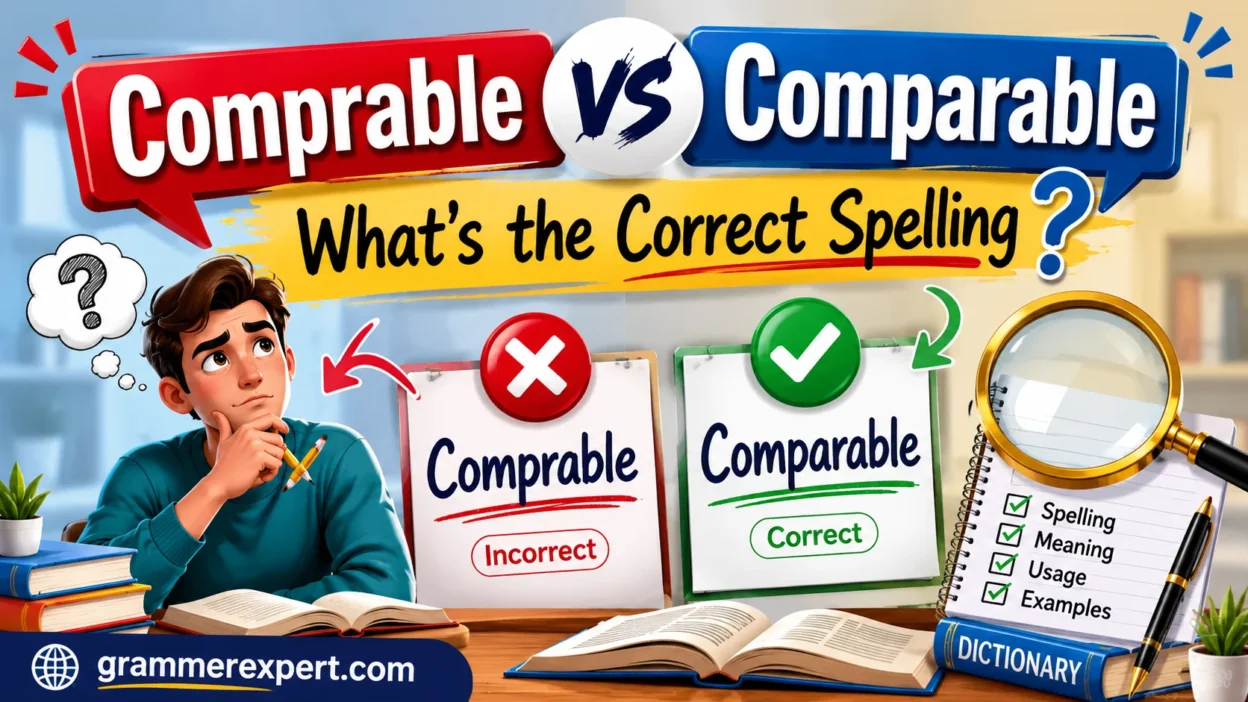
Comprable vs Comparable: What’s the Correct Spelling and Why It Matters explains common spelling confusion in English writing quickly today.
Have you ever, while writing, felt unsure whether it is comparable or comprable? It is a common mistake that many writers face because the words look almost identical at first glance, yet only one is correct in standard English spelling. This confusion can affect how professional and trustworthy your writing appears in emails, reports, and documents.
In daily writing, people often get confused when typing fast or skipping checks, which leads to mistakes in emails, essays, and documents. Understanding vs helps improve clarity, accuracy, and overall communication. The idea is simple: both words may look similar, but learning the difference ensures better writing and avoids future mistakes.
From experience, many writers ask whether to use comparable or comprable, but grammar rules make the answer clear. When you apply correct usage in real writing situations, it improves confidence and reduces confusion. Over time, you naturally avoid the mistake, making your communication more clear and effective.
Comprable vs Comparable — The Quick Answer
If you’re in a hurry, here’s the truth:
- Comparable ✅ is the correct spelling
- Comprable ❌ is a misspelling
Simple. Clear. No exceptions.
Still, it helps to see the difference visually:
WordCorrect?MeaningComprable❌ NoMisspellingComparable✅ YesAble to be compared
Even though “comprable” appears in casual writing online, it doesn’t exist in standard English dictionaries. It’s a spelling error—nothing more.
CLICK HERE: Shinny vs Shiny: What’s the Difference
What Does “Comparable” Mean?
Now let’s go deeper.
The word comparable describes things that can be compared because they share similar qualities. It doesn’t mean they’re identical. It simply means you can evaluate them side by side.
Think of it as placing two items on a scale and asking, “How do these stack up?”
Simple Definition
Comparable means:
Capable of being compared due to similarities in features, quality, or purpose.
Real-World Examples
- “These two smartphones are comparable in performance.”
- “Her writing skills are comparable to a professional editor.”
- “The salaries offered are comparable across companies.”
Each example shows comparison—not sameness.
Where You’ll See It Used
You’ll find “comparable” almost everywhere:
- Business: comparing prices, revenue, or competitors
- Education: comparing grades or performance
- Technology: comparing product features
- Daily life: comparing experiences or options
In short, it’s a practical, everyday word.
Why “Comprable” Is Incorrect
Here’s the blunt truth: “comprable” is simply wrong.
It’s not recognized in formal writing. It won’t appear in dictionaries. And if you use it in professional content, it weakens your credibility.
Why People Make This Mistake
The error doesn’t come from ignorance. It comes from how we speak.
Common reasons include:
- Fast typing
- Skipping vowels unconsciously
- Phonetic spelling habits
- Autocorrect failures
When spoken quickly, “comparable” sounds like “comprable.” The middle “a” almost disappears.
That’s where the confusion begins.
Quick Reality Check
Even if it looks right, even if others use it, “comprable” is always incorrect.
No exceptions.
Pronunciation Breakdown: Why This Confusion Happens
Let’s slow the word down.
Comparable is pronounced as:
- /ˈkɑːm.pər.ə.bəl/
- or /ˈkɒm.pər.ə.bəl/
Notice something? The “a” in the middle is soft. It blends into the word.
That’s why people drop it when writing.
A Simple Trick That Works
Say the word like this:
compare + able
Break it into two parts. Suddenly, the spelling becomes obvious.
Comparable in Different Contexts
Words become clearer when you see them in action. Let’s explore how “comparable” behaves in different areas.
In Business and Finance
This is where the word truly shines.
Professionals constantly compare:
- Sales performance
- Market trends
- Pricing strategies
- Company growth
Example:
“This quarter’s revenue is comparable to last year’s results.”
You’ll also hear the term “comps”—short for comparable data.
In Technology
Tech comparisons drive buying decisions.
- Smartphones
- Laptops
- Software tools
Example:
“This laptop offers comparable speed at a lower price.”
Here, “comparable” helps buyers evaluate value.
In Everyday Language
Outside business, the word still plays a role.
- Comparing experiences
- Comparing skills
- Comparing quality
Example:
“That restaurant offers a comparable dining experience.”
Comparable vs Similar — What’s the Difference?
These words often get mixed up. They seem close. Still, they’re not identical.
Key Difference
- Comparable = can be compared
- Similar = already alike
Side-by-Side Comparison
WordMeaningUsage ExampleComparableAble to be compared“These cars are comparable.”SimilarNearly the same“These cars are similar.”
Why This Matters
Using the wrong word can subtly change your meaning.
- Comparable invites analysis
- Similar implies resemblance
That’s a big difference in professional writing.
Common Mistakes Related to “Comparable”
Misspelling isn’t the only issue.
Writers also misuse the word in ways that feel off.
Frequent Spelling Errors
Watch out for these:
- Comprable ❌
- Comparible ❌
- Comperable ❌
Only one version is correct: comparable.
Usage Mistakes
- Using “comparable” when you mean “equal”
- Overusing it instead of simpler words
- Forcing it into casual sentences
Example of Misuse
❌ “These two products are exactly comparable.” ✅ “These two products are identical.”
Easy Memory Tricks to Spell “Comparable” Correctly
Spelling sticks when you simplify it.
Here are techniques that actually work.
Break It Down
compare + able = comparable
If you can spell “compare,” you’re already halfway there.
Visual Trick
The word “compare” lives inside “comparable.”
Spot it. Lock it in.
Mnemonic
“If you can compare it, it’s comparable.”
Short. Catchy. Hard to forget.
Examples of “Comparable” in Sentences
Let’s mix things up with varied sentence styles.
Simple Examples
- “Their offers are comparable.”
- “The two designs are comparable.”
Detailed Examples
- “Although the brands differ in style, their performance remains comparable.”
- “Given the price range, these services provide comparable value.”
Professional Examples
- “The data suggests comparable growth across all sectors.”
- “Their results are comparable to industry benchmarks.”
When You Should Use “Comparable” (And When Not To)
Using the right word at the right time matters.
Use “Comparable” When
- You’re analyzing two or more things
- You want to highlight similarities without claiming equality
- You’re presenting data or comparisons
Avoid It When
- You mean identical or equal
- You’re speaking casually and “similar” works better
- The comparison isn’t meaningful
Case Study: How One Misspelling Affected Credibility
A small business published a pricing page comparing its services to competitors.
They repeatedly used “comprable.”
At first, it seemed minor. Still, visitors noticed.
Here’s what happened:
- Trust dropped
- Bounce rate increased
- Conversion rates fell
Why?
Because spelling errors signal carelessness.
Even a single mistake can change perception.
Why Correct Spelling Matters for SEO and Trust
Search engines care about clarity. So do readers.
Impact on SEO
- Correct spelling improves keyword matching
- Search engines favor clean, accurate content
- Errors reduce content quality signals
Impact on Readers
- Builds credibility
- Enhances readability
- Shows professionalism
Quick Fact
Studies show users judge credibility within seconds. Spelling errors speed up negative judgments.
Quick Recap
Let’s lock it in:
- Comparable is correct
- Comprable is incorrect
- The word comes from compare + able
Keep it simple. Keep it accurate.
FAQs
1. What is the correct spelling, comprable or comparable?
The correct spelling is comparable. Comprable is a misspelling and is not accepted in standard English.
2. Why do people write comprable instead of comparable?
People often type quickly or rely on how the word sounds, which leads to confusion between comparable and comprable.
3. What does comparable mean in English?
Comparable means two things are similar enough to be compared in terms of quality, price, features, or nature.
4. Is comprable a real English word?
No, comprable has no meaning in English dictionaries and is considered incorrect.
5. Where is comparable commonly used?
It is used in emails, academic papers, business reports, and everyday writing to compare similar things.
6. How can I avoid spelling comprable wrong?
You can avoid the mistake by remembering that the correct form is comparable, with “-para-” in the middle.
7. Does this spelling mistake affect writing quality?
Yes, using comprable instead of comparable can make writing look less professional and reduce credibility.
8. Why is it important to learn the correct spelling?
Learning the correct spelling improves clarity, accuracy, and overall communication in both formal and informal writing.
Conclusion
The confusion between comparable and comprable is common, but only one form is correct in English. Using the right spelling shows attention to detail and improves writing quality. When you consistently use comparable, your communication becomes clearer, more professional, and more trustworthy in all types of writing situations.