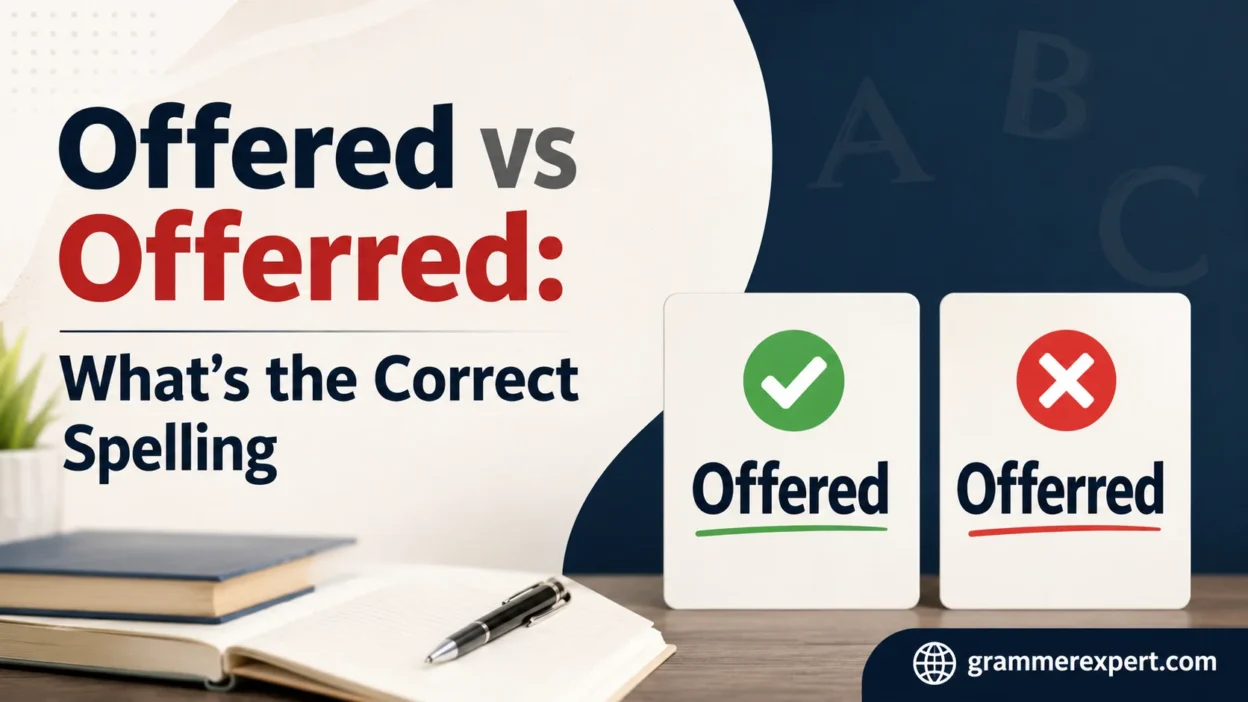
In my early writing, I often felt confused by similar-looking words, especially offered and offerred. This is why Offered vs Offerred: What’s the Correct Spelling and Why It Matters becomes so important in daily use. Like many people, I would wonder which spelling is correct and how to use it properly in sentences, because this understanding of the difference is important. Using the wrong form can make your work look unprofessional or unclear, so in simple terms, offered is the past tense and participle of the verb offer, meaning to present, suggest, or provide something for consideration, while the other hand shows offerred as a common misspelling that should be avoided. This article will explore the meanings, proper usage, mistakes, and examples to help you write confidently in everyday English.
English can be tricky, even for fluent speakers, where one small extra letter can turn a word into a mistake. That’s exactly why people search offered vs offerred, since both spellings come from the same verb and may seem logical at first glance, but only one follows standard rules. This confusion usually appears when we write emails, job offers, business proposals, school assignments, or social media posts. You might pause and ask if you should double the r or not choose it, but the wrong choice may feel careless in formal contexts, so the purpose is to clear it once and for all, give a quick answer, explain the origin, compare British and American rules, and show how it is used in real life.
Offered vs Offerred — The Quick Answer
Here’s the simple truth:
- Offered ✅ Correct spelling
- Offerred ❌ Incorrect spelling
You should always use “offered.” The version with two “r”s doesn’t exist in standard English.
That might feel surprising. After all, English often doubles letters when adding “-ed.” But this word follows a different rule.
READ ALSO: Arial vs Aerial: What’s the Difference
Why “Offerred” Is Incorrect
At first glance, “offerred” looks logical. Many verbs double their final consonant before adding “-ed.” So it’s easy to assume “offer” should follow the same pattern.
But here’s the catch: not all verbs behave the same way.
The mistake usually comes from overgeneralizing rules. People see words like:
- preferred
- referred
- occurred
Then they assume “offer” should become “offerred.” That assumption breaks down once you understand how stress patterns work in English.
The Core Issue
English spelling depends heavily on syllable stress, not just letter patterns.
“Offer” doesn’t meet the conditions required to double the “r.” So adding an extra “r” creates a spelling error.
The Rule Behind Offered vs Offerred (Explained Simply)
Let’s break it down without jargon.
When Do You Double the Final Consonant?
You double the last consonant before adding “-ed” when:
- The word has one syllable
- Or the stress falls on the last syllable
Examples
Base WordPast FormReasonStopStoppedOne syllable → double “p”PlanPlannedOne syllable → double “n”PreferPreferredStress on last syllable
Why “Offer” Doesn’t Double the “R”
Now look at “offer.”
- Pronunciation: OF-fer
- Stress falls on the first syllable
That’s the key.
Because the stress doesn’t land on the last syllable, you don’t double the “r.”
So the correct form becomes:
- Offer + ed = Offered
Simple. Clean. No extra letter needed.
Offered vs Offerred — Side-by-Side Comparison
WordCorrect?ExplanationOffered✅ YesFollows standard spelling ruleOfferred❌ NoIncorrect consonant doubling
If you remember nothing else, remember this table.
Real-Life Examples of “Offered” in Action
Seeing words in context helps lock them into memory. Here are examples you’ll recognize from everyday writing.
Everyday Usage
- She offered help when no one else did.
- They offered a discount to loyal customers.
- I offered my opinion during the meeting.
Each sentence flows naturally because the spelling aligns with standard rules.
Professional Context
- The company offered a competitive salary package.
- He offered strategic insights during the presentation.
- We offered solutions instead of complaints.
These examples show how often this word appears in serious writing. One misspelling here can weaken your authority.
Common Mistakes and Why They Happen
Even strong writers slip up. Here’s why “offerred” keeps showing up.
Overgeneralizing Rules
People learn that some words double consonants. Then they apply that rule everywhere. That shortcut backfires.
Confusing Similar Words
Words like these create confusion:
- Refer → Referred
- Prefer → Preferred
- Occur → Occurred
They look similar but follow a different stress pattern.
Typing Habits
Fast typing leads to automatic patterns. Your brain fills in what “feels right” instead of what is correct.
Autocorrect Dependence
Spellcheck helps, but it’s not perfect. Sometimes it misses errors or gets ignored.
Quick Memory Tricks for Offered vs Offerred
You don’t need to memorize rules if you use smart shortcuts.
Easy Ways to Remember
- Stress trick: “OF-fer” → no double “r”
- Simple addition rule: Offer + ed = Offered
- Visual memory: One “r” stays one
Mental Shortcut
Think of it this way:
“If the word feels relaxed at the end, don’t double the letter.”
“Offer” ends softly. No stress. No doubling.
Similar Words That Confuse Writers
This is where most people get tripped up.
Words That Double the Final Consonant
Base WordCorrect FormReferReferredPreferPreferredOccurOccurred
These words stress the last syllable, so they double the consonant.
Words That Don’t Double
Base WordCorrect FormOfferOfferedVisitVisitedOpenOpened
Here, stress falls earlier, so no doubling happens.
How to Avoid This Mistake in Writing
Fixing this issue doesn’t require perfection. It requires awareness.
Practical Tips
- Slow down when editing
- Read sentences out loud
- Look for patterns, not guesses
- Use grammar tools wisely
Writing Habit That Works
Pause for one second when adding “-ed.” Ask:
“Does this word need a double letter?”
That tiny pause saves you from common errors.
Offered vs Offerred in Professional Writing
In casual texting, small errors slide by. In professional writing, they don’t.
Why It Matters
- Spelling reflects attention to detail
- Errors reduce trust instantly
- Readers judge expertise quickly
Real-World Scenario
Imagine sending this email:
“We offerred a solution last week.”
Even if your idea is brilliant, that typo stands out. It creates doubt.
Now compare:
“We offered a solution last week.”
Clean. Confident. Professional.
Case Study: How One Letter Impacts Perception
A small study of hiring managers showed that spelling errors reduce perceived competence by over 50% in resumes.
What This Means
- Recruiters scan quickly
- Errors stand out immediately
- Correct spelling builds trust fast
One extra “r” might seem minor. In reality, it changes how people see your work.
Commonly Confused Grammar Patterns (Beyond Offered vs Offerred)
Once you understand this rule, you’ll notice similar patterns everywhere.
Watch Out for These
- Travel → Traveled (US English)
- Cancel → Canceled
- Admit → Admitted
Key Insight
English isn’t random. It follows patterns based on:
- Stress
- Syllables
- Pronunciation
Master those, and spelling gets easier.
Quick Reference Checklist
Use this before finalizing your writing:
- Does the word end in a stressed syllable?
- Is it one syllable?
- Does it feel natural when spoken?
If the answer is “no,” don’t double the consonant.
FAQs
1. What is the correct spelling: offered or offerred?
The correct spelling is offered. The form offerred is a misspelling and should be avoided in standard English writing.
2. Why do people confuse offered and offerred?
Many people get confused because of similar-looking words like preferred, referred, and transferred, which use double r patterns.
3. What does “offered” mean?
Offered is the past tense and participle of the verb offer, meaning to present, suggest, or provide something for consideration.
4. Is “offerred” ever correct in English?
No, offerred is never correct in standard English, whether in British or American usage.
5. Where is the mistake commonly seen?
This mistake usually appears in emails, job offers, business proposals, school assignments, and social media posts.
6. Why is correct spelling important in writing?
Using the wrong spelling can make your writing look unprofessional, unclear, or even careless, especially in formal contexts.
7. How can I remember the correct spelling?
A simple memory trick is to remember that offer does not follow the same pattern as words like preferred, so it stays as offered.
8. Does this rule apply to all forms of writing?
Yes, whether it’s academic papers, blog posts, resumes, or professional communication, the correct form is always offered.
Conclusion
Understanding Offered vs Offerred: What’s the Correct Spelling and Why It Matters helps you avoid a very common but noticeable mistake. Even though English can feel tricky, learning small rules like this improves your overall writing and builds confidence.
In simple terms, always use offered and avoid offerred. With regular practice, real-life examples, and a few memory tricks, you will never make this error again and will write more clearly in everyday and professional situations.