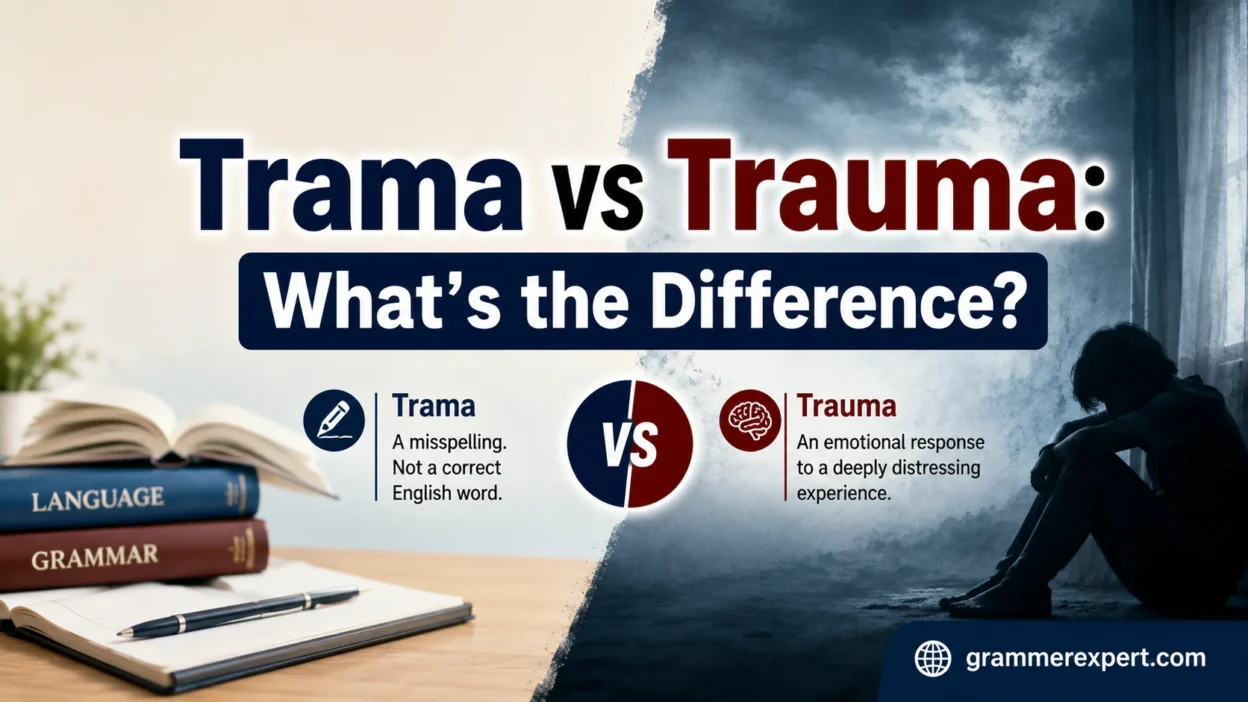
Trama vs Trauma: What’s the Difference? explains why the right spelling matters when meaning, context, and correct usage can change the message.
Trama and Trauma may look similar, but their meaning and context are very different. If you’ve ever paused while writing, unsure about the correct form, this confusion is understandable. In standard English, Trauma describes real emotional damage, physical harm, or a serious psychological impact, while Trama is not an actual accepted variant for this meaning. A traumatic experience may follow a traumatic event, such as an accident, loss, or sudden change, and can create a deep emotional impact on a person who thinks and feels differently afterward.
Such experiences can affect the mind, body, and emotions deeply, causing emotional harm even without a visible injury. The terminology and vocabulary become more interesting because Trama can have meanings in Spanish and Italian, where it may refer to a plot, storyline, textile, or pattern. These different spellings can create word confusion during language learning, so communication, spelling accuracy, writing skills, correct usage, and writing accuracy matter in education, healthcare, and everyday communication. Whether you’re a student, writer, translator, or professional, understanding Interpretation, semantic meaning, linguistic meaning, and contextual meaning helps you choose the right word and deliver a clear message.
Trama vs. Trauma: Quick Answer
The short answer is simple: trauma is the standard English word. It describes physical injury or severe emotional and psychological shock. Cambridge Dictionary recognizes both meanings and lists trauma as a noun.
| Word | Standard English Use | Meaning |
| Trauma | Yes | Physical injury or severe emotional shock |
| Trama | Usually no | Generally a misspelling of trauma in English |
| Traumatic | Yes | Causing or relating to trauma |
| Traumatize | Yes | To cause someone to experience trauma |
So, if you’re talking about an accident, serious injury, emotional shock, or a deeply distressing experience, choose trauma.
CLICK HERE: Constant vs Attentive: What’s the Difference?
The Correct Spelling
The correct spelling is:
T-R-A-U-M-A → trauma
The common incorrect form is:
T-R-A-M-A → trama
The difference is only one letter, but that letter belongs there. Think of the word as TR + AU + MA. The AU is the part you don’t want to lose.
What Does “Trauma” Mean?
Trauma has two major meanings in English. One relates to the body, while the other relates to emotional or psychological harm.
Cambridge Dictionary defines trauma as severe and lasting emotional shock caused by an extremely upsetting experience. It also defines the word in medical contexts as physical injury usually resulting from an accident or attack.
Trauma as Emotional or Psychological Distress
In everyday and psychological contexts, trauma can describe the lasting emotional impact of an extremely distressing experience.
For example, someone who survives a serious accident might experience fear long after the physical injuries heal. A person who experienced severe abuse during childhood may also carry emotional effects into adulthood.
Consider these examples:
- The accident left him with emotional trauma.
- She struggled with childhood trauma for years.
- The disaster caused widespread psychological trauma.
- The experience was deeply traumatic for the family.
The word doesn’t simply mean that something was unpleasant. English speakers sometimes use trauma casually to describe an embarrassing, frustrating, or uncomfortable experience. However, serious psychological discussions generally use the term for experiences involving much greater distress.
That distinction matters. Calling every annoying event “traumatic” can blur the difference between ordinary stress and severe psychological harm.
Trauma as Physical Injury
In medicine, trauma can mean an injury caused by an external force. Cambridge specifically identifies this specialized meaning and gives examples involving brain trauma, head trauma, blunt trauma, and trauma centers.
For instance:
“The patient suffered severe head trauma after the collision.”
Here, trauma doesn’t mean emotional pain. It refers to physical injury.
Medical professionals may use the term in phrases such as:
- head trauma
- brain trauma
- blunt trauma
- physical trauma
- traumatic injury
- trauma center
This meaning explains why the word appears frequently in emergency medicine and injury-related reporting.
Trauma in Everyday English
Outside medicine and psychology, trauma can describe a deeply upsetting experience or its emotional consequences.
For example, someone might say:
“Moving away from her family was a difficult experience, but the accident years earlier caused lasting trauma.”
The first event represents ordinary emotional difficulty. The second illustrates a much more serious use of trauma.
That difference helps you choose stronger words accurately. Not every hardship needs the label trauma.
What Does “Trama” Mean?
Is “Trama” an English Word?
When you’re writing standard English and mean physical injury or severe emotional shock, trama isn’t the correct spelling.
If you see trama in an English sentence about an accident or psychological injury, the writer probably intended trauma.
For example:
❌ The patient suffered severe trama.
✅ The patient suffered severe trauma.
Likewise:
❌ The experience caused childhood trama.
✅ The experience caused childhood trauma.
The mistake is easy to make because the two spellings differ by only one letter.
Why You May See “Trama”
Several practical reasons can explain the spelling:
- The writer accidentally omitted the u.
- The writer typed quickly and didn’t proofread.
- The pronunciation didn’t make the spelling obvious.
- The writer learned the word by hearing it rather than reading it.
- Another language influenced the writer’s spelling.
That final point is worth remembering because trama can have legitimate meanings in other languages. In English, however, the word needed for emotional or physical injury is trauma.
Trama in Other Languages
The existence of trama outside English can create genuine confusion.
For example, trama has established meanings in languages such as Italian and Spanish. In Italian, the word can refer to a plot or weft, depending on context. English learners may therefore encounter trama as a perfectly valid foreign-language word.
That doesn’t make it the correct English spelling of trauma.
Language works through context. A word can be correct in one language and incorrect in another. That’s why the safest rule for English writing is straightforward: use trauma when you mean injury or severe emotional shock.
Trauma vs. Trama: Spelling Difference
The spelling difference is tiny but easy to identify.
| Correct | Incorrect in Standard English |
| Trauma | Trama |
| T-R-A-U-M-A | T-R-A-M-A |
| Contains AU | Missing U |
| Used for injury or emotional shock | Usually a misspelling in this context |
The most useful visual clue is AU.
Break the correct word into three pieces:
TR + AU + MA = TRAUMA
Once you see that structure, the spelling becomes much easier to retain.
Why the Missing “U” Causes Confusion
English contains many words whose pronunciation doesn’t perfectly reveal their spelling. Trauma is a good example.
When someone hears the word, they may remember its sound but not its exact letter sequence. That problem becomes more likely when the word appears infrequently in everyday writing.
The visual similarity makes the error even sneakier. Trama looks plausible at first glance. A quick spell-check may catch it, but human readers sometimes understand the intended meaning immediately and overlook the mistake.
Trauma vs. Trama: Pronunciation
In US English, Cambridge Dictionary gives trauma a pronunciation represented as /ˈtrɑː.mə/.
The pronunciation can make spelling tricky because the spoken form doesn’t clearly announce every letter.
A useful approach is to connect the sound with the written form:
Trauma → TR + AU + MA
Don’t rely entirely on pronunciation to spell the word. Instead, remember its visual pattern.
Is “Trama” Pronounced Differently?
If trama appears as a foreign-language word, its pronunciation depends on that language. If someone writes trama as an English misspelling of trauma, they usually intend the pronunciation of trauma.
Therefore, pronunciation isn’t a reliable reason to choose trama.
Trauma vs. Trama: Part of Speech
Trauma as a Noun
Trauma is a noun. It can identify either a physical injury or severe emotional shock.
Examples include:
- The doctor treated the trauma immediately.
- She experienced trauma after the accident.
- Childhood trauma can affect later life.
- The athlete sustained head trauma.
The noun can also appear in singular and plural forms. Merriam-Webster lists trauma with plural forms including traumas and the less common traumata.
Traumatic as an Adjective
Traumatic is an adjective related to trauma. It describes something that causes or relates to severe emotional shock or physical injury.
For example:
The accident was traumatic.
Here, traumatic describes the accident.
Compare:
- The accident caused trauma.
- The accident was traumatic.
The first sentence uses a noun. The second uses an adjective.
Traumatize as a Verb
Traumatize functions as a verb. It means to cause someone to experience psychological trauma.
For example:
The violent event traumatized the witness.
This gives you a useful word family:
| Word | Part of Speech | Example |
| Trauma | Noun | The event caused trauma. |
| Traumatic | Adjective | It was a traumatic experience. |
| Traumatize | Verb | The accident traumatized him. |
| Traumatized | Adjective/participle | She felt traumatized afterward. |
Keeping these forms separate makes your writing cleaner and more precise.
How to Use “Trauma” Correctly in a Sentence
Examples About Emotional Trauma
Use trauma when discussing severe emotional or psychological effects.
- The child experienced trauma after witnessing the accident.
- She sought professional support for childhood trauma.
- The disaster left the community with collective trauma.
- The experience created lasting emotional trauma.
These sentences show that trauma can describe both an individual’s experience and broader effects across a community.
Examples About Physical Trauma
Use the word differently when discussing bodily injury.
- The cyclist suffered serious head trauma.
- The doctor examined the patient for signs of physical trauma.
- The collision caused significant blunt trauma.
- The hospital specializes in treating severe trauma.
Here, the surrounding words make the medical meaning clear.
Examples With Related Words
Compare these sentences:
Trauma: The accident caused emotional trauma.
Traumatic: The accident was traumatic.
Traumatized: The survivor felt traumatized by what happened.
Changing the word changes the grammar. The meaning remains closely connected.
Common Mistakes With “Trama” and “Trauma”
The most common error is simply leaving out the u.
| Incorrect | Correct |
| The crash caused severe trama. | The crash caused severe trauma. |
| She suffered childhood trama. | She suffered childhood trauma. |
| It was a trama response. | It was a trauma response. |
| The patient had head trama. | The patient had head trauma. |
Why the Error Matters
In casual texting, readers may understand what trama means. Professional writing is different.
A spelling error can weaken an otherwise strong article, report, essay, medical document, or application. When discussing sensitive subjects such as psychological distress or serious injury, accuracy matters even more.
The good news? This is an easy mistake to eliminate once you remember the AU.
Trama vs. Trauma: Side-by-Side Comparison
| Feature | Trauma | Trama |
| Standard English spelling for injury | Yes | No |
| Means severe emotional shock | Yes | No |
| Means physical injury | Yes | No |
| Contains AU | Yes | No |
| Common English spelling error | No | Yes |
| Legitimate foreign-language word | Not relevant | Yes, depending on language |
| Correct choice in an English medical sentence | Yes | No |
This comparison answers the central question quickly: trauma is the correct English spelling for the intended meaning.
Why Do People Spell Trauma as Trama?
The Missing “U”
The simplest explanation is an ordinary spelling mistake. People often omit letters when typing quickly, especially when a word’s pronunciation doesn’t make its spelling obvious.
Visual Similarity
Trama resembles trauma closely enough to fool a hurried reader.
That’s why proofreading helps. When you already know what a sentence intends to say, your brain can sometimes overlook a missing letter.
Pronunciation
Because spoken language doesn’t display letters, hearing trauma doesn’t automatically tell you that the written word contains AU.
This is a classic spelling challenge: the sound is familiar while the exact letter pattern isn’t.
Language Influence
Multilingual speakers may encounter trama as an authentic word in another language. That can add another layer of confusion when switching between languages.
How to Remember the Correct Spelling
Here’s the easiest trick:
TR + AU + MA = TRAUMA
Remember the AU in the middle.
You can also associate the spelling with the meaning:
Trauma = injury or severe emotional shock.
If you’re writing about either one, check whether you’ve included the u.
A Quick Memory Test
Fill in the missing letters:
TR + ___ + MA
The answer is:
AU
So:
TR + AU + MA = TRAUMA
That’s all you need. No complicated mnemonic is necessary.
Trauma in Medical and Psychological Contexts
The word becomes more precise when paired with a context-specific term.
| Term | General Meaning |
| Physical trauma | Bodily injury caused by an external force |
| Psychological trauma | Severe emotional or psychological effects |
| Head trauma | Injury affecting the head |
| Brain trauma | Physical injury involving the brain |
| Blunt trauma | Injury caused by a non-penetrating force |
| Trauma center | Medical facility equipped to treat serious injuries |
Cambridge specifically lists medical uses such as brain trauma, head trauma, blunt trauma, and trauma center.
It’s also important not to treat trauma and PTSD as interchangeable terms. Trauma can refer to an experience, injury, or psychological response. PTSD is a specific mental health disorder with defined diagnostic criteria. The words aren’t synonyms.
Traumatic vs. Trauma: Are They the Same?
They’re related, but they aren’t interchangeable.
Trauma is the noun:
The accident caused severe trauma.
Traumatic is the adjective:
The accident was traumatic.
Traumatize is the verb:
The experience traumatized the witness.
This simple pattern can prevent many grammar mistakes.
A Simple Word-Family Diagram
TRAUMA
↓
TRAUMATIC → describes something related to trauma
↓
TRAUMATIZE → describes causing trauma
↓
TRAUMATIZED → describes someone affected by trauma
The spelling remains consistent across the word family. The important part is knowing which form fits the sentence.
Trama vs. Trauma: Which One Should You Use?
When you’re writing in standard English, the answer is clear:
Use “trauma.”
Choose trauma when discussing:
- Physical injury
- Emotional shock
- Psychological distress
- Childhood trauma
- Head or brain injury
- Serious accidents
- Traumatic experiences
- Medical trauma
Use trama only when you’re intentionally using a legitimate foreign-language term or another context in which that spelling has its own meaning.
A Real-World Writing Example
Imagine you’re writing about a car accident.
❌ The victim suffered severe trama in the crash.
The spelling is wrong.
✅ The victim suffered severe trauma in the crash.
Now imagine you’re discussing the emotional aftermath:
❌ The crash caused lasting trama.
✅ The crash caused lasting trauma.
Same correction. Different context. Trauma remains the correct English choice.
Frequently Asked Questions
1. Is “Trama” or “Trauma” correct in English?
Trauma is the correct word in standard English when you mean emotional or physical harm caused by a distressing experience. Trama is generally a spelling mistake when used with this meaning.
2. What does “Trauma” mean?
Trauma refers to emotional or psychological harm, or a physical injury, caused by a deeply distressing event or experience. It can affect a person’s mind, body, and emotions.
3. Is “Trama” a real word?
Trama can be a real word in some other languages, including Spanish and Italian, where it may have meanings related to a plot, storyline, or textile pattern. However, it isn’t the standard English spelling for emotional or physical trauma.
4. Why do people confuse Trama and Trauma?
People often confuse them because the words look and sound similar. A small spelling change can make the difference easy to miss, especially when writing quickly.
5. What is a traumatic experience?
A traumatic experience is an event or situation that causes severe emotional, psychological, or physical distress. Examples can include accidents, loss, illness, or major life changes.
6. Can trauma affect your emotions and body?
Yes. Trauma can affect the mind, body, and emotions. A person may experience strong emotional reactions even when there’s no visible physical injury.
7. How can I remember the correct spelling?
A simple way to remember it is to connect Trauma with traumatic. Both words contain “trau”, making it easier to recognize the correct English spelling.
8. Is “Trama” acceptable in professional writing?
If you’re writing in English about emotional, psychological, or physical harm, use Trauma. Using Trama in this context can create confusion and may be considered a spelling mistake.
Conclusion
The difference between Trama vs Trauma is mainly about spelling, meaning, and language context. In standard English, Trauma is the correct word for emotional, psychological, or physical harm caused by a distressing experience. Trama may have legitimate meanings in other languages, but it shouldn’t replace Trauma in English writing when discussing emotional or physical harm.When you mean a distressing experience or its lasting effects, choose Trauma. Keeping this simple distinction in mind can help you avoid common spelling mistakes and communicate your meaning clearly.