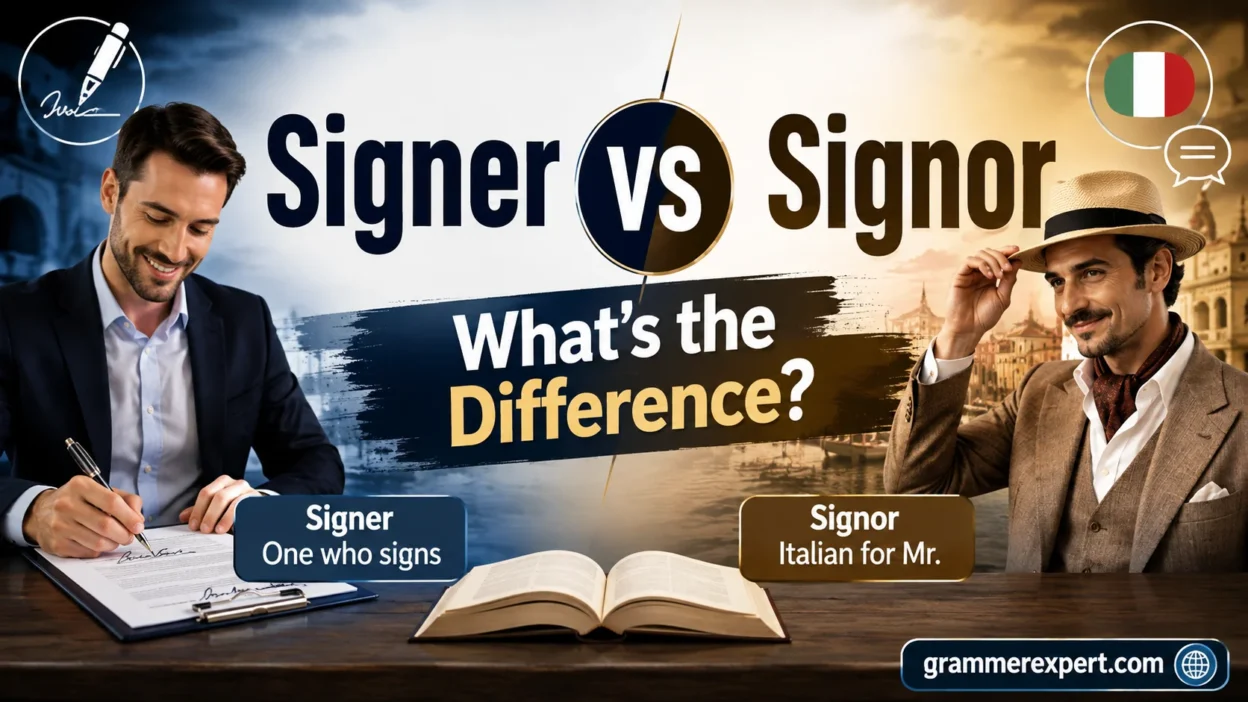
Understanding Signer vs Signor: What’s the Difference? helps you choose the right word in legal writing, contracts, and Italian communication.
In formal writing, legal documents, emails, contracts, social media posts, and banking documents, signer and signor may cause confusion because they are similar sounding words, but their meanings, origins, and uses differ. A signer is someone who puts their name and signature on a contract, formal documents, or legal contracts, while a contract signer or legal signer may act as an endorser involved in validating official agreements, bank authorizations, business contracts, and other official agreements. Choosing the right words correctly, clearly, professionally, and accurately matters in communication, especially for writers, professionals, and English learners seeking correct language, accurate language, and contextually clear language in everyday use. This confusing pair can cause hesitation because the words look almost identical, and using the wrong one can change the intent and create serious misunderstandings in sentences.
By contrast, Signor is an Italian honorific and formal address used when greeting men in Italian-speaking countries. Signor Rossi and Signor Giovanni show cultural respect, politeness, and Italian culture, while Signor may appear on an Italian menu, in formal letters, or during Italian dining at a restaurant in Rome. The word suggests elegance, manners, Italian flair, etiquette, and professional address, whereas signer relates to signing, contract signing, agreements, authorization, banking, and business. In real-life situations, signer belongs to the act of signing, while signor belongs to Italian language and culture. Learning this distinction in simple language helps prevent common mistakes, embarrassing mistakes, and mistakes in real-life communication, while helping you use each term correctly in contexts involving legal work, professional settings, Italian dining, and formal communication.
Signer vs. Signor: Quick Difference
The easiest way to separate these words is to focus on their jobs in a sentence.
| Word | Meaning | Typical use | Example |
| Signer | Someone who signs something | Contracts, forms, agreements, petitions | “The signer approved the contract.” |
| Signor | An Italian title equivalent to Mr. | Names and formal address | “Signor Rossi arrived early.” |
The two words aren’t alternate spellings. They represent different meanings and different linguistic histories.
Think of them as two roads that happen to begin with similar signs. One road leads toward signatures and documents. The other leads toward Italian names and formal address.
READ MORE: Enable vs Inable: What’s the Difference?
The simplest rule to remember
Use this quick test:
- Someone signs → signer
- An Italian title → signor
- A signature appears → signer
- “Mr.” appears before an Italian man’s name → signor
For example, “The signer completed the form” makes sense because the person performed the action of signing.
By contrast, “Signor Bianchi entered the room” makes sense because Signor serves as a title.
What Does “Signer” Mean?
Signer Definition
Signer is a noun meaning a person who signs something. Merriam-Webster defines it as “one that signs” and lists signatory as a related term. It also gives a second meaning: someone who uses sign language.
The most common meaning appears in situations involving written documents. A signer may put a signature on a contract, loan document, application, consent form, petition, or agreement.
The word follows a familiar English pattern. The verb sign describes the action, while the suffix -er identifies the person performing that action.
Compare:
- teach → teacher
- write → writer
- drive → driver
- sign → signer
That pattern makes signer relatively easy to understand once you know what sign means.
Examples of “Signer” in Sentences
Here are practical examples:
- “Every signer must read the agreement before signing.”
- “The bank requires an authorized signer for the account.”
- “Each signer received a copy of the contract.”
- “The petition attracted thousands of signers.”
- “The final signer approved the document.”
- “The interpreter communicated with the signer.”
Notice the common thread. In each example, signer identifies a person connected with signing.
The word doesn’t describe a title, nationality, or social rank. It describes a role or action.
Common Expressions With “Signer”
You may encounter signer in several common combinations:
- Authorized signer: A person permitted to sign on behalf of an account, organization, or other entity.
- Contract signer: Someone who signs a contract.
- Document signer: A person who signs a document.
- Co-signer: Someone who signs alongside another person, often accepting a particular responsibility under the agreement.
- Signers of an agreement: The people or entities that sign the agreement.
The exact legal effect of a signature depends on the document and applicable law. Still, the basic vocabulary remains straightforward: the person who signs is a signer.
What Does “Signor” Mean?
Signor Definition
Signor is an Italian title used for a man. In English, dictionaries describe it as equivalent to Mr. Merriam-Webster lists signor as a noun meaning an Italian man, traditionally associated with rank or gentility, and says it is used as a title equivalent to Mr.
For example:
Signor Rossi will attend the meeting.
Here, Signor doesn’t mean that Rossi signed anything. It simply functions as a formal title.
That’s the crucial distinction.
The spelling may remind you of sign, but that similarity doesn’t make signor a word for someone who signs. Its history follows a different path. Merriam-Webster traces it to Italian signore and ultimately to Medieval Latin senior.
How “Signor” Is Used
In Italian, signor commonly appears before a man’s surname or name in formal usage. Treccani explains that signore serves as a respectful form of address before a surname or name, while the shortened form signor appears in certain constructions.
Examples include:
- “Good morning, Signor Rossi.”
- “I spoke with Signor Bianchi yesterday.”
- “The letter was addressed to Signor Romano.”
- “Please ask Signor Conti to wait.”
English-language dictionaries also recognize signor as an established English noun borrowed from Italian. Its first recorded English use dates to 1539, according to Merriam-Webster.
That historical detail helps explain why you’ll sometimes see signor in English writing about Italian people, history, literature, and culture.
Signer vs. Signor: The Key Differences
Meaning
The first difference is the most important:
Signer means someone who signs.
Signor means an Italian title equivalent to Mr.
That distinction alone solves most cases of confusion.
Language and Origin
Signer belongs naturally to English vocabulary and follows the productive -er pattern used for people who perform actions.
Signor entered English from Italian. Its deeper history reaches back to Medieval Latin senior, a word associated with an older or superior person and later used as a title.
So although the spellings look related, their histories don’t make them interchangeable.
Function in a Sentence
Signer names a person performing or associated with the act of signing.
Signor functions as a title or respectful form of address.
Compare these:
“The signer completed the agreement.”
“Signor Rossi completed the meeting.”
The first sentence focuses on signing. The second uses Signor as a title.
Context
Context provides another reliable clue.
If you’re discussing:
- contracts
- forms
- signatures
- petitions
- agreements
- banking documents
you probably need signer.
If you’re discussing:
- an Italian man’s name
- formal Italian address
- Italian culture
- historical writing
- translated literature
you may need signor.
Pronunciation
The words don’t sound alike in standard English usage.
Merriam-Webster gives signer as /ˈsīnər/, roughly “SYE-ner.” It gives signor as /sēn-ˈyȯr/, roughly “seen-YOR.”
The pronunciation difference offers another useful clue. If you’re saying the word aloud, signor shouldn’t sound like the English noun signer.
Signer or Signor: Which One Is Correct?
Neither word is universally “more correct.” The correct choice depends on what you mean.
Use “Signer” When Someone Signs
Choose signer when you mean a person who signs something.
For example:
- “The signer must initial each page.”
- “The contract requires two signers.”
- “The authorized signer completed the banking form.”
- “Every signer received a digital copy.”
Here, replacing signer with signor would make the sentence incorrect because the sentence concerns the act of signing.
Use “Signor” for an Italian Title
Use signor when it functions as an Italian title.
For example:
- “Signor Ferrari will arrive shortly.”
- “We sent the invitation to Signor Moretti.”
- “Have you met Signor Romano?”
In these sentences, signor means something like Mr. It doesn’t describe an action.
A Simple Memory Trick
Here’s the quickest trick:
Signer → signature
Signor → Mr.
If a signature is involved, think signer.
If a man’s Italian title is involved, think signor.
It’s simple, but it works.
Signer vs. Signor in Legal and Business Writing
Professional writing makes this distinction especially important because a single letter can change the meaning dramatically.
When “Signer” Is the Right Word
Contracts and financial documents regularly refer to people who sign as signers.
Consider this sentence:
“Each signer must review the agreement before submitting it.”
The meaning is immediately clear. The people involved are the individuals who sign the agreement.
Likewise, authorized signer commonly describes someone who has permission to sign for an account or organization. The exact authority attached to that role depends on the relevant agreement, policy, or law.
Why “Signor” Would Be Wrong Here
Imagine a form saying:
“The signor must sign below.”
That sentence creates a strange problem. The writer apparently means the person who signs, but signor doesn’t carry that meaning.
The appropriate wording would be:
“The signer must sign below.”
This is more than a spelling preference. It’s a meaning problem.
Signer vs. Signatory vs. Signee
Once you understand signer and signor, another group of similar terms can cause confusion.
Signer
Signer is the broad, straightforward word for someone who signs. Merriam-Webster defines it as “one that signs” and treats signatory as a related term.
Example:
“Every signer received a copy.”
Signatory
Signatory is more formal. Merriam-Webster defines it as a signer with another person or group, especially someone or a government bound by a signed convention.
For instance:
“The countries became signatories to the agreement.”
This word fits naturally in discussions of treaties, conventions, formal agreements, and official documents.
Signee
Signee appears in contract and business contexts, but its usage can vary. Don’t automatically treat it as a perfect substitute for signer in every legal sentence.
When you simply mean someone who signs, signer is usually the clearest choice.
| Term | Basic meaning | Typical context |
| Signer | Person who signs | General and professional writing |
| Signatory | Person or entity that signs, especially with others | Formal agreements and treaties |
| Signee | Person associated with signing an agreement | Contract and business contexts |
| Signor | Italian title equivalent to Mr. | Names and formal address |
Common Mistakes With “Signer” and “Signor”
Mistake: Using “Signor” for a Contract Signer
Incorrect:
“The signor signed the contract.”
Correct:
“The signer signed the contract.”
The first sentence treats signor as if it meant someone who signs. It doesn’t.
Mistake: Using “Signer” as an Italian Title
Incorrect:
“Good afternoon, Signer Rossi.”
Correct:
“Good afternoon, Signor Rossi.”
If you mean Mr. Rossi, use Signor Rossi.
Mistake: Assuming the Words Are Alternate Spellings
They aren’t.
This isn’t like choosing between regional spelling variants such as color and colour. Signer and signor have different definitions.
Mistake: Connecting “Signor” to “Sign”
Their similar appearance can create a false connection. However, signor comes through Italian signore, not from the English verb sign. Its etymology ultimately connects with Latin senior.
Real-World Examples: Signer vs. Signor
Examples make the distinction much easier to spot.
Contracts and Documents
- “The signer must date the agreement.”
- “Each signer should keep a copy.”
- “The final signer completed the electronic form.”
Banking and Business
- “The company added an authorized signer.”
- “Two signers must approve the transaction.”
Italian Names and Formal Address
- “Signor Conti arrived at noon.”
- “We spoke with Signor Moretti after the presentation.”
Incorrect vs. Correct Examples
| Incorrect | Correct | Reason |
| “The signor signed the contract.” | “The signer signed the contract.” | A person who signs is a signer. |
| “Good afternoon, Signer Rossi.” | “Good afternoon, Signor Rossi.” | Signor is the Italian title. |
| “The bank needs an authorized signor.” | “The bank needs an authorized signer.” | The role involves signing. |
| “Signor completed the application.” | “The signer completed the application.” | The sentence concerns the person signing. |
A Practical Case Study: Choosing the Right Word
Imagine that an Italian businessman named Marco Rossi signs a commercial agreement.
Two descriptions could refer to him, but they emphasize different things.
If the sentence says:
“The signer approved the agreement.”
the writer focuses on Marco’s role in signing the document.
If the sentence says:
“Signor Rossi attended the meeting.”
the writer focuses on his formal title.
The same person could therefore be both a signer and Signor Rossi. The words aren’t competing labels for the same concept. They highlight different facts about him.
That’s the heart of signer vs. signor.
How to Remember the Difference Between Signer and Signor
Use this two-line memory aid:
Signer = someone who signs.
Signor = Mr. in Italian.
You can also connect each word to a visual image.
Picture a person holding a pen over a contract. That’s the signer.
Now picture a formal introduction:
“Good afternoon, Signor Rossi.”
That’s signor.
The images are completely different. Once you connect each word to its context, the spelling becomes much easier to remember.
Signer vs. Signor: Frequently Asked Questions
Is “signer” or “signor” correct?
Both words are correct, but they mean different things. Signer means someone who signs. Signor is an Italian title equivalent to Mr.
What does “signer” mean?
A signer is someone who signs something. The word can also refer to someone who uses sign language.
What does “signor” mean?
Signor is an Italian title for a man and corresponds roughly to Mr. in English.
Is “signor” another spelling of “signer”?
No. The words have different meanings and different origins.
What do you call someone who signs a document?
The straightforward term is signer. In more formal contexts, signatory may also fit. Merriam-Webster defines signatory as a signer with another person or group.
Does “signor” mean Mr.?
Yes. In English usage, signor is an Italian title equivalent to Mr.
What is the difference between signer and signatory?
Both can refer to someone who signs. Signer is the simpler everyday term, while signatory often appears in formal contexts involving agreements, conventions, or multiple parties.
How do you use “signor” in a sentence?
Use it as a title, usually with an Italian man’s name. For example: “Signor Rossi will speak first.” Italian reference sources describe signor as a form used before names and surnames.
Signer vs. Signor: Final Comparison
| If you mean… | Use this word |
| A person who signs a document | Signer |
| Someone who signs an agreement | Signer |
| An authorized person who signs for an account | Signer |
| A formal Italian title for a man | Signor |
| The equivalent of “Mr.” before an Italian name | Signor |
| A formal party to a signed agreement | Signatory |
The distinction is remarkably simple once you strip away the similar spelling.
Signer belongs with signatures. Signor belongs with an Italian title. Signatory belongs mainly in more formal discussions of signed agreements and conventions.
FAQs
1. What is the difference between signer and signor?
A signer is a person who signs a document, contract, agreement, or other official paper. Signor is an Italian honorific used as a respectful form of address for a man. The two words sound similar, but they have completely different meanings.
2. What does signer mean?
Signer means someone who signs something. For example, if you sign a business contract, you’re the signer of that contract. The word commonly appears in legal, financial, and professional contexts.
3. What does signor mean?
Signor is an Italian title used before a man’s name, similar to Mr. in English. For example, Signor Rossi means Mr. Rossi. It’s mainly used when addressing or referring to an Italian man respectfully.
4. Is signor a legal term?
No. Signor is an Italian honorific, not a legal term. Signer, however, is commonly used in legal and business contexts to identify someone who signs a contract, agreement, or official document.
5. Should I use signer or signor in a contract?
Use signer when referring to someone who signs a contract or legal document. Signor would only be appropriate if you’re using an Italian title as part of someone’s name or form of address.
6. Can signer and signor be used interchangeably?
No. Signer and signor aren’t interchangeable. Although they sound similar, signer relates to signing, while signor is an Italian title for a man.
7. What is an easy way to remember signer vs signor?
Think of signer as someone who signs. The ending connects naturally with the action. For signor, think of Italian names and titles, such as Signor Giovanni or Signor Rossi.
8. Which is correct: signer or signor?
Both are correct, but they’re correct in different situations. Choose signer for a person who signs something, especially in legal or business settings. Choose signor when using the Italian honorific for a man.
Conclusion
The difference between signer and signor is simple once you connect each word with its purpose. A signer is someone who signs a document, contract, or agreement, while signor is an Italian title used to respectfully address a man. Remembering this distinction will help you avoid confusion and use both words correctly in legal, professional, and everyday communication.