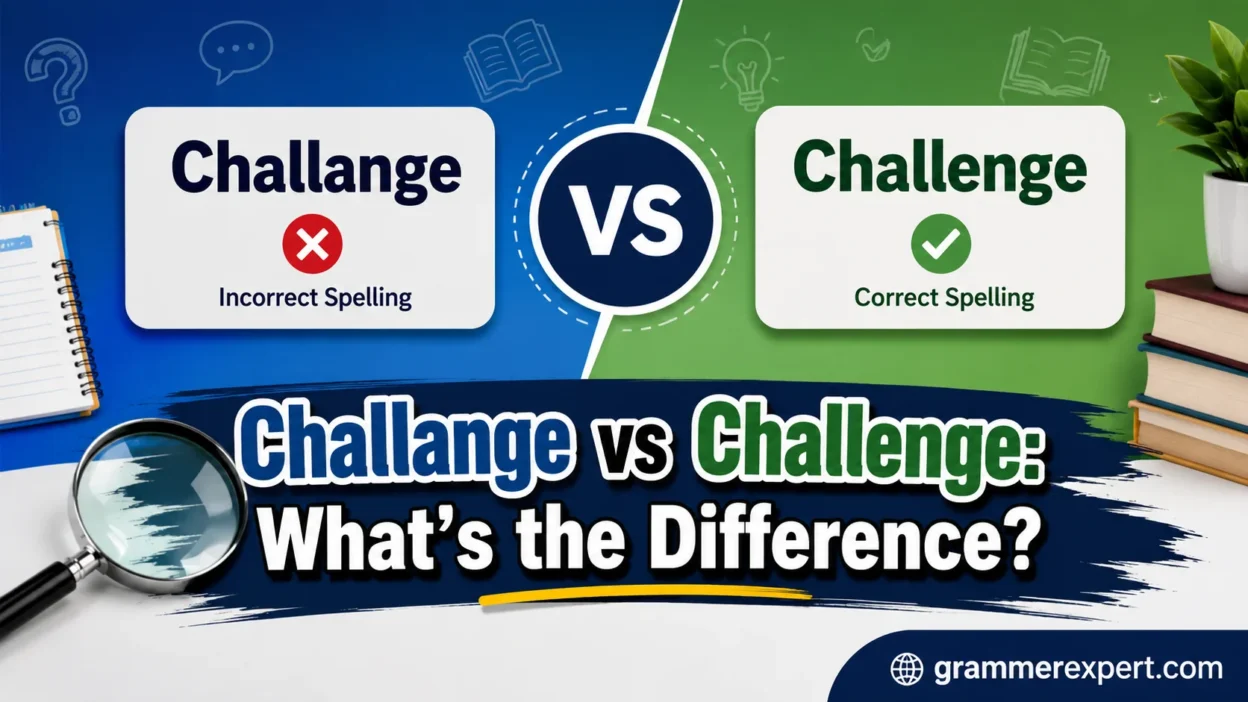
For Challange vs Challenge: What’s the Difference?, remember that Challenge is the correct English spelling, while Challange is a misspelling. These similar words can leave writers confused and may cause them to accidentally type the wrong form. The difference is simple: Challenge follows the correct rule, while Challange is a common mistake and one of many spelling mistakes that appear in everyday writing.
The error can occur in communication, everyday conversations, emails, social media posts, academic writing, and professional documents. Checking the words side by side makes the spelling error easier to recognize. Grammar doesn’t change the answer because correct usage requires Challenge, whereas incorrect usage uses Challange. This guide provides examples and memory tricks to help you remember the right spelling and avoid a grammar error, spelling error, or grammar and spelling error.
Challange vs Challenge: Which Spelling Is Correct?
The correct spelling is challenge, with -enge at the end.
Challange is not an alternative spelling with a different meaning. It’s simply a common spelling error.
| Spelling | Correct? | Meaning |
| Challenge | ✅ Yes | A difficult task, test, competition, objection, or act of questioning |
| Challange | ❌ No | Misspelling of challenge |
The easiest way to spot the difference is to focus on the final vowel before -ge:
- ❌ challange
- ✅ challenge
Notice the middle sequence:
challange → a
challenge → e
That tiny difference changes a correctly spelled word into an error.
READ ALSO: Intention vs Intension: What’s the Difference?
Why “Challenge” Is the Correct Form
Challenge appears as a standard English noun and verb in major dictionaries. Cambridge Dictionary gives it several established meanings, including a difficult task, an expression of doubt, a competition, and an invitation to compete.
There’s no equivalent standard entry that makes challange a legitimate spelling of the same word.
Therefore, in formal or standard English, always choose challenge.
What Does Challenge Mean?
The word challenge has a surprisingly broad range of meanings. Context determines which sense the writer intends.
As a noun, it commonly refers to something difficult that requires effort, skill, or determination. Cambridge defines this sense as something requiring significant mental or physical effort to complete successfully.
For example:
- Learning another language can be a challenge.
- The team faced a serious challenge.
- Finishing the project before Friday was a challenge.
In each sentence, challenge describes something demanding.
However, the word doesn’t always mean difficulty.
Challenge as a Noun
A challenge can also mean a competition or an invitation to prove your ability.
For example:
- She accepted his challenge to a tennis match.
- The candidate faced a strong challenge in the election.
- The championship presented a new challenge for the defending team.
It can also refer to an objection or expression of doubt:
- The evidence came under challenge.
- The lawyer issued a challenge to the ruling.
This broader meaning explains why challenge appears in education, sports, politics, law, business, technology, and ordinary conversation.
Challenge as a Verb
Challenge also works as a verb. In this form, it can mean to test someone, invite someone to compete, question something, or create difficulty.
For example:
- The puzzle challenged the students.
- She challenged the decision.
- He challenged his brother to a race.
- The new regulations challenged small businesses.
Cambridge lists these major verb uses, including presenting a difficult test, expressing doubt, inviting competition, and causing difficulty.
That versatility makes challenge a useful word. One spelling serves several related purposes.
Why Is “Challange” Incorrect?
The main problem with challange is simple: it uses the wrong vowel.
The correct spelling contains -enge:
chall + enge = challenge
The incorrect version changes that sequence to -ange:
chall + ange = challange
Pronunciation probably contributes to the confusion. In normal speech, the unstressed vowel in challenge isn’t strongly emphasized. Cambridge gives the US pronunciation as approximately /ˈtʃæl.əndʒ/.
That means your ear may not clearly tell you whether the written vowel should be a or e.
Spelling, in this case, doesn’t neatly follow pronunciation.
The Key Spelling Difference
Compare the words side by side:
❌ challange
✅ challenge
The second syllable contains e, not a.
This is one of those spelling details worth memorizing instead of trying to guess from sound.
Challenge: Meaning, Pronunciation, and Word Type
Here’s a quick reference for the word:
| Feature | Details |
| Correct spelling | Challenge |
| Incorrect spelling | Challange |
| Part of speech | Noun and verb |
| US pronunciation | /ˈtʃæl.əndʒ/ |
| Plural | Challenges |
| Past tense | Challenged |
| Present participle | Challenging |
| Person who challenges | Challenger |
| Main noun sense | A difficult task or test |
| Common verb senses | Test, question, dispute, compete against |
Merriam-Webster lists challenged and challenging as forms of the verb and identifies challenger as the related noun.
Challenge Word Forms You Should Know
Learning the related forms together can make the spelling much easier to remember.
Challenge
This is the basic noun and verb.
- The exam was a difficult challenge.
- The coach challenged the players.
Challenges
Add -s when you need the plural noun or third-person singular verb.
- Students face different challenges.
- The job challenges her every day.
Challenged
The past-tense form adds -ed.
- The question challenged my assumptions.
- She challenged the decision yesterday.
Challenging
The -ing form becomes challenging.
- The course is challenging but rewarding.
- They’re working on a challenging problem.
Merriam-Webster defines challenging as something that stimulates competitive interest, thought, or action. It can describe difficult work, questions, studies, or situations.
Challenger
A challenger is someone who challenges another person or competes against them.
- The challenger trained for months before the match.
- The young company became a serious challenger to established brands.
Notice that all these forms retain the same central spelling pattern:
challenge → challenged → challenging → challenger
None becomes challange.
Challange vs Challenge Examples
Seeing the mistake in real sentences makes the distinction easier to remember.
Incorrect Examples
These sentences contain the misspelling:
- ❌ The final exam was a difficult challange.
- ❌ She accepted the challange.
- ❌ The project created a major challange.
- ❌ He enjoys every new challange.
- ❌ They faced several challanges at work.
Correct Examples
These sentences use the standard spelling:
- ✅ The final exam was a difficult challenge.
- ✅ She accepted the challenge.
- ✅ The project created a major challenge.
- ✅ He enjoys every new challenge.
- ✅ They faced several challenges at work.
The last example highlights another useful point: the plural is challenges, not challanges.
Challenge in Different Contexts
One reason challenge is so common is its flexibility. You can use it naturally in many areas of life.
Challenge in School and Education
Students encounter challenges whenever they must apply knowledge instead of simply memorizing facts.
For example:
Writing a research paper was the biggest challenge of the semester.
Here, challenge describes a demanding task that requires planning, research, and persistence.
A teacher might also say:
This assignment will challenge you to think critically.
In that sentence, challenge works as a verb. It means the assignment will push students beyond easy answers.
Challenge in the Workplace
Professional writing uses challenge constantly.
Consider:
The company faces the challenge of reducing costs without lowering quality.
The word identifies a difficult business problem. It doesn’t necessarily mean failure. In fact, calling something a challenge can emphasize the work required to solve it.
That distinction matters. A problem can simply be something wrong. A challenge often carries the additional idea of effort, testing, or achievement.
Challenge in Sports
Sports provide another obvious use.
- The team accepted the challenge.
- The defending champion faces a tough challenge.
- The coach challenged the players to improve.
- She challenged her rival to a rematch.
Here, challenge can describe both difficulty and competition.
Challenge in Everyday Life
You don’t need a formal setting to use the word.
- Moving to a new city was a challenge.
- Cooking for ten people can be a challenge.
- Learning to play guitar is challenging.
- He challenged himself to exercise every morning.
The meaning shifts slightly with context, yet the spelling never changes.
Common Words and Phrases With Challenge
Some combinations appear so often that they’re worth learning as complete phrases.
| Phrase | Meaning | Example |
| Face a challenge | Encounter something difficult | We face a major challenge. |
| Accept a challenge | Agree to attempt something difficult or competitive | She accepted the challenge. |
| Overcome a challenge | Successfully deal with difficulty | They overcame the challenge. |
| Meet a challenge | Deal successfully with a demanding situation | The team met the challenge. |
| Take on a challenge | Decide to tackle something difficult | He took on a new challenge. |
| Rise to the challenge | Respond successfully to difficulty | She rose to the challenge. |
| Challenge yourself | Push yourself beyond your usual limits | Challenge yourself to learn something new. |
These phrases are useful because they show how native English speakers naturally combine the word with other expressions.
Why Do People Spell Challenge as “Challange”?
The a/e confusion is the heart of this spelling mistake.
The word sounds roughly like CHAL-ənj in ordinary American English. The middle vowel isn’t strongly pronounced.
When a vowel becomes less prominent in speech, spelling from sound alone becomes unreliable.
That’s why it’s better to remember the visual pattern:
challenge = -enge
Think of the final part as a fixed unit. Don’t rebuild the spelling from pronunciation every time you write it.
Another reason errors happen is typing speed. If you’re writing quickly, your fingers may produce challange before your brain catches the missing e.
A spell-checker can catch some mistakes, but knowing the correct pattern remains more reliable.
Easy Ways to Remember the Spelling of Challenge
A good memory trick should be quick enough to use while writing.
Remember “-enge,” Not “-ange”
The simplest rule is:
Challenge ends in -enge.
Write it several times:
- challenge
- challenge
- challenge
Then connect it with its related forms:
- challenge
- challenged
- challenging
- challenger
The shared chall- base helps reinforce the correct spelling.
Use a Memory Sentence
Try:
“Every challenge needs an E.”
It’s short, memorable, and points directly toward the troublesome letter.
Another useful technique is visual comparison:
❌ challANGE
✅ challENGE
The incorrect version has A where the correct version has E.
Challenge vs Challange: Quick Comparison
| Point | Challenge | Challange |
| Standard spelling | ✅ Yes | ❌ No |
| Standard dictionary word | ✅ Yes | ❌ No |
| Noun | ✅ Yes | ❌ No |
| Verb | ✅ Yes | ❌ No |
| Means a difficult task | ✅ Yes | ❌ No |
| Means to question or dispute | ✅ Yes | ❌ No |
| Means to invite competition | ✅ Yes | ❌ No |
| Suitable for formal writing | ✅ Yes | ❌ No |
There isn’t a meaningful challange vs challenge definition battle because the two forms don’t represent separate standard words.
One is correct. One is a spelling mistake.
Challenge Synonyms
The best synonym depends on which meaning of challenge you intend.
For a difficult task, useful alternatives include:
- difficulty
- obstacle
- test
- trial
- problem
- demand
For an expression of disagreement or doubt, alternatives may include:
- objection
- question
- dispute
- protest
- criticism
For competition, possible alternatives include:
- contest
- competition
- rivalry
- dare
Merriam-Webster’s thesaurus also lists words such as objection, question, difficulty, protest, dispute, and doubt among related terms.
However, these words aren’t interchangeable in every sentence. Challenge has several meanings, so always choose a synonym based on context.
Challenge vs Similar Words
Understanding nearby words can sharpen your vocabulary.
Challenge vs Difficulty
A difficulty is something hard to do or deal with. A challenge can describe the same situation but often carries an additional sense of testing ability.
Compare:
The difficult climb was a challenge.
Here, difficulty describes the hardship while challenge frames it as something to tackle.
Challenge vs Problem
A problem usually calls for a solution.
A challenge often emphasizes the effort involved in achieving something.
For example:
The software has a problem.
This points to something that isn’t working properly.
Learning the new software is a challenge.
This suggests that learning it requires time, effort, or skill.
Challenge vs Obstacle
An obstacle stands in the way of progress.
A challenge can be an obstacle, but it doesn’t have to block progress. It can simply test your ability.
That difference gives challenge a broader range of uses.
Common Mistakes to Avoid
The most common mistake is obvious:
❌ challange
✅ challenge
But spelling the base word correctly isn’t the only concern.
Watch for these errors:
- ❌ challanges → ✅ challenges
- ❌ challanged → ✅ challenged
- ❌ challanging → ✅ challenging
The pattern is consistent. Once you learn challenge, the related forms become easier to recognize.
Is “Challange” Ever Correct?
In standard English, challange isn’t the correct spelling of challenge.
You might encounter the misspelling online, in usernames, social media posts, informal comments, or other user-generated content. Seeing it frequently doesn’t make it standard.
That distinction is important because internet usage can spread errors quickly.
If you’re writing a resume, academic paper, business email, report, website article, or formal letter, use challenge.
How to Use Challenge in a Sentence
The easiest way to understand the word is to see its different grammatical functions.
Noun Examples
- The new assignment presented a serious challenge.
- She enjoys a challenge.
- The team overcame several challenges.
- Finishing the race was his biggest challenge.
- The proposal faced a legal challenge.
Each sentence uses challenge as a noun, but the exact meaning changes with context.
Verb Examples
- The difficult course challenged every student.
- She challenged the accuracy of the report.
- The athlete challenged the reigning champion.
- The experience challenged his assumptions.
- The new system challenged the company’s existing workflow.
Here, challenge acts as a verb. It can mean test, question, dispute, compete against, or create difficulty.
Frequently Asked Questions
1. Is “Challange” or “Challenge” correct?
Challenge is the correct spelling. Challange is a misspelling and shouldn’t be used in standard English writing.
2. Why do people spell Challenge as Challange?
People often write Challange because it looks and sounds similar to Challenge. Typing quickly or relying on pronunciation can also cause this common spelling mistake.
3. What does Challenge mean?
Challenge can mean a difficult task, problem, or situation that requires effort. It can also mean inviting someone to compete or prove something.
4. Is Challange a real English word?
No. Challange isn’t the standard English spelling of the word. Use Challenge instead.
5. How can I remember the spelling of Challenge?
A simple memory trick is to remember “Challenge” has “-enge,” not “-ange.” Checking the middle letters can help you avoid the mistake.
6. Can I use Challenge in professional writing?
Yes. Challenge is appropriate for emails, academic writing, professional documents, social media posts, and everyday communication.
7. Is Challenge a noun or a verb?
Challenge can be both a noun and a verb. As a noun, it can describe a difficult task. As a verb, it can mean questioning, testing, or inviting someone to compete.
8. How do I avoid the Challange vs Challenge mistake?
Remember that Challenge is the correct spelling. When proofreading, look carefully at the middle of the word and make sure you’ve used -enge rather than -ange.
Conclusion
Challenge is the only correct spelling in standard English, while Challange is a misspelling. Although the two forms look similar, remembering the “-enge” spelling makes the difference easy to recognize.Whether you’re writing an email, school paper, social media post, or professional document, choose Challenge. A quick spelling check can help you avoid this common mistake and make your writing clearer and more polished.